Most people typing agentic operating system aos into a search bar are asking the same two questions: what does AOS actually stand for, and is it a real thing you can use — or just another acronym doing the rounds? Here is the short version. AOS stands for Agentic Operating System: the operating layer that sits around AI agents so they can plan, act, remember and coordinate. Instead of one chatbot in one window, you get a system. Julian Goldie runs his entire business on one, and this page unpacks the term properly — the definition, the anatomy, real examples, and the two ways to get one.
📺 Watch: How to Build Agent OS - FREE Course!
🔥 Get the Agent OS as a free bonus: AI Profit Boardroom members get the full Agent OS zip, prompt libraries, daily tutorials and weekly live coaching calls. → Get inside
What Does AOS Stand For?
AOS is short for Agentic Operating System. Break the phrase down and the meaning falls out of it. "Agentic" describes AI that takes actions rather than just producing answers — it can research, write, publish and check its own work. "Operating system" is the layer that coordinates everything, the same way the OS on your laptop quietly coordinates apps, files and memory.
Put together, an agentic operating system is the operating layer around AI agents: the environment where agents plan, act, remember and coordinate as a team. The shift is structural — a chatbot is a single window you talk to, while an AOS runs missions, keeps a permanent record and carries on working after you close the laptop.
The clearest worked example is Agent OS, the system Julian Goldie built and runs his business on. The rest of this page uses it to show what each part of an AOS does in practice.
Agentic Operating System AOS: The Anatomy
Strip any AOS back and you find five components. Julian runs all five daily, so none of this is theoretical.
1. The Agent: The Reasoning Engine
At the centre sits the agent — the reasoning engine that reads a mission, makes a plan and does the work. In Julian's system that engine is called Hermes. Crucially, an AOS is model-agnostic: the harness stays the same while the brain inside it can be a frontier model or a free local one. Julian decides which model powers his AOS using Goldie Bench, his own hands-on benchmark where he runs real business tasks through candidate models and keeps whichever performs best for him — personal testing, not an official leaderboard.
2. Skills: Reusable Capabilities
A skill is a packaged capability the agent can load on demand: research, content writing, SEO, publishing, coding. You write the instructions once and every future mission can reuse them. Skills are why an AOS grows more capable over time instead of starting from zero on every task.
3. Memory: The Shared Brain
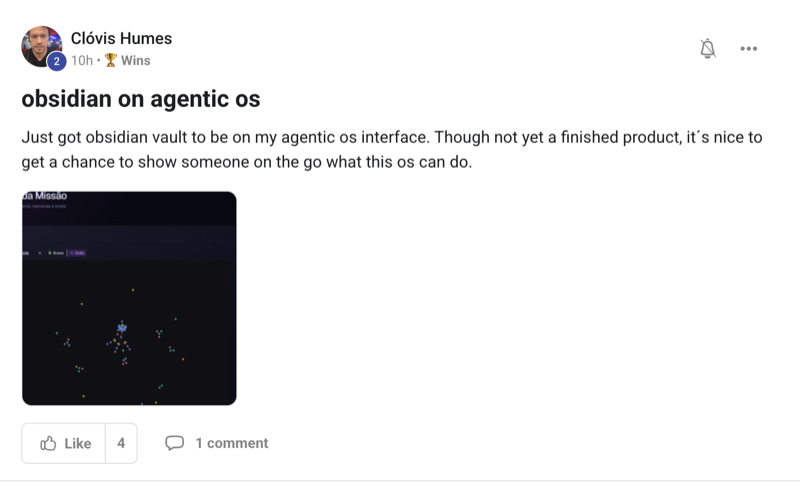
Memory is the thing a chatbot conspicuously lacks. In an AOS it is a shared layer that every agent reads and writes. Julian's memory lives in Obsidian — he calls it his "memory galaxy" — and it means every agent already knows his business, his offers, his style and his past decisions before a mission even starts. No re-explaining, ever.
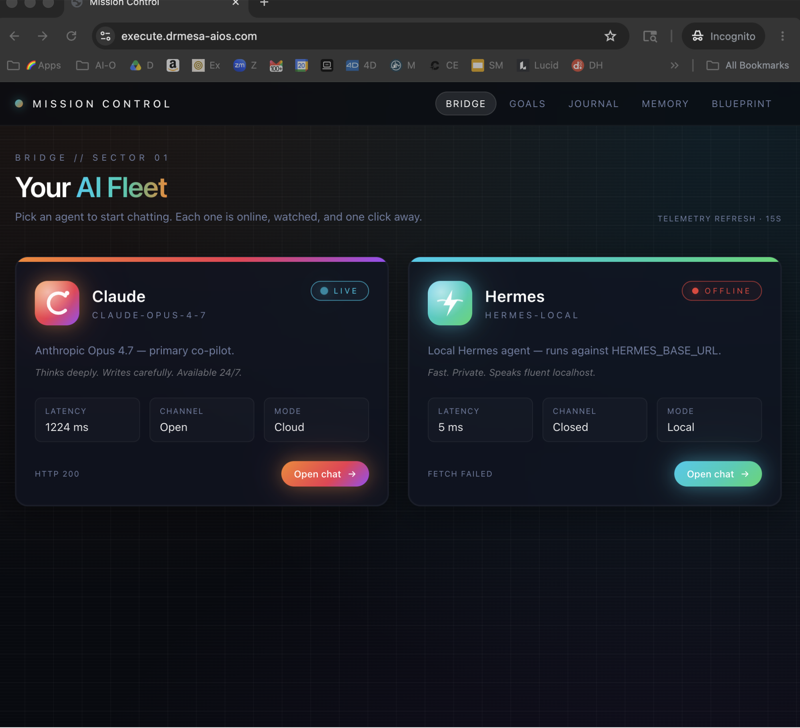
4. Mission Control: The Dashboard
Mission Control is where you launch, watch and steer the work: a chat to brief agents, a Kanban board showing what is queued, in progress and done, live logs so you can watch the reasoning as it happens, and a workspace holding everything the agents produce.
5. Orchestration: Agents Working Together
The final component is coordination between agents. One agent can delegate to another, a swarm can split a big job into parallel pieces, and the newer A2A agent-to-agent protocol lets agents talk to each other directly. Orchestration is the part that makes this an operating system rather than just a very good assistant.
| Component | Job | In Julian's Agent OS |
|---|---|---|
| Agent | The reasoning engine that plans and executes missions | Hermes, with the model chosen through his own Goldie Bench testing |
| Skills | Reusable capabilities loaded on demand | Research, content, SEO, publishing and coding skills |
| Memory | Shared knowledge every agent reads and writes | An Obsidian-based "memory galaxy" of his whole business |
| Mission Control | Launch, watch and steer missions | Chat, Kanban board, live logs and a workspace |
| Orchestration | Multiple agents coordinating on one goal | Delegation, swarms and the A2A agent-to-agent protocol |
📺 Watch: LIVE: Building Agentic Operating Systems with Claude
AOS vs A Chatbot vs A Single AI Agent
The acronym matters because the difference in behaviour is enormous.
A chatbot answers and forgets. It is brilliant in the moment, but the moment is all it has: close the tab and the context is gone, and it never takes an action in the real world on its own.
A single agent is a step up — it can act, but it remains one worker in isolation. No shared memory of your business, no team to hand work to, and nothing happening when you are not there prompting it.
An AOS is the full operating layer:
- It runs missions, not messages. You brief an outcome; the system plans and executes the steps.
- It saves everything. Every mission feeds the shared memory, so the system compounds instead of resetting.
- It retries failures. When a step breaks, the system notices and has another go rather than silently stopping.
- It works in the background 24/7. Scheduled workflows run without you — Julian has builds that run daily straight from memory, so he wakes up to finished work.
📺 Watch: NEW Claude 5 + Agentic Operating System!
Real Examples From A Working AOS
Definitions are cheap, so here is what actually runs inside Julian's Agent OS day to day:
- Hermes Apollo — a real-time voice agent, so he can talk to the system instead of typing at it.
- Hermes Oracle — pulls in industry news and drafts content from it.
- Hermes Astros — watches competitors and turns what it finds into content angles.
- The Kanban board — triages incoming tickets and delegates coding work to OpenCode.
- An outreach agent — handles lead generation in the background.
- A studio — produces images, video and voice on request.
Notice the pattern: agents with jobs, coordinated by one system, all drawing on the same memory — not a person prompting a chatbot.
📺 Watch: How to Build your Own Agent Operating System!
What Does An AOS Cost To Run?
Less than most people assume — potentially nothing. The harness Julian uses, Hermes, is free. The models can be free too: run open models locally through Ollama, or use free API options. The memory layer is Obsidian, which is also free. That is a complete, working agentic operating system at zero cost.
Paid frontier models are optional power-ups, not requirements. Start free, and upgrade the brain only where it earns its keep.
How To Get An Agentic Operating System
There are exactly two routes, and both are legitimate.
Route 1: Build It Yourself
Assemble the five components above: pick a harness, load skills, wire up an Obsidian memory, stand up Mission Control, then add orchestration. The step-by-step Agent OS build guide walks through the whole process in order. Building teaches you how every part works.
Route 2: Install A Ready-Made One
The faster route is installing a system someone else has already built. Julian's Agent OS ships as a zip file with a video tutorial walking through installation, inside the AI Profit Boardroom, updated daily as the system evolves. This is the route for people who want the outcome more than the education.
One myth worth killing: you do not need to be technical. Julian describes himself as non-technical, and thousands of his members — many with no coding background at all — run the same system.
If you want an agentic operating system making you money, check out the AI Profit Boardroom — the ready-made Agent OS is inside as an install zip with a video tutorial, updated daily. → Get your AOS installed this week
AOS: Frequently Asked Questions
Is an AOS the same thing as an AI agent?
No. An agent is a single worker. An AOS is the operating layer around many agents — the skills, memory, dashboard and orchestration that turn workers into a coordinated team. Every AOS contains agents; an agent alone is not an AOS.
Do I need to be a developer to run one?
No. The ready-made route is install-the-zip, follow-the-video. Julian is not a developer, and non-technical members run the system every day.
Which AI model powers an AOS?
Whichever you choose — that is the point of being model-agnostic. The harness stays constant while the model underneath can be a paid frontier model or a free local one. Julian's approach is to test candidates on his own real tasks through Goldie Bench and keep the winner.
Does an AOS really work while I sleep?
Yes, and this is the clearest practical difference from a chatbot. Scheduled workflows run on their own — Julian's system runs daily builds straight from memory — and failed steps get retried rather than abandoned. You review the output; you do not babysit the process.
The Bottom Line
AOS stands for Agentic Operating System: the operating layer that turns AI from one forgetful chatbot into a coordinated team of agents that plan, act, remember and work around the clock. The anatomy is five parts — agent, skills, memory, mission control and orchestration — and the whole thing can run on entirely free tools.
You do not need to wait for the industry to settle its vocabulary. Build one with the guide, or install Julian's ready-made version. Either way, the sooner your business sits on an agentic operating system, the sooner the compounding starts.