Learning how to build a personal agentic operating system is the difference between using AI as a chat window and running it like a team that works for you. A personal agentic OS wraps an AI agent in the things that make it genuinely useful — skills, memory, a dashboard and orchestration — so it remembers your context, runs real workflows, and improves over time. This guide walks through what it is, the core parts, and how to build one.
📺 Watch: LIVE: Building Agentic Operating Systems with Claude
🔥 Get the Agent OS as a free bonus: AI Profit Boardroom members get the full Agent OS zip, prompt libraries, daily tutorials and weekly live coaching calls. → Get inside
What a Personal Agentic Operating System Is
A personal agentic operating system is a setup where an AI agent is the "processor," and around it sit the components an operating system needs: a place to store memory, a library of skills it can call, a dashboard to control it, and an orchestration layer so multiple agents can work together. Instead of starting every task from a blank prompt, your agent operates inside a system that already knows you.
The word "personal" matters. This is not an enterprise platform — it is yours, tuned to your business, your voice and your workflows, running on your machine or your accounts.
The Core Components
Every personal agentic operating system that actually works is built from the same core parts:
- The agent — the reasoning engine that plans and acts. This can be a frontier model or a free local model.
- Skills — reusable capabilities the agent can call, like keyword research, content generation, outreach or publishing.
- Memory — a shared store, often built on Obsidian, that feeds the agent your context so its output sounds like you.
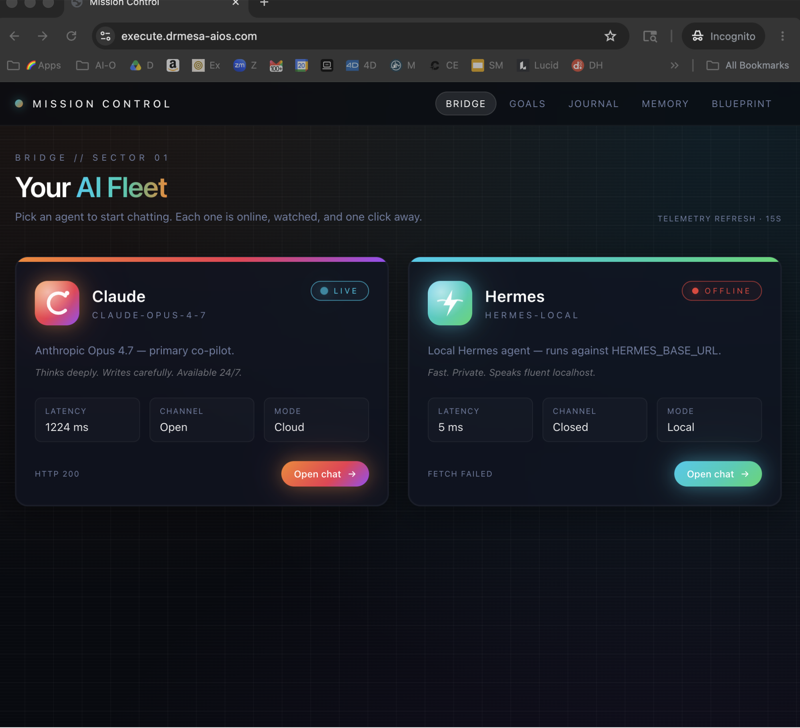
- A control center — a dashboard to launch missions, watch agents work, and save the results.
- Orchestration — the layer that lets several agents work on one goal in parallel and hand results to each other.
How To Build a Personal Agentic Operating System, Step by Step
- Pick your agent engine. Choose the model your agent will run on. A free local model through Ollama keeps costs near zero; a frontier model gives more power. You can wire in both and switch.
- Add a memory layer. Set up an Obsidian vault (or similar) as shared memory: daily notes, entity notes and project files the agent reads and writes. This is what stops your agent sounding generic.
- Give it skills. Define reusable skills for the jobs you repeat — research, drafting, auditing, publishing — so the agent has proven capabilities to call instead of improvising each time.
- Wire in tools. Connect the tools your work needs through MCP or direct integrations, so the agent can actually do things, not just describe them.
- Add a control center. Put a dashboard on top so you can launch a mission, watch the agents run, and review outputs in one place.
- Turn on orchestration. Let the system spin up multiple agents for bigger goals, so a planner, a builder and a checker work together instead of one agent doing everything slowly.
- Save and replay. Make sure every run and its context are stored, so good missions can be replayed and improved rather than rebuilt.
If you want a personal agentic operating system without building it from scratch, check out the AI Profit Boardroom — the done-for-you Agent OS, install zip, video tutorials and weekly coaching are all inside. → Get the ready-made Agent OS here
Tools You Can Use
- Claude Code — a strong engine for running agentic coding and automation tasks from the terminal.
- Ollama — run free local models so your agent is not tied to paid API calls.
- Obsidian — a simple, durable memory layer built on plain markdown files agents can read and write safely.
- MCP — a standard way to connect tools so your agent can take real actions.
📺 Watch: How to Build your Own Agent Operating System!
Common Mistakes To Avoid
- Skipping memory. Without a memory layer, every task starts from zero and the output stays generic.
- No dashboard. Running everything from a raw terminal makes big jobs hard to see and manage.
- Over-building before you use it. Start with one agent, one skill and one real task, then expand. A system you actually run beats a perfect one you never finish.
📺 Watch: How to Build Claude Agent Operating Systems
A Worked Example: Building a Content Agent OS
To make this real, here is a small personal agentic operating system built for one job — producing content — which you can then extend to anything else.
- Engine: a free local model through Ollama for drafting, with a frontier model on standby for the harder reasoning steps.
- Memory: an Obsidian vault holding your brand voice notes, past posts, and a running list of topics and keywords.
- Skills: a "research" skill, a "draft" skill, an "edit-to-brand-voice" skill, and a "publish" skill.
- Control center: a dashboard where you launch the mission "write this week's post" and watch it run.
- Orchestration: a researcher, a writer and an editor working in sequence, each reading and writing to the shared memory.
Once that loop runs cleanly for content, the same shape handles outreach, reporting or research — you add skills and agents, not a whole new system. That is the payoff of building it as an operating system rather than a one-off script.
How Long It Takes and What It Costs
A basic personal agentic operating system — one agent, a memory folder and a couple of skills — can be running in an afternoon. Adding a control center and multi-agent orchestration is the part that takes longer to make clean and reliable, which is where most DIY builds stall. On cost: using free local models and open tools, the main investment is your time. Frontier models and hosted tools are optional upgrades you add only where they clearly earn their keep. Start free, prove the loop, then spend where it pays.
Frequently Asked Questions
Do I need to be a developer?
It helps, but it is not required. The components are increasingly plug-and-play, and a ready-made Agent OS lets non-developers run a personal agentic system without wiring it themselves.
Can I build it for free?
Largely, yes. Free local models, Obsidian and open tools mean the main cost is your time. Paid models are optional upgrades for more power.
How long does it take?
A basic version can be running in an afternoon. A polished, multi-agent system takes longer — which is why many people start from a ready-made template and customise it.
The Bottom Line
Knowing how to build a personal agentic operating system comes down to five parts: an agent, skills, memory, a control center and orchestration. Assemble them yourself with tools like Claude Code, Ollama and Obsidian, or start from a ready-made Agent OS and customise it. Either way, the goal is the same — an AI that knows your context and runs your work like a team.