How to setup Hermes with Ollama is the question I get asked most this month, and the honest answer is that it's much easier than you'd think. Most people assume they need GitHub repos, terminal commands, and configuration files to make it work, but the whole thing takes about 20 seconds with a one-click setup if you know which path to follow.
This post walks you through every option for setting up Hermes with Ollama, including the fastest one-click path, when to use cloud versus local models, and the common issues that trip people up.
Why You Should Setup Hermes With Ollama
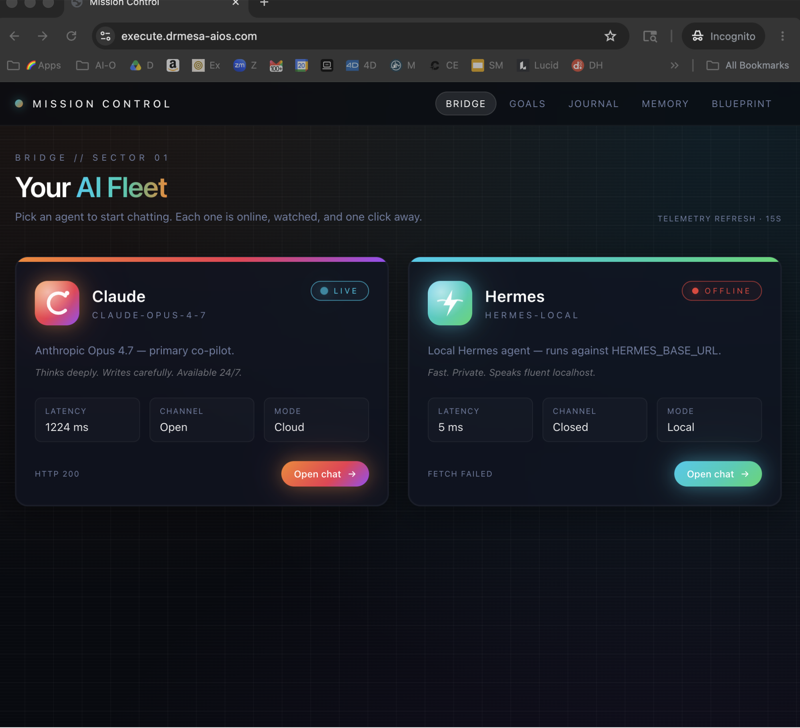
Hermes on its own is one of the best AI agents I've used, and Ollama makes it free to run. Together you get a fully working AI agent on your own computer with no per-token costs, which is genuinely a step-change for daily use.
Three reasons this matters. The first is no bills — cloud models charge per token while local models don't. The second is privacy, because your data never leaves your machine when you run inference locally. The third is reliability — there are no API outages, no rate limits, and no internet required after install.
If you've been paying API bills for daily agent work, this is the upgrade you've been looking for.
The Three Ways To Setup Hermes
There are three real options and I'll cover all three so you can pick what suits you.
The first option is a cloud model, which is the quickest way to try Hermes if you don't want to install much. Free cloud models work great with Hermes, but they have token limits, which makes them good for testing rather than heavy daily use.
The second option is a local model with Ollama, which is the recommended path for most people. It's free, has no token limits, and runs entirely on your computer. This is the focus of this post.
The third option is Max Hermes, a hosted paid version that's a non-technical option living in the cloud. You don't get the customisation of the terminal version, but you don't have to install anything either. It's a good fit for someone who wants zero friction and is willing to pay for it.
How To Setup Hermes With Ollama In 5 Steps
Here's the exact one-click setup for the most common path.
Step one is downloading Ollama from ollama.com — pick the build for your OS and install it like a normal app. That's the prerequisite. Step two is picking a model from the Ollama models page. Recommended models for Hermes include DeepSeek (designed for agentic tasks and lightweight), Gemma 4 (small and efficient at only ~7GB), Qwen 3.6 (a solid agent-friendly model), and Nemotron 3 Nano Omni (Nvidia's new agentic model, great for sub-agents). If you're not sure, start with DeepSeek.
Step three is running the install command for your chosen model. Each model has a single command on its Ollama page — copy it, paste into your terminal, hit enter, and wait for the download. Step four is connecting Hermes, which usually auto-detects Ollama once it's running locally. If it doesn't, point Hermes at your local Ollama URL — usually http://localhost:11434. Step five is running the agent: open Hermes, pick the Ollama model from the provider dropdown, and send a message. You're now running Hermes with a free local model.
🔥 Want my full Hermes + Ollama setup? Inside the AI Profit Boardroom, I share my exact Hermes config, model recommendations per use case, system prompts, and a 2-hour Hermes course covering every workflow. Plus weekly screen-share coaching where you can ask anything live. 3,000+ members. → Get the full setup
Cloud Vs Local: When To Use Each
I run both depending on the task at hand.
Use cloud models when you need maximum reasoning power, when token limits aren't an issue for the workload, or when you're working with very long context windows that local models can't handle efficiently. Use local Ollama models when you want zero token costs, when you care about privacy and data residency, or when you're running the agent 24/7 where API bills would otherwise eat you alive.
For most daily Hermes work, local Ollama is the smart pick.
The Best Models To Use
Quick recommendations by use case.
For most users wanting a free local model, Gemma 4 is the best pick at only 7GB. For agentic work specifically, DeepSeek is designed for the task and outperforms general-purpose models. For sub-agents in multi-agent setups, Nemotron 3 Nano Omni from Nvidia is the new gold standard. For coding work, Qwen 3.6 is the strongest local option.
For cloud models on Hermes, the recommended combos are Kimi K2.5, GLM 5.1 Cloud, Qwen 3.5 Cloud, and Minimax M2.7 Cloud. I cover deeper model comparisons in Hermes Gemma 4 and Hermes DeepSeek.
What You Can Do With Hermes Once It's Running
Hermes works with 70+ skills out of the box, and you'll only use a handful daily. The ones I run most often are web search, browser automation, code generation, memory profiles, and text-to-speech. All of them work free, locally, and on Ollama with no extra config.
For full skill walkthroughs, see Hermes Agent Workspace.
If You're Not Technical
There's a shortcut for non-technical users that genuinely works.
Don't fight the terminal — use Claude Code or Codex to do the install for you. The trick is simple: copy the Ollama install command for the model you want, paste it into Claude Code, and type "set this up for me." Claude Code (or Codex) will run the install and configure Hermes for you with zero friction. I cover this trick in Free Claude Code too.
Common Setup Issues
Three things trip people up most often.
The first is Ollama not running. Make sure Ollama is open before you start Hermes — it needs to be running in the background for Hermes to detect it. The second is model not found errors. Run ollama list in your terminal to confirm the model is actually downloaded; if not, run the install command again. The third is Hermes not seeing the model. Restart Hermes after Ollama starts and it'll pick the model up on launch.
Why Local Beats Cloud Most Of The Time
I'll be straight with you. If you're just experimenting, cloud is fine. But if you're running an agent for real work — content, SEO, automation — local Ollama saves you a fortune over time.
I've shifted 80% of my Hermes work to local Ollama models. API bills dropped to nearly zero, and performance is more than enough for daily tasks. For high-volume use, local is genuinely the better economic choice.
Quick Recap
To setup Hermes with Ollama, download Ollama from ollama.com, pick a model (DeepSeek or Gemma 4 are great starters), run the install command in your terminal, open Hermes, select your Ollama model, and send a message. That's the whole flow.
🚀 Want all my Hermes automations + 70+ skills configured? The AI Profit Boardroom has the full Hermes course (2 hours), my exact skill stack, and weekly live coaching. Daily training drops, and a community where 3,000+ members share their setups. → Join here
FAQ — How To Setup Hermes With Ollama
Do I need a powerful computer?
Gemma 4 at 7GB runs on most modern laptops. Bigger models like Nemotron 3 at 28GB need more RAM.
Is Hermes with Ollama actually free?
Yes — both Hermes and Ollama are free, and local models cost zero per token.
How long does the install take?
The Ollama install is quick. Model download depends on size — 5-20 minutes for a typical model.
Can I switch between models on Hermes?
Yes — you can swap models any time without restarting Hermes.
Will it work without internet after setup?
Yes — once the model is downloaded, you can run Hermes fully offline.
Which model should a beginner pick?
Start with Gemma 4 if your laptop is light, or DeepSeek if you've got more RAM available.
Can I use cloud and local models on the same Hermes setup?
Yes — Hermes supports multiple providers at once.
Related Reading
- Ollama Hermes — deeper Ollama walkthrough.
- Hermes Gemma 4 — model-specific setup.
- Hermes DeepSeek — best agentic model setup.
📺 Video notes + links to the tools 👉
🎥 Learn how I make these videos 👉
🆓 Get a FREE AI Course + Community + 1,000 AI Agents 👉
That's how to setup Hermes with Ollama in one click — fastest way to get a free, local AI agent up and running.