If you have been searching for how to use qwen 3.8, this is the shortcut. Qwen 3.8 is one of Alibaba's open-weight models, which means you can run it on your own computer for free, call it through a hosted API when you want more power, or plug it straight into an AI agent to do real work. Below is the practical, no-hype version: what it is, how to run it two different ways, how to pick the right size, and how to put it to work inside Julian Goldie's Hermes agent.
📺 Watch: New FREE Hermes Computer Use Agents!
🔥 Get the Agent OS as a free bonus: AI Profit Boardroom members get the full Agent OS zip, prompt libraries, daily tutorials and weekly live coaching calls. → Get inside
No invented benchmarks and no marketing spin — just the steps that take you from "curious" to "using it today".
What Qwen 3.8 Actually Is
Qwen is the family of large language models built by Alibaba, and Qwen 3.8 is one release in that line. The important word is open-weight: the model files are published for you to download, so you are not locked into a single provider. You can keep the model on your own disk, run it offline once it is downloaded, and swap it in and out of your tools whenever you like.
Like the rest of the Qwen family, it is offered in more than one size, it handles multiple languages, and it comes in instruct-tuned versions built for following instructions and chatting rather than raw text completion. That combination — open, multilingual, and available small enough to run on a laptop — is exactly why so many people are asking how to run it.
How To Use Qwen 3.8 Free And Local With Ollama
The fastest free route is Ollama, a small tool that downloads open models and runs them on your own machine. Nothing leaves your computer, and there is no bill. Here is the whole process.
- Install Ollama. Download it for your operating system and install it like any normal app. It runs quietly in the background.
- Pull the model. Use Ollama's pull command with the Qwen model name to download it. The first download is several gigabytes, so give it a moment.
- Start chatting. Use the run command and you are talking to Qwen 3.8 in your terminal straight away — no account, no API key.
- Point your apps at it. Ollama exposes a local endpoint, so any tool that speaks the standard chat format — including an AI agent — can use your local Qwen as its brain.
That is the entire free setup. Once the file is on your disk, nobody can rate-limit you, change the terms, or take the model away.
How To Use Qwen 3.8 Through An API
Local is brilliant for privacy and zero cost, but your laptop caps how large a model you can run. When you want a bigger version without buying hardware, use a hosted API instead.
You have two main options. Alibaba Cloud offers Qwen through its own model service, and several independent gateways also serve open models like Qwen behind a single key. Either way the pattern is the same: sign up, generate an API key, and send your prompts to the endpoint. Most of these services follow the widely used chat-completions format, so anything already built for that will work with only a change of key and model name.
Rule of thumb: use local for private, repeatable, everyday jobs, and use an API for the occasional heavy task that needs a larger model than your machine can hold.
Choosing A Size And Quantisation
Two choices decide whether Qwen 3.8 runs smoothly for you: how big a version you pick, and how heavily it is compressed (its quantisation).
Size is about parameters. Smaller builds are faster and need less memory but reason less deeply; larger builds are sharper but demand more RAM and run slower. Quantisation shrinks the model so it fits in less memory: a 4-bit version is much smaller and quicker with a small quality trade-off, while 8-bit or full precision stays closer to the original at the cost of size and speed.
| Your machine | Sensible starting point | Best for |
|---|---|---|
| Around 16GB RAM laptop | A small Qwen build at 4-bit | Drafting, summarising, quick chat |
| 32GB RAM or more | A mid-size build at 4-bit or 8-bit | Coding help, longer reasoning |
| No spare hardware | A larger version through an API | Heavy one-off tasks |
The honest advice: start one size smaller than you think you need. A model that answers instantly and never runs out of memory beats a bigger one that crawls.
📺 Watch: How to Use Claude Code FREE with N2!
What Qwen 3.8 Is Good For
Three jobs cover most of what people actually use it for.
- Writing. Drafting, rewriting, summarising long documents and turning rough notes into clean copy. A small local model is more than enough for the bulk of day-to-day writing.
- Coding. Explaining code, writing small functions, spotting bugs and translating between languages. The Qwen family includes coder-focused variants, and even the general models are handy for everyday programming help.
- Tool-calling. This is the one that matters for automation. Qwen models can return structured calls that trigger real actions — searching the web, editing a file, hitting an API — which is exactly what turns a chatbot into an agent.
📺 Watch: How to Use Hermes + NotebookLM for FREE!
Running Qwen 3.8 Inside Hermes And Agent OS
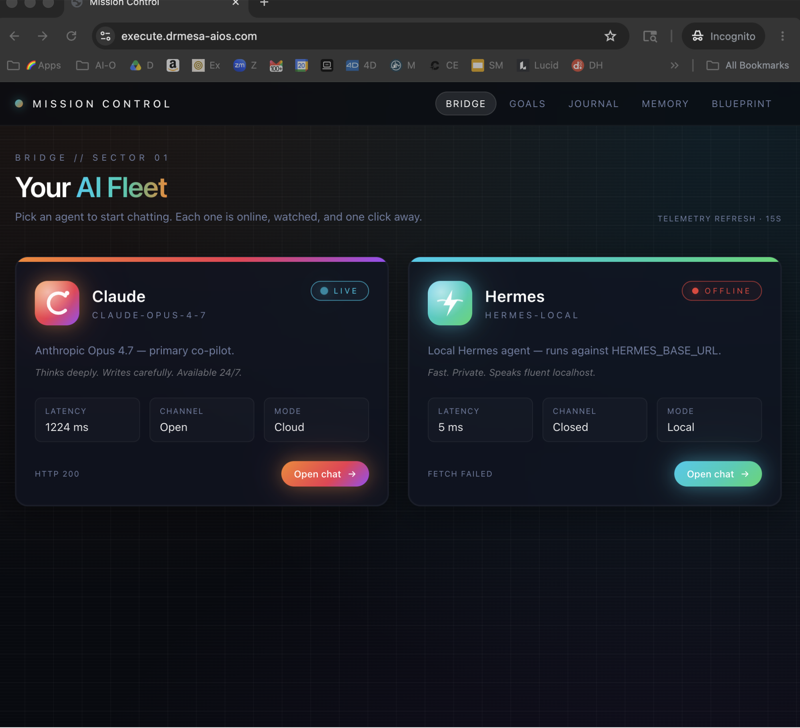
This is where a model stops being a novelty and starts earning its keep. Hermes is the AI agent inside Julian Goldie's Agent OS, and it does not care which model powers it — you choose. Point it at your local Qwen through Ollama and you get an agent that runs on your own machine at zero cost per task.
The flow is simple. Pull Qwen 3.8 in Ollama, then tell Hermes to use it as its model. From there the agent handles the loop — reading your request, calling tools, editing files, reporting back — while Qwen supplies the thinking. Because Agent OS keeps a memory of your business and a library of skills, the same local model gets more useful over time as it learns your context and your repeatable workflows.
A sensible pattern is to run everyday, private, high-volume jobs on local Qwen inside Hermes, then switch to a larger API model only for the occasional task that needs more horsepower. Same agent, same skills, a different brain when it counts.
Practical Tips To Get More Out Of Qwen 3.8
- Be specific. Open models reward clear, detailed instructions even more than the big hosted ones. Say exactly what you want, and in what format.
- Use the instruct version. For chatting and agents, pick the instruct-tuned build rather than the base model — it follows directions far better.
- Keep a fallback. Configure a second route (a free API, or a larger model) so a heavy task never leaves you stuck.
- Match the model to the job. Do not burn a big model on a small task. Reserve size for the work that actually needs it, and let a small local build handle the routine volume.
- Test on your real work. Judge it on the jobs you do every week, not on puzzles from social media. That is the only benchmark that pays you back.
If you want to turn a free local model into automations that actually make money, check out the AI Profit Boardroom — the ready-made Agent OS, the tested Hermes setups and the community that shows you exactly what to run are all inside. → Get the open-model agent playbook here
Qwen 3.8 FAQ
Is Qwen 3.8 free to use?
Run locally through Ollama, it is free — no subscription and no per-token bill. Hosted APIs usually charge for usage, so the cost depends on the route you choose.
Do I need a powerful computer?
Not for the smaller builds. A modern laptop with around 16GB of RAM comfortably runs a small, quantised Qwen. Larger versions want more memory, or you use an API instead.
Is my data private if I run it locally?
Yes. With the local route your prompts never leave your machine. A hosted API is different — your requests go to the provider, so read their terms before sending anything sensitive.
Can Qwen 3.8 power an AI agent?
Yes. Because it supports tool-calling, it can drive an agent like Hermes — searching, editing files and running workflows rather than just chatting.
How does it compare to other open models?
Qwen is one of several strong open-weight families, alongside models from other labs. Rather than trust a leaderboard, run your own tasks on it — the right model is the one that finishes your real jobs cleanly.
The Bottom Line
Learning how to use qwen 3.8 comes down to three moves: run it free and local with Ollama, reach for an API only when a task needs a bigger model, and let an agent like Hermes put it to work. Start small, test it on the jobs you actually do, and let the model earn its place. Zero cost to begin, and a real path from chatting to shipping.