Everyone searching for the maple preview model wants the same three answers: what actually is it, is it really as fast as the demos suggest, and should you trust the benchmark claims? I have been running it hands-on inside my local Agent OS engine, and I have put it through my Goldie Bench testing the same way I test every new model. This guide covers what Maple Preview is, how the ternary-weights trick works in plain English, where it genuinely wins, and where the honest limits are.
📺 Watch: Maple AI: FREE Local Model on Your iPhone
🔥 Get the Agent OS as a free bonus: AI Profit Boardroom members get the full Agent OS zip, prompt libraries, daily tutorials and weekly live coaching calls. → Get inside
Short version: it is not a frontier coder, and I will show you exactly where it falls short. But it might be the clearest early sign yet of where local AI is heading — free reasoning models running on your phone.
What Is Maple Preview?
Maple Preview is a new open-source local reasoning LLM. The headline numbers: 20 billion parameters with only around 1 billion active at runtime — the 20B-A1B setup — built on ternary weights. The team behind it claims state-of-the-art performance in its weight class. That is their claim, not mine, and I will give you my own testing further down.
Three things stand out before you even run it:
- MIT licence. Completely free, and commercial use is allowed. You can build a business on top of it.
- 128k token context window. Long documents and long agent sessions fit comfortably.
- A genuine reasoning model. It thinks through problems rather than just pattern-matching a quick reply.
And the real headline is not the specs at all. Maple is aimed at smaller devices — the team shows it running on an iPhone. More on why that matters in a moment.
Maple Preview Specs and Architecture
| Spec | Maple Preview |
|---|---|
| Model type | Open-source local reasoning LLM |
| Total parameters | 20 billion |
| Active parameters per token | Roughly 1 billion (20B-A1B) |
| Weights | Ternary — each connection stored as minus, zero or plus |
| Expert networks | 256 small specialists, 8 woken per token by a router |
| Context window | 128k tokens |
| Approximate size | Around 5GB, where a model this size would normally need around 38GB |
| Licence | MIT — free, commercial use allowed |
| Benchmark position | State-of-the-art in its weight class (their claim) |
| Where to get it | Their chat site, or open weights on Hugging Face |
Ternary Weights Explained in Plain English
This is the bit most write-ups skip or bury in maths. Here is the simple version.
A normal model stores every single connection between its neurons as a precise number with lots of decimal places. Billions of connections, each one a fussy, high-precision value. That is why model files are enormous and why your machine grinds through them slowly.
Maple stores each connection as just one of three symbols: minus, zero or plus. That is it. Three options instead of a many-decimal number.
Two things happen as a result:
- The file becomes tiny. A model that would normally need around 38GB fits in around 5GB.
- The maths becomes fast. Mac chips run through minus-zero-plus arithmetic far quicker than high-precision multiplication.
Smaller file, faster tokens, same machine. That is the whole ternary pitch, and in my testing the speed part is real.
The 256-Expert Trick
The second clever move is how Maple spends its 20 billion parameters. Instead of one giant network, it holds 256 small specialist networks. For every token, a router wakes only the 8 most useful specialists and leaves the other 248 asleep.
The result: you get the knowledge of a roughly 20B model at roughly the running cost of a 1B model. That is what 20B-A1B actually means in practice — big brain, small bill.
Where It Sits on the Speed-Quality Frontier
Every local model lives on the same trade-off: quality for speed. The frontier looks roughly like this right now:
- Gemma 4 (E4B and E2B) sits mid-frontier — a solid balance of quality and pace.
- LFM 2.5 is fast, and a favourite for lightweight agent work.
- Qwen 3.6-27B is the name people mention most, but on my Mac Studio it is far too slow — on comparable setups a simple question can take minutes.
Maple's pitch is that it breaks the trade-off: high speed and decent quality at the same time, per their benchmarks. That is a bold claim, so I did what I always do — I tested it myself.
📺 Watch: DeepSeek-V4 Preview Update is INSANE
My Goldie Bench Testing: What Actually Happened
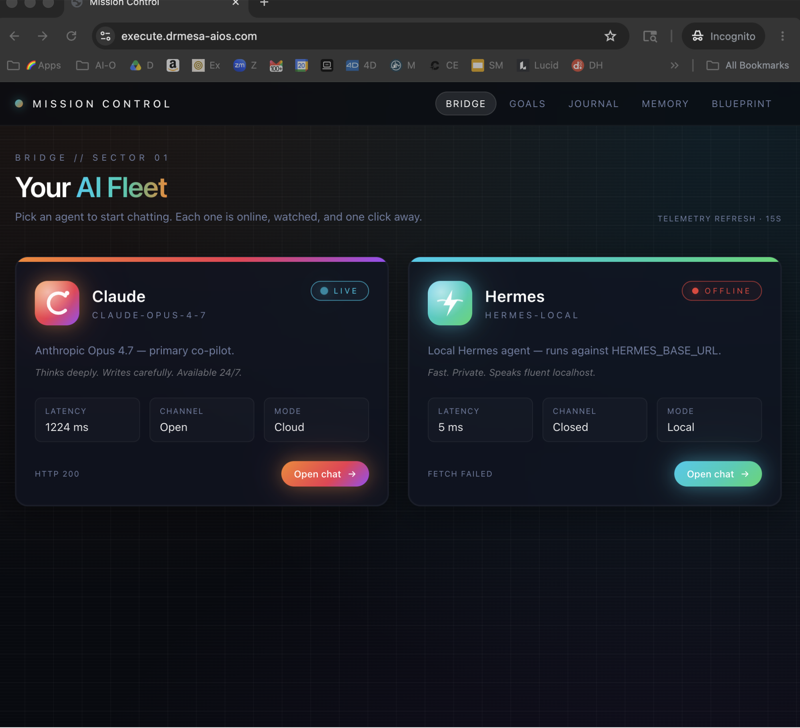
I plugged Maple Preview into the local engine inside Agent OS, where models swap in and out and everything an agent builds is saved straight to the workspace. Then I ran my usual Goldie Bench tasks.
First test: a snake game. Second test: an SEO agency landing page. Both built locally, both saved into the workspace, and both genuinely quick — this is one of the fastest local models I have run at this level of capability. The responses were also nicer and more detailed than most local models I have tried, which surprised me for something this light.
Then the test that matters for local AI: I switched the Wi-Fi off and kept going. Everything continued to work, fully offline. No cloud, no API bill, no connection needed.
The Honest Verdict on Coding Quality
Now the part the marketing will not tell you. In my Goldie Bench testing, Maple's coding quality is not at the level of Gemma 4, GLM 4.7 Flash, GPT-OSS or Claude Sonnet 5. The team's own comparison against Claude Sonnet 5 on coding is one I simply do not entertain — it is not that conversation.
The win here is speed and lightness, not frontier coding. If you need the best possible code from a local model, other options beat it. If you need fast, decent, offline reasoning in a 5GB file, Maple is exactly that.
📺 Watch: Hunyuan3 Preview: NEW Chinese AI DESTROYS Kimi K2?
The Real Headline: Free AI on Your Phone
Here is why I think Maple matters beyond the benchmarks. It is aimed at smaller devices, and the team shows it running on an iPhone — a genuine reasoning model, on a phone, free.
They also show it running more autonomously on a MacBook Pro, where it decides on its own to remember details rather than waiting to be told. Small sign, big direction.
My take: free local models on phones is the future that is coming, and Maple Preview is one of the first credible early signs of it. The models will keep shrinking, the chips will keep improving, and at some point the default place your AI runs will be in your pocket — not someone else's data centre.
How to Try Maple Preview Today
Two easy routes:
- Their chat site — the fastest way to poke at it with zero setup.
- Hugging Face — grab the open weights and run it locally yourself.
I run it the third way: inside the local section of Agent OS, where models swap in and out per task and everything is saved to the workspace. It sits alongside my other agents — for example LFM paired with Hermes — so each job gets the model that suits it. If you are choosing a model to drive your own agent, my breakdown of the best free models for Hermes covers the current options.
If you want free local AI making you money, check out the AI Profit Boardroom — the full Agent OS setup and the local engine I tested Maple inside are waiting for you there. → Get your local AI engine running
Maple Preview FAQ
Is Maple Preview free for commercial use?
Yes. It ships under the MIT licence, which means it is free and commercial use is allowed. You can use it in client work or products without paying anyone.
What does 20B-A1B actually mean?
20 billion total parameters, but only around 1 billion active per token. A router wakes 8 of the 256 expert networks for each token, so you get big-model knowledge at small-model running cost.
How big is the download?
Around 5GB, thanks to ternary weights. A model of this size stored the normal way would need around 38GB.
Does Maple Preview work offline?
Yes. In my Goldie Bench testing I switched the Wi-Fi off mid-session and it kept building without missing a beat. Everything runs and saves locally.
Is it good at coding?
It is decent and very fast, but in my testing it is not at the level of Gemma 4, GLM 4.7 Flash, GPT-OSS or Claude Sonnet 5. Treat it as a speed-first local model, not a frontier coder.
The Bottom Line
Maple Preview is a 20B-parameter reasoning model that behaves like a 1B model on your hardware: a 5GB file, ternary weights, 256 experts with 8 awake at a time, a 128k context window, and an MIT licence that lets you build commercially for free.
In my Goldie Bench testing it was genuinely quick, gave more detailed responses than most local models I have tried, built a snake game and a landing page inside Agent OS, and carried on working with the Wi-Fi off. It is not the model I would pick for serious coding — Gemma 4, GLM 4.7 Flash and GPT-OSS all beat it there, and Claude Sonnet 5 is in a different league.
But judged for what it is — a free, fast, offline reasoning model light enough to run on a phone — it is one of the most interesting local releases in months. Download it, drop it into your local stack, and get a feel for where this is all heading. Your pocket is the next data centre.