orca ade is the term to search if you want one app where several AI agents build several projects at the same time, while you watch, steer and approve from your desk or your phone. ADE stands for agentic development environment, and it is a genuinely different category from the coding tools you already know.
📺 Watch: Orca: NEW AI Coding Agent is INSANE!
🔥 Get the Agent OS as a free bonus: AI Profit Boardroom members get the full Agent OS zip, prompt libraries, daily tutorials and weekly live coaching calls. → Get inside
Julian Goldie has been running Orca as his coding cockpit, and his newest video covers a wave of fresh features: a mobile companion app, page annotations, forked agent sessions, an agent dashboard and scheduled automations. This guide unpacks the ADE idea and the new features in plain English. Julian describes himself as non-technical, so nothing here assumes you can code.
What Is the Orca ADE?
An IDE, or integrated development environment, was designed for a human who types code. An ADE flips the relationship. It is designed for a human who directs agents, while the agents do the typing.
Orca is free and open source, and it works with any coding agent you already use rather than locking you into one. Out of the box, the Orca ADE gives you:
- Parallel agents working in multiple terminals at once
- Live previews of each project as it is built
- A desktop app plus a mobile companion, so your phone can control your local multi-terminal setup
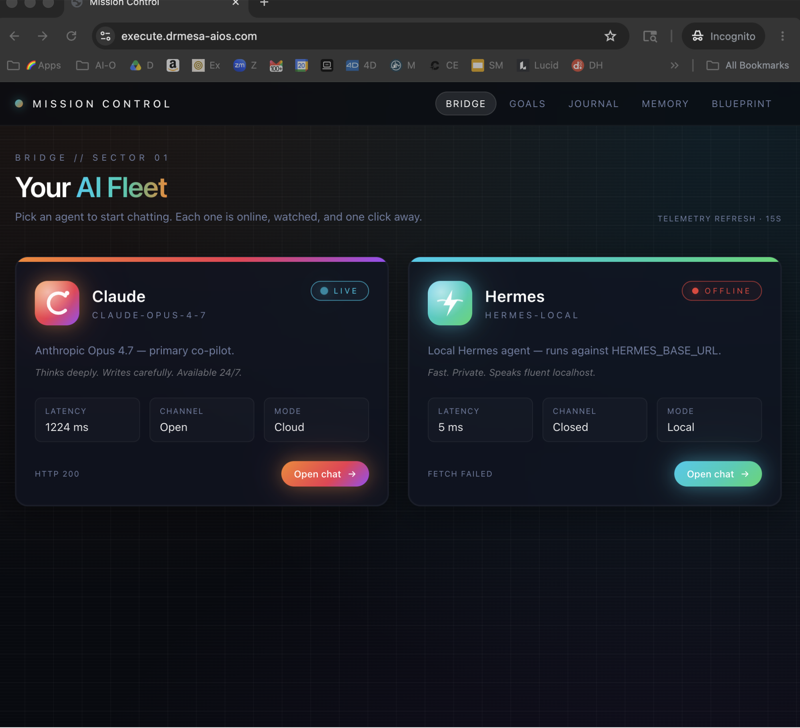
- Support for whichever coding agent you prefer, from Claude Code to Hermes
Guides on this site already cover the basic Orca setup and the agent fleet, so this page sticks to the ADE concept and the newest features.
Projects: Local, Remote and Several at Once
When you create a project, you choose where it lives. Run it locally on your machine, or point it at a remote Orca server, such as a VPS, so the heavy work happens elsewhere.
You can load GitHub projects straight in, or simply drag files into the window. And you are not limited to one project: Julian runs a mobile app, a website and a game side by side, with agents coding across all three in parallel.
There is also smart dev branch naming: branch an existing project, right-click and rename it, and test a risky idea on a copy without touching the version that works.
Split Terminals: Two Agents, One Project
Inside a project, terminals split to the right or downwards, so Claude Code can sit in one pane and Hermes in another, both coding the same project simultaneously.
Want a completely free route? Run the free Hermes agent with the free Ling 3.0 Flash plugged in for subtasks. Julian’s earlier Orca coding walkthrough covers that setup step by step.
Live Preview, Grab and Annotate
Every project gets a localhost URL for a live preview. Hit the plus sign, open a new browser tab inside Orca, paste the URL, and you are looking at your project while the agents build it. You can even import your browser data.
Two features make this brilliant for non-coders:
- Grab an element. Select any part of the page and copy it straight into the agent with an instruction like "make that more interesting". No digging through files to work out which line controls which button.
- Annotate the page. Draw on a screenshot, add notes, and mark each annotation as a question or a change. Queue several up, then send the whole batch to Claude, agent teams, Codex or OpenCode in one go.
The Mobile Companion: Your Dev Team in Your Pocket
Install the mobile companion app, scan a QR code, and your phone pairs with the desktop, turning Orca into a remote control for your whole setup.
From there you can keep an eye on your multi-terminal setup and manage automations without sitting at the desk. Pair that with a remote Orca server and the heavy lifting never touches your laptop at all.
Mobile Emulation, Markdown Tabs and Forked Sessions
Building a phone app? Open a new tab and choose the mobile emulator. You will need Xcode or an Android Studio virtual device installed, and then you get code on the left and a live phone screen on the right.
Tabs also open markdown files, handy for plans and notes.
Then there is fork agent sessions. Right-click a session, choose fork, and you get parallel versions of the same conversation: try two approaches to the same feature, let both play out, keep the winner.
📺 Watch: Orca: FREE AI Coding Agent (Open Source!)
The Agent Dashboard: No More Idle Agents
The most common failure with AI agents is silent waiting. An agent finishes, or pauses for approval, and sits there doing nothing while you assume it is busy.
Orca’s experimental features attack exactly this. A pen overlay lets you pin a view of what an agent is working on while you browse elsewhere. There is an agent view, a chat UI and, the big one, an agent dashboard that shows who is working and who needs help or approval. Nothing sits idle unnoticed.
Automations: Put Your Agents on a Schedule
Automations let you schedule recurring tasks per agent. Pick the agent, Hermes for example, choose weekdays and times on a 12-hour clock, and use the built-in templates to set things up quickly. You can manage these schedules from your phone as well.
This is where Julian’s positioning gets specific: Hermes Desktop, for all its strengths, is not a multi-agent orchestration platform, while Orca really is. The two are not rivals, though, because you can select Hermes as the agent inside Orca’s automations.
📺 Watch: New OpenClaw Upgrades are INSANE!
Settings Worth Switching On
A few settings make a real difference:
- Orchestration skill. Lets agents hand off context and coordinate work through Orca. Julian recommends enabling it: it is the difference between agents working near each other and with each other.
- Computer use skill. Lets agents operate the computer when a task needs it.
- Default agent picker. Enable or disable Claude Code, agent teams, Codex, Gemini, Antigravity, Kimi, Hermes, OpenCode and more, then set your default.
- Voice dictation. Built in, though Julian prefers Whisper Flow for talking to his agents.
- Integrations. Git and friends, so version control stays wired in.
These picks come from Goldie Bench, Julian’s own hands-on testing rather than an official benchmark, and his test is always the same: does the feature survive a real project, not just a demo?
Orca ADE Features at a Glance
| Feature | What it does | Why it matters |
|---|---|---|
| Parallel terminals | Split right or down; multiple agents code one project at once | Claude Code and Hermes collaborate instead of queueing |
| Mobile companion | QR-code pairing controls your local setup from your phone | Steer your dev team away from the desk |
| Preview and annotations | Grab page elements or draw notes and send them to an agent | Design feedback without reading code |
| Fork agent sessions | Right-click to create parallel conversation versions | Test two approaches side by side |
| Agent dashboard | Shows who is working and who needs help or approval | No agent sits idle unnoticed |
| Automations | Recurring scheduled tasks per agent, with templates | Work runs on a timetable, not on demand |
| Remote projects | Run projects on an Orca server such as a VPS | Your laptop stops being the bottleneck |
| Mobile emulator | Live phone screen beside the code, via Xcode or Android Studio | See the app the way users will |
Orca ADE vs the Agent OS
A fair question: if you already run an Agent OS, do you need Orca? They solve different problems.
Orca is the coding cockpit. It is where software gets built by parallel agents, with previews, forks, a dashboard and scheduled runs. The Agent OS is the always-on business layer: content, SEO, memory and mission control for the whole operation. One builds the product; the other runs the machine around it.
In Julian’s stack they complement each other: Orca ships the projects while the Agent OS keeps the business moving.
If you want a full AI dev team making you money, check out the AI Profit Boardroom — live calls, Julian’s plug-and-play agent workflows, and a community building real projects with tools like Orca every single week. → Build your own agent-powered dev team
Orca ADE FAQ
Is Orca free?
Yes. Orca is free and open source. For a fully free agent route, run the Hermes agent with Ling 3.0 Flash handling subtasks.
Does Orca replace Claude Code or my current agent?
No, it wraps around them. Orca runs with any coding agent, and the picker includes Claude Code, agent teams, Codex, Gemini, Antigravity, Kimi, Hermes and OpenCode, each of which you can enable or disable.
What do I need for the mobile emulator?
Xcode or an Android Studio virtual device. Once one is installed, open a new tab and choose the mobile emulator to see your app running beside the code.
What is the difference between an ADE and an IDE?
An IDE is built for a human writing code. An ADE is built for a human directing agents that write the code, so the emphasis shifts to parallel terminals, previews, orchestration and approvals in one place.
The Bottom Line
The Orca ADE is the closest thing right now to a proper cockpit for agentic coding: parallel terminals running any agent you like, live previews you can scribble on, forked sessions, a dashboard that stops agents idling, automations on a schedule and a phone app to oversee the lot.
Start small. One project, two split terminals, orchestration switched on. Then add the mobile companion and a single automation. If a self-described non-technical marketer can direct a team of agents this way, so can you.