The paperclip hermes agent setup is the closest thing I've seen to running a real company with zero humans inside it.
I'll be straight with you — I've had 20 Claude Code tabs open at once, context lost on every reboot, agents working on stuff I forgot I told them to do.
Paperclip fixed it in one evening.
What the paperclip hermes agent combo actually is
Paperclip is a free open-source tool on GitHub.
It's the control layer that sits on top of all your agents — Hermes, OpenClaw, Claude Code, Codex, Cursor — and lets you manage them like employees in a company.
You set a mission.
The CEO agent plans the strategy.
Other agents get hired to fill the gaps — and every one of them runs on a schedule with its own budget and its own context.
Hermes is one of the adapters Paperclip ships with, which means you can point a Hermes-powered agent at a specific role inside your org chart.
That's the whole thing.
No more tab chaos, no more lost context, no more forgetting what you told which agent to do.
Why I stopped using Multion and moved to Paperclip
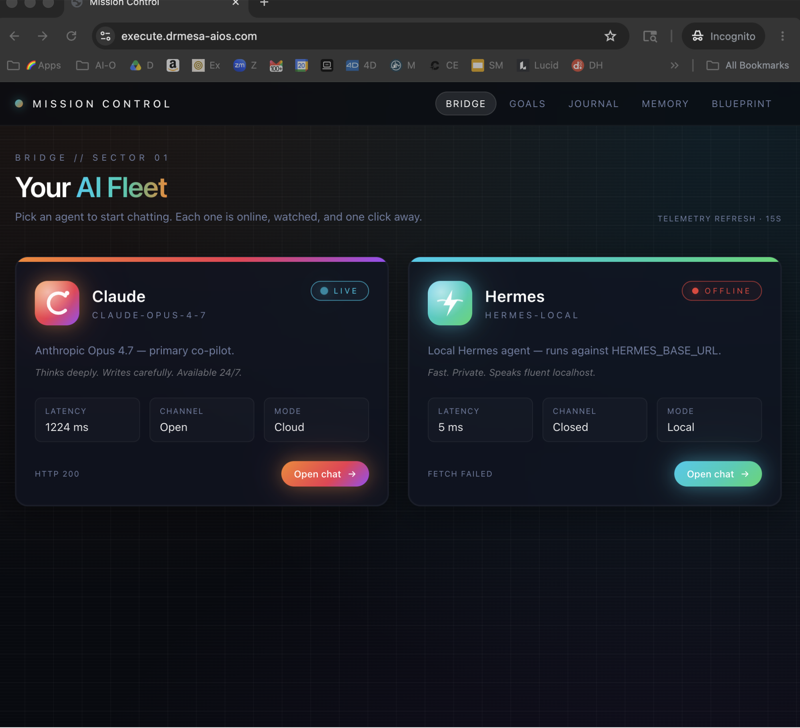
I've been running Hermes agent mission control for a while now — that was my previous favourite for orchestrating multiple AI workers.
Paperclip is better.
Here's why:
- More control — every agent has a clear title, job description, goal, and budget. I can see exactly what each one is doing.
- More intuitive — the org chart visual is immediately obvious. You look at it and you get it.
- Less buggy — Multion would randomly lose sync between agents. Paperclip's sync is clean.
- Easier to hire new agents — the CEO agent literally sends me inbox recommendations. I approve, agent created, done.
If you've read my Hermes vs OpenClaw breakdown, this slots in above both of them — it's the layer that manages them.
Installing the paperclip hermes agent stack
Two ways to get it running.
Option 1: Clone from GitHub.
Standard open-source install — pull the repo, follow the readme.
Option 2: Let Claude Code do it.
This is what I do.
I tell Claude Code: "Install Paperclip from GitHub into this folder."
Claude pulls it, wires it up, runs it on localhost.
Done in minutes.
Setting up the org chart
This is where it gets fun.
You open Paperclip on localhost.
You start with a blank canvas.
Then you add a CEO agent.
Each agent gets:
- A title (CEO, CMO, Lead Engineer, Content Writer, etc.)
- A job description (what this role does)
- A goal (what success looks like for this agent)
- An adapter (Claude, Hermes, OpenClaw, Codex — pick your model)
- A budget (how much it's allowed to spend)
Then you set a top-level company mission.
Mine is: "Grow the AI Profit Boardroom."
Every agent in the org chart aligns to that mission.
The CEO plans strategy off it, the CMO plans marketing off it, the engineers build tools that support it.
How the CEO agent hires for you
This is the bit that blew my mind.
The CEO runs on a schedule.
It looks at the mission, looks at the current org chart, and decides what's missing.
Then it sends you an inbox recommendation — "I think we need a content writer agent with this job description and this goal."
You approve.
Paperclip auto-creates the agent with the right adapter plugged in.
New hire, onboarded, working.
You never had to open a config file.
Schedules and budgets
Every agent runs on a cadence you set.
Wake up at 9am, do the work, report back.
Or every hour, or every 15 minutes, or on a custom cron.
Each one has a budget cap — when it hits the cap, it auto-stops.
No more surprise $400 API bills because a looped agent went feral.
🔥 Want my exact Paperclip + Hermes setup? Inside the AI Profit Boardroom, I've got the full Paperclip walkthrough — the exact org chart I'm using, the mission prompt that makes the CEO agent actually useful, and the adapters I pair with Hermes for specific roles. 3,000+ members are already running this. → Get the full Paperclip setup here
Audit logs and ticketing
Every decision every agent makes is logged.
Every task has a ticket.
You can scroll back and see exactly why the CMO agent decided to launch that campaign, what data it was looking at, and which sub-agent it assigned the work to.
This is the bit that makes it feel like a real company instead of a chaos machine.
Paperclip Hermes Agent dashboard + mobile monitoring
I monitor the whole thing from my phone.
The dashboard shows:
- Which agents are active right now
- What projects are in flight
- Open tickets
- Budget burn across the org
- Recent decisions
It's like checking Slack for your AI company.
How this fixes the 20-tab Claude Code problem
If you've been running Claude Code seriously, you know this pain.
You open five terminals, one per project.
You switch between them all day.
You reboot, you lose everything.
Paperclip solves this because each agent has its own persistent context.
The context doesn't live in your terminal — it lives in Paperclip's database.
Close your laptop, reopen it, the agent is still running, still has memory, still knows what you told it three days ago.
Pairs beautifully with my Claude Code local setup — Paperclip is the orchestration layer on top.
Projects, issues, and task assignment
Paperclip has project management built in.
You create a project, you break it into issues, you assign issues to agents.
The CEO agent can do this for you too.
"Launch the April content campaign" → CEO breaks it into 12 sub-tasks → assigns 8 to the content agent, 3 to the SEO agent, 1 to the engineer agent.
You just watch it happen.
The adapter model — why Hermes matters
Paperclip's killer feature is the adapter system.
Every agent you create picks an adapter — the model it runs on.
Hermes adapter is available directly on the Paperclip GitHub.
You can also pick:
- Claude (for heavy reasoning)
- OpenClaw (for SEO work — see my OpenClaw AI SEO guide)
- Codex (for code)
- Cursor (for more complex dev)
- Gemma / Ollama locals
So you build an org where the CEO runs on Claude Opus for strategy, the engineers run on Codex for speed, the SEO agent runs on OpenClaw, and the research agent runs on Hermes locally so you don't pay for it.
Mix and match per role.
A real example — my content writer agent
Title: Content Writer Adapter: Claude Opus 4.7 Goal: Publish 5 SEO articles per week aligned to the company mission Budget: $30/week Schedule: Wakes at 8am Mon/Wed/Fri
The agent pulls the content brief from the CMO agent, writes the draft, runs it through the editor agent, publishes to the blog.
I don't touch it.
Video notes + links to the tools 👉 https://www.skool.com/ai-profit-lab-7462/about
FAQ
What is the paperclip hermes agent setup?
It's using Paperclip (the org-chart orchestration tool) with the Hermes adapter plugged into specific agent roles — giving you a managed AI company where Hermes handles certain jobs alongside Claude, OpenClaw, and Codex agents.
Is Paperclip free?
Yes — fully open source on GitHub. You just pay for the underlying model API calls for each agent.
Can Claude Code install Paperclip for me?
Yes — tell Claude Code to install Paperclip from GitHub into a local folder and it'll handle the full setup. Runs on localhost after that.
How does the paperclip hermes agent pairing compare to Multion?
I prefer Paperclip — more control, cleaner sync between agents, less buggy, easier to hire new agents via the CEO's inbox recommendations.
Can I use Hermes for every agent in Paperclip?
Yes, but you shouldn't. Pick the best adapter per role — Hermes for local/free tasks, Claude for strategy, Codex for code, OpenClaw for SEO.
Does Paperclip work on mobile?
The dashboard is mobile-friendly so you can monitor your whole AI company from your phone.
Related reading
- Hermes agent mission control — my previous orchestration setup
- Hermes vs OpenClaw — which agent to plug into which role
- Claude Code local — the base layer Paperclip sits on top of
Wrapping up
If you're running more than two agents, you need an org chart.
Paperclip gives you one, for free, with every adapter you care about already supported.
Get a FREE AI Course + Community + 1,000 AI Agents 👉 https://www.skool.com/ai-seo-with-julian-goldie-1553/about
Learn how I make these videos 👉 https://aiprofitboardroom.com/
Stop juggling tabs and start running a company — the paperclip hermes agent stack is the shortcut.