Agentic OS mission control is the tool that finally lets you see what your AI agent has been hiding from you this whole time.
Not on purpose — you've just been trusting the final answer.
You never get to see what really happened to get there.
What if the real mistake was buried in the middle the whole time?
Now there's a way to see every single step, and honestly, it's kind of wild.
The black box problem nobody talks about
Let me start with the problem, because it's bigger than people think.
AI agents are getting really powerful right now.
You give one a task and it runs tools, searches the web, pulls from memory, and switches between models.
It retries when something fails, then hands you a finished answer at the end.
That sounds amazing, and it is — right up until something goes wrong.
Because here's the thing: when the answer is wrong, you have no idea why.
When the agent fails, you can't tell where it failed.
When it used a bad source, you don't catch it until the mistake is already out the door.
Most people just run the agent, wait, and hope nothing broke along the way.
That's not a system — that's crossing your fingers.
This is what people call the black box problem.
You tell the agent what to do, you get a result, but the entire middle part is invisible.
And the middle is exactly where things break.
🔥 Want the exact setup I used to get these results? Inside the AI Profit Boardroom, I've got a full agentic OS mission control section with step-by-step video tutorials. Plus weekly coaching calls + 2,800+ members building real automations. → Get access here
What agentic OS mission control actually does
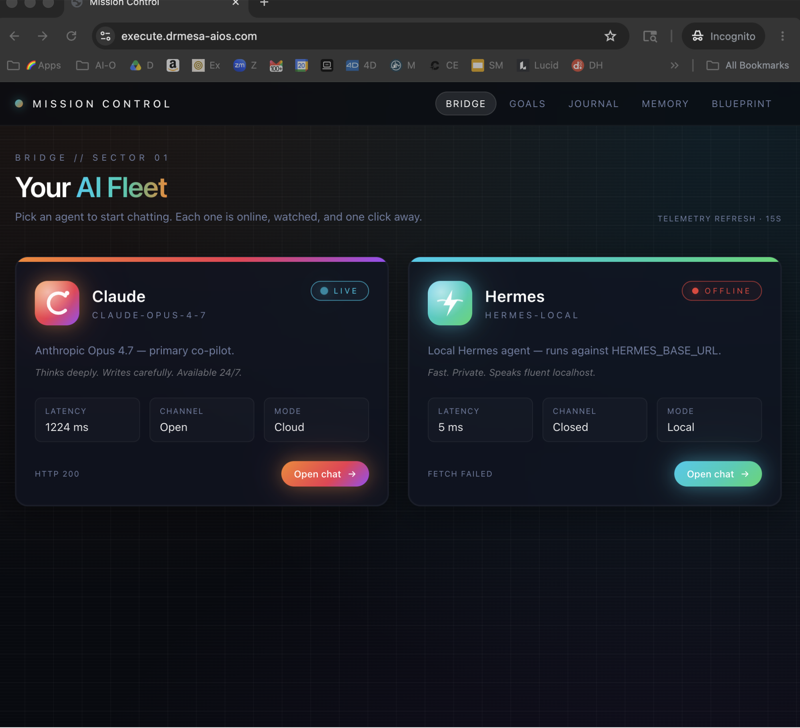
Agentic OS mission control is a dashboard that sits on top of your Hermes agent and shows you the whole journey, not just the ending.
A journey is just the full path your agent took from start to finish, every single step.
So instead of one final answer, you see the prompts, the tool calls, and the tool results.
You see the failures, the model switches, the approvals, and the memory it pulled from.
You even see where it compressed its own context to save room.
The messy middle — all of it laid out where you can actually read it.
If you want the deeper UI walkthrough of how this dashboard evolved, I covered the native workspace build in my Hermes Agent Mission Control breakdown.
How I actually use it (real example)
Let me give you a real example of how I put this to work.
I used agentic OS mission control to inspect the content agent I run to bring more people into the AI Profit Boardroom.
That agent researches topics, builds outlines, and drafts posts that pull the right audience in.
Before, if a post came out weak, I had no clue why.
Now I open the journey map and I can see the exact step where it pulled the wrong source or skipped the research.
That means I fix the one weak step instead of rebuilding the entire workflow.
See how useful that is?
You stop guessing and you start seeing.
Why journey maps matter so much
This is the core of the whole thing, so stick with me here.
Agent work is almost never one simple action.
A good agent might search, then read, then summarise, then compare, then write, then revise, then report.
That's a long chain of decisions.
If that chain is hidden, you have to trust the output blindly.
If the chain is visible, you can improve it — simple as that.
And when you can see the chain, you start noticing patterns.
Maybe the agent keeps grabbing the wrong tool for research.
Maybe it switches models way too often and wastes time.
Maybe it pulls old memory when it should go search for something fresh.
You'd never spot any of that from the final answer alone.
But on the journey map, it's right there in front of you.
The big shift is this: you don't get better agents by prompting harder and harder.
You get better agents by finding the exact step that's breaking and fixing that step.
Mission control is the thing that shows you where to look.
How to read your first journey map without getting overwhelmed
Here's a simple habit that makes the whole thing click.
Don't try to read every single step at once.
Start at the end where the result landed, then walk backwards until you hit the step that looks off.
Nine times out of ten, the weak link is only one or two steps before the final answer.
It's rarely all the way back at the start.
Once you train your eye to scan backwards like that, a journey map stops feeling like a wall of text.
It starts feeling like a map you can actually follow.
That one habit alone changes how fast you can debug.
Skills tracking: looking at the agent's brain
Mission control gets smarter the more your agent works.
A skill in Hermes is just a reusable playbook.
The agent saves a way of doing something so it doesn't start from zero every single time.
The more your agent works, the more of these playbooks it builds up.
That's great, but it can get hard to track.
You end up with skills you forgot about, and some of them go stale.
Mission control shows you the skills your agent has and which ones it's actually using.
It's like looking at the agent's brain.
You can see the playbooks that exist and spot the outdated ones that need a refresh.
That's how your automation actually gets more reliable over time instead of slowly getting messier.
Model switching: where your money is going
It also shows you something most dashboards completely ignore — model switching.
Agents often start on a lighter model for the easy stuff and jump to a stronger model when things get harder.
That can be smart, but if it's switching at the wrong moments, you're burning model power for no reason.
Mission control shows you exactly when those switches happen.
So you can see where the heavy lifting is going and tighten it up.
Good AI systems aren't just powerful — they're efficient.
This is how you make them efficient.
Mission control vs flying blind
Here's the honest comparison after testing it on my own stack.
| What you're comparing | No mission control | Agentic OS mission control |
|---|---|---|
| When a task fails | You guess and rebuild | You open the exact broken step |
| Average fix time | Around an hour | Around 5 minutes |
| Bad sources | Found after the fact | Spotted mid-journey |
| Model waste | Invisible | Visible per switch |
| Client trust | "Trust me" | Exportable, redacted report |
| Safety | Full access tools | Read-only, secrets redacted |
For the wider command-centre view of how all of this sits inside the OS, I broke that down in my agentic OS command center guide.
The one feature that turns a broken task into a 5-minute fix
Now here's the part I really want you to get.
When an agent task fails, the final result almost never tells you why.
Maybe it used a bad source, maybe a tool call quietly failed, maybe the prompt was unclear.
Maybe it switched models at the worst moment and lost the thread.
From the outside, you just see a bad answer.
Mission control lets you open that exact failed step.
You see the input that went in, you see the output that came back, and you see the timing and the result.
So instead of tearing down your whole automation and rebuilding it from scratch, you walk straight to the broken step.
You fix that one thing.
That's the difference between an hour of frustration and a 5-minute repair.
It sounds small, but it changes everything about how you run agents.
Why it's safe to use on real client work
Here's the part that makes it safe.
Agentic OS mission control is read-only.
That means it watches what the agent did without ever changing the agent session itself.
It can't start, stop, or mess with your live runs — it just observes.
Tools with deep access can break things if something goes wrong.
A read-only tool looks without touching.
So you get full visibility without handing over too much control.
On top of that, it redacts secrets in the previews and the reports, so things like API keys stay hidden.
When you need to share what an agent did, you can export the whole journey as a clean report in markdown or JSON.
The sensitive stuff is already redacted.
That's huge for client work and team reviews.
People can see the process, understand where the result came from, and trust it without you exposing anything private.
Transparency is good, but safe transparency is better.
🔥 Want to set this up on your own agents this week? Inside the AI Profit Boardroom we've got the full agentic OS mission control walkthrough, plus the zip file inside the Agent OS ready to install — and a complete 30-day roadmap of real use cases. → Join 2,800+ members here
Where AI agents are actually heading
This is what I do across my own setup.
I keep the lead workflow that pulls people into the AI Profit Boardroom running clean by checking its journey maps regularly.
When a step drifts, I catch it early before it ever reaches a real person.
That's the whole point.
I'm not treating my agents like magic anymore.
I'm treating them like systems I can see, debug, and improve.
The future isn't just agents that do more.
It's agents you can observe, test, improve, and actually trust.
Real automation needs reliability, and reliability needs visibility.
If you want to see how this fits the bigger picture, my Agentic OS overview shows the full stack I run, and the Hermes Agent Swarm guide covers running multiple agents at once.
FAQ: agentic OS mission control
What is agentic OS mission control?
Agentic OS mission control is a read-only observability dashboard that sits on top of your Hermes agent and shows the full journey of every task — prompts, tool calls, results, failures, model switches, and memory pulls — instead of just the final answer.
How does agentic OS mission control help me debug agents?
It shows you the exact step where a task broke, so you fix the one weak step instead of rebuilding the whole workflow. Most fixes drop from about an hour of guessing to a 5-minute repair.
Is agentic OS mission control safe for client work?
Yes. It's read-only, so it never changes your live agent session, and it redacts secrets like API keys in previews and exported reports. You can export clean markdown or JSON journeys to share with clients safely.
What is a journey map in mission control?
A journey map is the full path your agent took from start to finish. You read it by starting at the end and walking backwards until you hit the step that looks off — usually only one or two steps before the result.
Does mission control show model switching?
Yes. It shows exactly when your agent jumps between a lighter and a stronger model, so you can spot wasted model power and tighten up efficiency.
About Julian
I'm Julian Goldie — AI entrepreneur, SEO expert, and founder of the AI Profit Boardroom (2,800+ members). I help business owners scale with AI agents, automation, and SEO.
- 400K+ YouTube subscribers
- 7-figure AI agency (Goldie Agency)
- Daily training inside the Boardroom
- Author of multiple AI automation playbooks
→ Get my best AI training inside the AI Profit Boardroom
Also On Our Network
- 🌐 Read on aiprofitboardroom.com
- 🌐 Read on juliangoldieaiautomation.com
- 🌐 Read on aisuccesslabjuliangoldie.com
- 🌐 Read on aimoneylabjuliangoldie.com
Related reading
- Hermes Agent Mission Control: The V2 Workspace
- Agentic OS Command Center: The 2026 Dashboard
- Agentic OS: The AI Operating System I Run In 2026
📺 Video notes + links to the tools 👉
🎥 Learn how I make these videos 👉
🆓 Get a FREE AI Course + Community + 1,000 AI Agents 👉
If reliability is what you're after, agentic OS mission control is the visibility layer that finally makes your agents worth trusting.