ChatGPT Dots vs OpenClaw is OpenAI's polished, closed take on the always-on agent that OpenClaw made popular as open source — and my read after launch day is that Dots looks like a beginner-friendly wrapper, much like Kimi Claw was a polished OpenClaw, but it's slower and less capable than the open-source tools it's chasing. I spent launch day testing Dots hands-on, and I've run OpenClaw for months alongside Hermes. This is the honest side-by-side, including what broke.
📺 Watch: Is OpenAI Dots Worth It?
🆓 Start free: FREE AI Course + Community + 1,000 AI Agents — join 75,000+ members learning AI at no cost. → Join free
If you want the full Dots breakdown first, read my OpenAI Dots guide. This page is about one question: should you use Dots, OpenClaw, or both?
OpenAI's Answer To OpenClaw
When I opened my Dots video on 30 September 2026, I called it OpenAI's "answer to OpenClaw or Hermes Agent." I still think that's exactly what it is. OpenClaw proved that people want an AI agent that stays on, remembers them, and actually does tasks instead of just chatting. OpenAI watched that happen and built its own version inside ChatGPT.
According to OpenAI, Dots were announced at DevDay on 29 September 2026. OpenAI describes them as always-on personal agents powered by GPT-6 Astra. Each Dot gets its own cloud computer, can connect to 4,000+ apps, and learns from your feedback over time. Access is limited to ChatGPT Pro and Business Premium in eligible markets, and OpenAI says Pro excludes the EEA, Switzerland and the UK. You get one Dot per user included.
OpenClaw came from the opposite direction. It started as a weekend project by Peter Steinberger and grew into a huge open-source community. You host the OpenClaw agent yourself, on your own machine or a server, and you choose the models it runs on — including free ones. New features ship almost every week. That speed is the whole appeal, and it's also why OpenClaw can break between updates.
So the Dots vs OpenClaw choice is really closed and polished versus open and powerful. Neither is automatically better. It depends on what you care about.
ChatGPT Dots Vs OpenClaw: The Side-By-Side Table
Here's how the two agents compare after my launch-day testing and months of running OpenClaw.
| Factor | ChatGPT Dots | OpenClaw |
|---|---|---|
| Open vs closed | Closed, owned by OpenAI | Open source, community-built |
| Cost | Needs a ChatGPT Pro or Business Premium plan | Free software, you pay only for the models and hosting you choose |
| Setup | Instant inside ChatGPT | Self-hosted, takes some setup |
| Model choice | GPT-6 Astra only | Any model, including free ones |
| Cloud computer | Built in | Runs wherever you host it |
| Speed and reliability today | Slow starts, some features not working on launch day | Fast and capable, but updates can break things |
| Community and extensibility | Early, limited to what OpenAI ships | Huge community, weekly features |
| Privacy and control | Your data sits with OpenAI | You control the machine and the data |
| Who it's for | Beginners who want zero setup | Builders who want power and control |
If you want to go deeper on OpenClaw itself, the AI Profit Boardroom includes a 6-hour OpenClaw deep-dive course, plus the setups I use for Hermes. It's a community of 3,000+ members, and the price is locked at $69 a month for people who join now.
📺 Watch: New ChatGPT Workspace Agents DESTROYS OpenClaw?
Polish Vs Power
The biggest difference between Dots and OpenClaw is polish versus power. Dots is clearly designed so someone who has never touched an agent can start in seconds. There's no server, no model picking, no config. You open ChatGPT, and your Dot is there.
Some of that polish is genuinely nice. When I set up my Dot's avatar, it drew a fiery orange lobster inspired by my OpenClaw stuff. That's a fun nod, and it shows the Dot was picking up context about me. The website builder produced a well-designed site, the research briefs were solid, and I could run parallel tasks and jump into take-over mode when I wanted to steer the cloud computer myself.
But that avatar took 20 to 30 minutes to generate. The call button wouldn't connect at all. That's the pattern I saw across the whole test: the Dots agent looks great, then you wait.
OpenClaw is the reverse. The interface isn't as pretty, and you have to set it up. Once it's running, though, the OpenClaw agent is faster, you can swap models whenever a better one drops, and the community keeps adding features OpenAI hasn't even announced. This is the same story I saw with Kimi Claw — a hosted, polished take on OpenClaw that was easier to start with but less flexible than the original.
📺 Watch: Claude 4.6 + ChatGPT 5.3 + OpenClaw
Cost And Control
Cost is where Dots and OpenClaw split hard. To use Dots at all, you need a ChatGPT Pro or Business Premium plan in an eligible market. If you're in the UK, Switzerland or the EEA, Pro isn't an option according to OpenAI, and I hit region and workspace access issues myself during testing. So for a lot of people, Dots isn't just expensive — it's unavailable.
OpenClaw is free software. You pay for your model usage and wherever you host it. If you run free models, the running cost can be very low. You can also mix models: a cheap one for routine tasks, a strong one for hard reasoning. I track how models actually perform on agent work in Goldie Bench, which helps when you're choosing what to plug into OpenClaw.
Control matters just as much as price. With Dots, your agent, its memory and its cloud computer all live with OpenAI. With OpenClaw, the agent runs on hardware you choose, and your data stays where you put it. For a business handling client work, that difference alone can decide it.
If you're trying to work out which agent setup actually makes sense for your business, you can book a free strategy session and we'll map it out with you.
Reliability In Real Use
Here's what actually happened when I put the Dots agent to work. The cloud computer took about 2 minutes just to start a task. A restaurant booking worked, but it took around 5 minutes end to end. Research briefs, the website builder, parallel tasks and take-over mode all worked. That's a decent list for launch day.
The weak spots were real, though. The call button wouldn't connect. App connections were unclear — OpenAI says 4,000+, but when I tried, Dots pointed me to the Zapier MCP rather than connecting directly. And the region and workspace access problems meant I spent time just getting in.
OpenClaw has its own reliability problem, and I'll be honest about it. Because it ships features weekly, an update can break something that worked yesterday. That's the price of moving fast in open source. The difference is that when OpenClaw breaks, the community usually has a fix quickly, and you can roll back. When Dots is slow, you just wait for OpenAI.
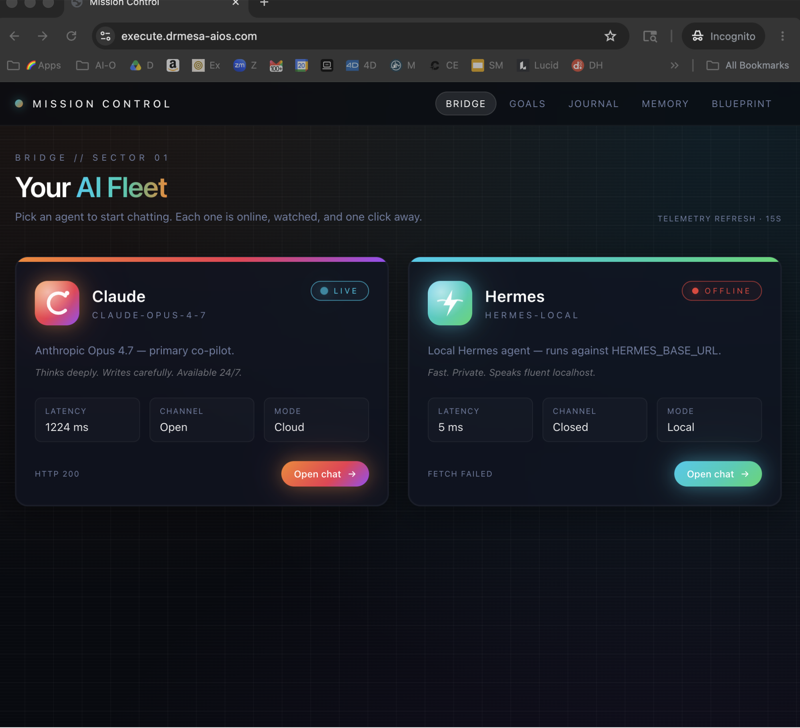
That's why I don't rely on a single agent. I run Hermes as my primary agent, OpenClaw as my secondary for features Hermes doesn't have yet, and Manus as a managed backup. I explain that setup in why I use OpenClaw instead of Manus. Dots might earn a spot in that stack once it matures, but it hasn't yet.
Who Should Pick Dots And Who Should Pick OpenClaw
Pick ChatGPT Dots if you want zero setup, you already pay for ChatGPT Pro or Business Premium, you're in an eligible market, and you're happy to wait while OpenAI irons out the launch problems. For a total beginner who lives inside ChatGPT, the Dots agent will eventually be the easiest way in.
Pick OpenClaw if you want power, control and free models today. If you're comfortable with a bit of setup, or willing to learn it, the OpenClaw agent does more, runs faster, and lets you own the whole thing. My OpenClaw course walks through that setup step by step.
And if you want my actual primary agent, look at Hermes. I compare the two open-source options in Hermes vs OpenClaw, and I put Hermes head to head with OpenAI's agent in ChatGPT Dots vs Hermes. For how all of this fits into one working system, the Agent OS guide shows how I run multiple agents together.
My honest verdict: Dots is a polished beginner wrapper that's slower and less capable than OpenClaw right now. If you want an agent that works hard for you today, go open source.
FAQ
Is ChatGPT Dots an OpenClaw alternative?
Yes. Dots is OpenAI's closed, hosted alternative to the always-on agent that OpenClaw made popular. It does many of the same jobs — research, bookings, building websites, running tasks on a cloud computer — but it only runs on GPT-6 Astra and lives inside ChatGPT. In my testing it was slower and less capable than OpenClaw on launch day.
Is OpenClaw free?
The OpenClaw software is free and open source. You pay for whatever models you connect and wherever you host it. If you use free models and your own machine, running OpenClaw can cost very little. That's a big contrast with Dots, which requires a ChatGPT Pro or Business Premium plan.
Which is easier for beginners?
Dots is easier to start, because there's nothing to install — it's already inside ChatGPT. OpenClaw needs self-hosting, which takes more effort up front. But once you learn it, OpenClaw gives you far more control, and a guided course makes the setup much less intimidating.
Get The Agent Setup That Actually Works
ChatGPT Dots vs OpenClaw comes down to this: Dots is the easy door, OpenClaw is the powerful one. Right now, the power is on the open-source side.
If you want the full 6-hour OpenClaw deep-dive course, my Hermes setups, and a community of 3,000+ members building with agents every day, join the AI Profit Boardroom. It's $69 a month locked in, normally $110.
If you'd rather get a plan built around your business, book your free strategy session and we'll work out whether Dots, OpenClaw or Hermes belongs in your stack — that's the real answer to ChatGPT Dots vs OpenClaw.