The deepseek harness vs claude code answer is simpler than the hype suggests: DeepSeek Harness finishes faster and costs almost nothing, and Claude Code still ships the better-looking build.
We ran both on the exact same prompt, on the same day, with no extra context.
DeepSeek Harness went from prompt to finished build in 11 minutes.
Claude Code was still going at 30 minutes.
The DeepSeek run cost about 5 cents.
But when we opened the two builds side by side, the Claude one was the one that looked like a real company website.
That is the whole comparison in four lines, and the rest of this post is the detail behind it.
The verdict up front
Use Claude Code when the output is going in front of a client.
Use DeepSeek Harness when you need volume, speed, or you are burning through drafts nobody will ever see.
Kasra Dash rated Claude Code a 9 out of 10 after using it every single day since launch.
He rated DeepSeek Harness lower and said it did not blow his socks off.
I gave DeepSeek Harness a 7 out of 10, mostly because I like what competition does to prices and to release schedules.
Both of those ratings are honest, and both of us are still on Claude for day-to-day work.
The interesting part is that neither of us thinks that stays true forever.
The test we actually ran
One prompt. No context. No follow-ups.
We asked for a 3D animated accountancy website, and we asked for a simple game on top of it.
Both agents got the identical prompt.
DeepSeek Harness was running DeepSeek V4 Pro.
Claude Code was running Claude Opus 5 on high.
That is a like-for-like frontier model comparison, not a cheap model against an expensive one.
Then we sat and watched.
Speed: 11 minutes against 30 minutes
DeepSeek Harness went from start to actual finish in 11 minutes.
Not 11 minutes to first output. Eleven minutes to done.
Claude Code was still working at the 30-minute mark, and it was still going when we moved on to talk about the GitHub numbers.
If you have ever sat watching a progress spinner while an agent thinks about your landing page, you will understand why that gap matters.
Speed is not a vanity metric when you are shipping ten pages a week.
Speed is how many attempts you get per hour.
Quality: Claude picked up the things nobody told it
Here is where the scoreboard flips.
The Claude build put the animation on the mouse, so the page reacted as you moved across it.
It also pulled in details about us that were never in the prompt, right down to mentioning Northwest England.
That is context Claude had from previous work, and it showed up as a site that felt written for a real business.
The DeepSeek build was animated and cartoony.
The Tetris game it produced worked, and it was fine.
But a cartoon game sitting on an accountancy website is a mismatch, and Kasra called it immediately.
The Claude game felt smoother and looked nicer.
Neither build was ready to publish.
Both would need more back and forth, more context and better prompting before they went anywhere near a client.
DeepSeek harness vs Claude Code compared
| Test | DeepSeek Harness | Claude Code |
|---|---|---|
| Time to finished build | 11 minutes | Still running at 30 minutes |
| Model used | DeepSeek V4 Pro | Claude Opus 5 (high) |
| Tokens burned | 483,000 | 48,000 at the 20-minute mark |
| Cost of the run | About 5 cents | Roughly 57x more per token |
| Look of the output | Animated, cartoony | Professional, mouse-reactive |
| Picked up unprompted context | No | Yes |
| Our rating | 7 / 10 | 9 / 10 |
| Version maturity | v0.1 developer preview | Shipping for months |
The token burn nobody mentions
DeepSeek Harness ripped through 483,000 tokens to build that one-page website.
Claude was at 48,000 tokens at the 20-minute mark.
That is roughly ten times the token burn for a build that looked less finished.
I said on camera that I almost felt cheated by it, and I meant it.
The counter-argument is real though: DeepSeek is about 56 to 57 times cheaper per token.
Kasra topped his account up to $10 before we recorded, and the whole build came in at about 5 cents.
So the maths still lands in DeepSeek's favour today.
The question is what happens when DeepSeek raises prices, because a verbose model on a normal price is a different product entirely.
Right now you are getting a discount that is subsidising a lot of wasted output.
Why the GitHub numbers went vertical
DeepSeek Harness dropped on GitHub and hit 105,000 stars in about two days.
That makes it one of the fastest growing open source projects anyone has seen.
The reason is not the model.
The reason is that the harness is free and open, and you can plug whatever brain you want into it.
You can run the harness for nothing, then point it at a free model — OpenCode works as a free brain inside it — and you have a coding agent with no subscription attached.
That is a genuinely different offer to a closed product with a monthly fee.
It is also worth remembering this is v0.1.
It is a developer preview, roughly a tenth of what it will be at a proper release.
Judging it as a finished product is the wrong frame.
How I would actually use it
I am not moving my day-to-day off Claude, and neither is Kasra.
What I would move is specific tasks.
Anything high-volume, repetitive, or throwaway is a good candidate for DeepSeek Harness, because the cost per attempt rounds to zero.
Anything a client sees stays on Claude.
The way I run this is through an orchestrator rather than by hand.
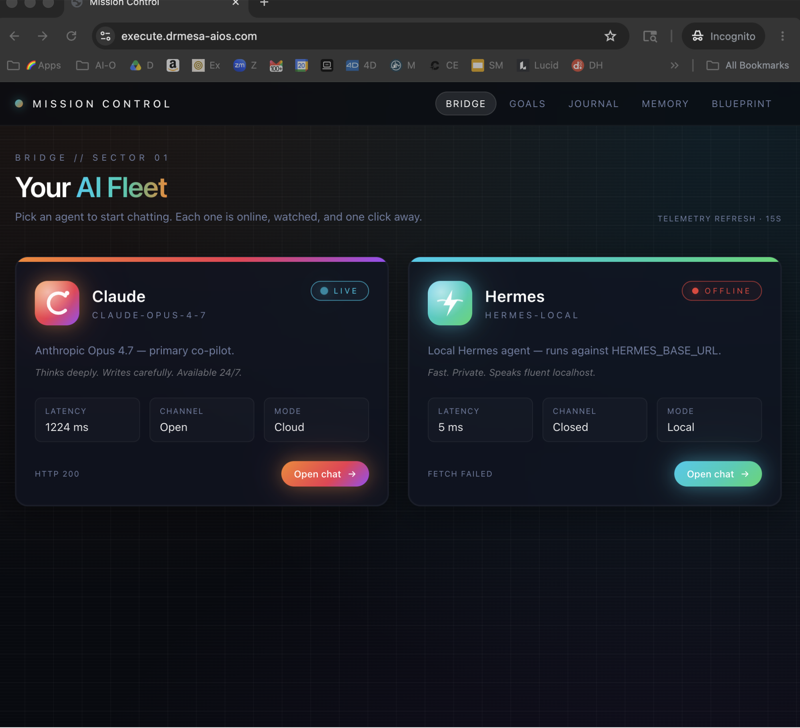
Inside my agentic operating system I let one AI act as the orchestrator, and it delegates the task to whichever system fits.
I did not even install DeepSeek Harness manually — I told Claude to set it up, test it, and wire it in.
That way you get the cheap engine without having to live inside another tool.
🔥 Want the exact orchestrator setup?
Inside the AI Profit Boardroom I show the full Agent OS build — DeepSeek Harness, Hermes and Claude Code running side by side, plus weekly coaching calls with 4,000+ members.
Who should pick which
Pick Claude Code if you are shipping client work, you care about polish, and your context and workflows already live there.
Pick DeepSeek Harness if cost is the constraint, if you want to own your stack, or if you like tools you can take apart.
Pick both if you are running any real volume, because the cost difference is too large to ignore and the quality difference is too obvious to pretend away.
That last option is what we both actually do.
What this comparison really tells you
Twelve months ago, a free open source coding agent that finished a full build in 11 minutes would have been the story of the year.
Now it is a Tuesday.
DeepSeek V4 Pro is a huge step up on the model side, and the harness finally gives that model somewhere to live.
Claude still has a giant head start on output quality, and you can see it in the first ten seconds of looking at the two builds.
But competition is the point here.
If DeepSeek ships something genuinely revolutionary in two or three months, Claude has to answer it.
That is good for everyone reading this.
FAQ
Is DeepSeek Harness better than Claude Code? Not on output quality today. It is faster and far cheaper, and Claude Code still produced the more professional build in our side-by-side test.
How much did the DeepSeek Harness build cost? About 5 cents, from a $10 account top-up, for a full one-page 3D animated website plus a working Tetris game.
Why did DeepSeek use 483,000 tokens? It is a very verbose model. Claude was at 48,000 tokens at the 20-minute mark on the same prompt, so DeepSeek burns roughly ten times more — but at about a 57th of the price.
Is DeepSeek Harness free? The harness itself is free and open source. You still need a model plugged into it, and you can use a free brain like OpenCode instead of paying for API access.
Should I switch from Claude Code to DeepSeek Harness? Not wholesale. Move high-volume or throwaway tasks across, keep client-facing work on Claude, and let an orchestrator decide which one runs each job.
What the harness actually is
A lot of people hear "DeepSeek Harness" and assume it is a model.
It is not.
The harness is the thing that sits around a model and lets it do work — read your files, run commands, change code, search the web, and keep going without you babysitting each step.
The model is the brain. The harness is the body.
That distinction is the whole reason this launch mattered more than the usual model release.
DeepSeek shipped V4 Pro and a harness at the same time, so the model finally had somewhere to live.
And because the harness is open source, the brain inside it is your choice.
You can run DeepSeek V4 Pro, which is what we tested.
You can run something free instead, and OpenCode works as a free brain inside the harness, which takes your running cost to nothing.
You can also just code inside it directly, because the interface is right there.
Compare that with a closed product where the model, the pricing and the roadmap are all decided for you.
That is why 105,000 people starred it in two days, and it is a better reason than any benchmark.
The setup shortcut most people miss
Here is the part I would actually push you towards.
You do not have to learn DeepSeek Harness to benefit from it.
I did not install it by hand.
I told Claude to set it up, test it, and wire it into my system, and it did the whole job.
That is the pattern: use the expensive, reliable agent as the installer and the orchestrator, and let it stand up the cheap one for you.
Once it is wired in, you never open it.
You send the task to your orchestrator, and the orchestrator decides whether this job is worth Claude's tokens or whether DeepSeek should take it.
That is how you get the cost saving without the learning curve, and without adding yet another app you have to remember to check.
It also means the day a better harness launches — and one will — you swap the engine and keep the workflow.
Three jobs worth moving across today
If you want something concrete to try this week, start here.
First drafts of anything. The first attempt is nearly always wrong, so pay as little as possible for being wrong. At around 5 cents a build, three bad attempts still cost less than a coffee.
Bulk generation. Page scaffolds, boilerplate components, repetitive variations. This is exactly where an 11-minute turnaround and a near-zero price compound into real output.
Experiments you would otherwise skip. The ideas you never test because the token bill makes them feel wasteful. Those become free.
What should not move is anything a client opens.
Our test made that obvious: the Claude build referenced context it was never given and looked like a real business site, while the DeepSeek build looked like a template with a cartoon bolted on.
Keep the polish where the polish is paid for.
About Julian
I'm Julian Goldie — AI entrepreneur, SEO expert, and founder of the AI Profit Boardroom (4,000+ members). I help business owners scale with AI agents, automation, and SEO.
- 400K+ YouTube subscribers
- 7-figure AI agency (Goldie Agency)
- Daily training inside the Boardroom
- Author of multiple AI automation playbooks
→ Get my best AI training inside the AI Profit Boardroom
Related reading
The honest deepseek harness vs claude code verdict is that you should run both, and let the cheap one do the work nobody sees.