A Hermes dashboard command is a single instruction — spoken or typed — that tells your Hermes agent to build something, look something up, or open something on your machine, and the dashboard shows you the result.
I say "Jarvis, build me a galaxy I can swirl with my mouse" and about a minute later there's a working 3D galaxy sat in my builds panel.
That's the whole idea, and this guide walks you through setting it up from zero.
What a Hermes dashboard command actually is
A Hermes dashboard command is an instruction you give the agent through the dashboard's voice input or chat box.
The dashboard is the screen in front of you, and the command is what you say or type into it.
Hermes takes that instruction, runs it with its agentic tools, and then puts whatever it produced into the dashboard so you can open it later.
That last part is the bit most people miss.
A normal chatbot answers you and forgets.
A Hermes dashboard command produces an artefact — a webpage, a game, a video, a report — and files it in the builds section where it stays.
I built a habit tracker, a full website, a Japanese flashcard game and a meditation timer this way.
I don't code.
I just said what I wanted and let the agent handle the rest.
🔥 Want the exact setup I used to get these results? Inside the AI Profit Boardroom, I've got a full Agent OS section with step-by-step video tutorials for the Hermes dashboard, the voice layer and the command setup. Plus weekly coaching calls + 2,800+ members building real automations. → Get access here
What the system is built from
There are three parts to the setup, and knowing them makes the install make sense.
Part one is Hermes agent, which is the open source project doing the actual work.
All of its agentic capabilities — file access, browser use, computer use, tool calling — are what turn a command into a finished build.
Part two is ElevenLabs, which generates the voice response.
That's the bit that makes it talk back to you like an assistant instead of printing text.
Part three is Claude, which I use in the background to improve the system itself.
Claude helps me build out the dashboard, write the glue code and come up with ideas for what to add next.
So the honest summary is: Hermes does the work, ElevenLabs does the voice, Claude builds the thing that holds it all together.
| Layer | Tool | What it handles |
|---|---|---|
| Agent brain | Hermes agent (open source) | Running commands, building files, browser + computer use |
| Voice output | ElevenLabs | Speaking the response back to you |
| System building | Claude | Improving the dashboard, writing the integration |
| Memory | Obsidian vault | Logging every conversation and build |
How to set up your Hermes dashboard command system
This is the order I'd do it in if I were starting again today.
Step one is installing Hermes agent itself.
Get the open source project running locally first and confirm it can complete a basic task in the terminal before you add anything on top.
If Hermes can't do the task in a terminal, it won't magically do it through a dashboard.
My Hermes agent installation guide covers this part properly.
Step two is getting the dashboard up.
The dashboard is what gives you the chat box, the history panel, the builds gallery and the model controls in one screen.
You can build your own front end, or you can use the Agent OS setup I ship inside the Boardroom.
Either way the dashboard just needs to talk to your local Hermes instance.
Step three is plugging in ElevenLabs for voice.
You drop in your API key and pick a voice, and every response gets spoken instead of just printed.
You can switch voices later from the dashboard, so don't agonise over the first pick.
Step four is setting the wake word.
I use "Jarvis" and "Hermes" as wake words, so saying either one switches the listener on.
Saying it again switches it off, which matters more than you'd think.
You want it sitting in the background in a kind of wall mode, ready and waiting, not listening to every word you say all day.
Step five is connecting your memory.
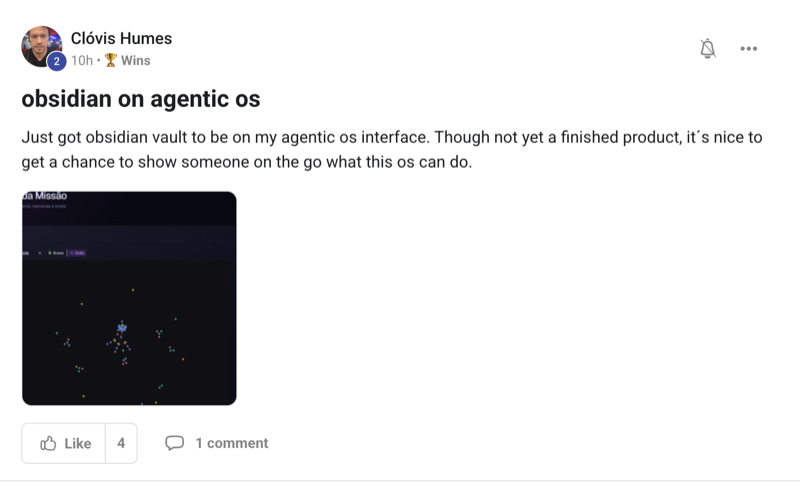
I link my conversations to my Obsidian vault, which I call the memory galaxy.
Everything I do with Jarvis gets logged there and I can go back to it weeks later.
The Hermes second brain setup walks through that link in detail.
The Hermes dashboard commands I actually use
Here are the real commands from my own setup, not invented examples.
"Jarvis, build me a galaxy I can swirl with my mouse."
This is the build command, and it's the one that sells the whole system to people.
It returns "Built and running, sir" and the thing is there, interactive, in the browser.
"Jarvis, what have I been working on this week?"
This is the memory command, and it reads from the logs rather than guessing.
Mine came back with "you've been tinkering with thumbnail work this week, sir" because the thumbnails log showed recent edits.
That only works because the memory layer is connected, which is why step five above isn't optional.
"Jarvis, show me my numbers."
This pulls up the metrics view in the dashboard.
"Jarvis, show me my team."
This one pulls up the agents ready inside the system — Claude, OpenClaw, Hermes, all of them together in one panel.
"Jarvis, open up juliangoldie.com."
This is the computer use and browser use command, and it literally opens the site on your machine.
"Show me everything I've built."
This opens the builds gallery so you can reopen anything from any previous session.
"Jarvis, tell me a joke about AI."
Not useful, but it's the fastest way to check the voice layer is alive before you trust it with real work.
| Command | What it triggers | Which layer does the work |
|---|---|---|
| "Build me a [thing]" | Creates a working file or app | Hermes agentic tools |
| "What have I been working on?" | Reads your activity logs | Obsidian memory link |
| "Show me my numbers" | Opens the metrics panel | Dashboard |
| "Show me my team" | Lists your configured agents | Dashboard + agent registry |
| "Open up [website]" | Launches the browser | Computer use / browser use |
| "Show me everything I've built" | Opens the builds gallery | Dashboard storage |
How to read the dashboard once a command finishes
The dashboard has a few sections and each one earns its place.
The history section shows every conversation you've had, in full.
That's genuinely useful when you half-remember a command that worked and want the exact phrasing back.
The builds section stores everything the agent has ever made for you.
You can view each one, open it, and carry on from where you left off.
This is where my habit tracker, my Japanese flashcard game, my videos and my meditation timer all live.
The model controls let you manage which model is answering and swap it from the dashboard.
The MCP section links Hermes to other tools through MCPs, which is how you extend what a command can reach.
The control room is the wider view of the system.
Goal mode is for when you want the agent chasing an outcome rather than doing one task.
Chat mode is there for when you just want to type at it like a normal assistant.
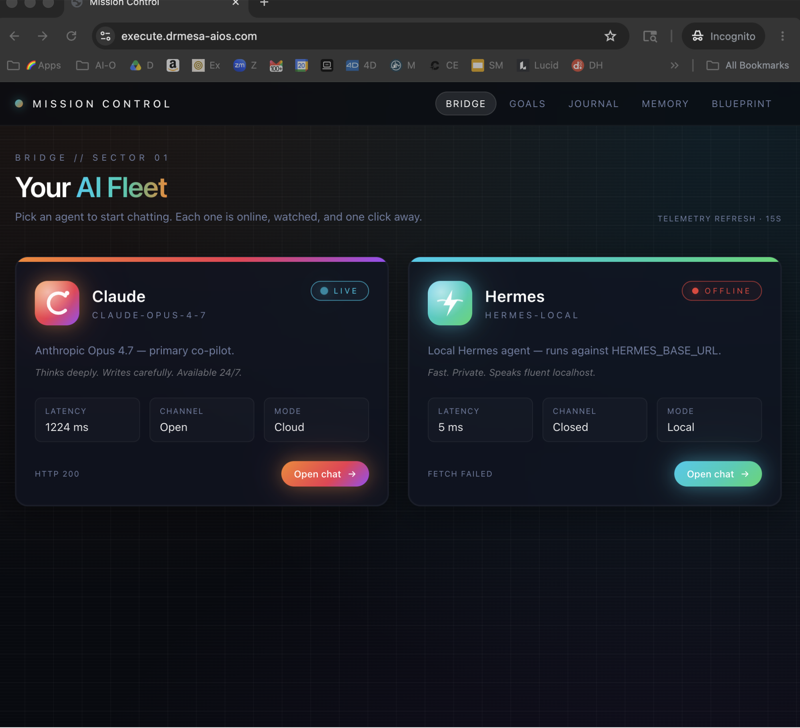
There's also mission control, an agent group chat where Hermes can talk to Claude and Gemini, and Paperclip with AI agent teams built in.
I cover how those fit together in the Hermes agent mission control breakdown.
Auto mode versus agent mode
The dashboard lets you switch between auto and agent mode, and the difference matters for how you phrase commands.
Auto mode is the lighter one, good for quick answers and lookups.
Agent mode is the one you want when the command should produce a build, because it lets the agent take multiple steps and use its tools properly.
If a build command comes back with just an answer instead of a file, check which mode you're in first.
That's the single most common reason a command "doesn't work" for people.
Tips and gotchas nobody tells you
It doesn't always work, and I'd rather say that than pretend.
Sometimes it isn't smooth, sometimes the command misfires, sometimes the voice trips over itself.
The power of it still blows my mind, but go in expecting a build you're improving daily rather than a finished product.
Be specific about the interaction, not just the object.
"Build me a galaxy" is fine, but "build me a galaxy I can swirl with my mouse" is what got me something I actually wanted to play with.
Turn the wake word off when you're recording or on calls.
Wall mode is brilliant until it hears itself.
Check the memory link before trusting a memory command.
If the logs aren't syncing, the agent will answer from thin air rather than from your week.
Don't treat this as your main production workflow on day one.
For getting real work done fast, I still lean on something like Paperclip or a structured agent team.
The voice dashboard is the best party trick I've got with AI, and increasingly it's more than that — but be honest with yourself about which job you're using it for.
🔥 Want my full Hermes dashboard command setup? The complete Agent OS build — dashboard, voice layer, wake word config, prompts and the install zip — is inside the AI Profit Boardroom. It's updated daily, with new tutorials added as I improve the system. → Get the Agent OS here
What I'd build with it first
If you've just got this running, don't start with a galaxy.
Start with something you'll actually reopen.
Ask it to build a habit tracker for whatever you're trying to stick to this month.
Ask it for a flashcard game for something you're learning.
Ask it what you worked on last week and see whether the memory link is telling you the truth.
Then push it — ask for a full one-page website and see how far a single command gets you.
Let's be honest: this is the worst this technology is ever going to be.
The commands only get better from here.
FAQ
What is a Hermes dashboard command?
It's an instruction you speak or type into the Hermes dashboard that makes the agent do something — build a file, read your logs, open a website, or list your agents. The result gets saved in the dashboard so you can reopen it later.
Do I need to code to use Hermes dashboard commands?
No. I don't code, and I built a habit tracker, a full website, a flashcard game, videos and a meditation timer purely through commands.
What do I need to install for the voice part?
ElevenLabs handles the voice response. You add your key, pick a voice, and you can switch voices from the dashboard afterwards.
Can I type commands instead of speaking them?
Yes. The dashboard has a chat box, so you can type any command you'd normally say. I often leave the wake word off and type instead.
Why did my Hermes dashboard command not build anything?
Nine times out of ten you're in auto mode rather than agent mode, so the agent answered instead of running its tools. Switch modes and run the command again.
Where do finished builds go?
Into the builds section of the dashboard. Every website, game, tool and video the agent has made stays there and can be reopened any time.
About Julian
I'm Julian Goldie — AI entrepreneur, SEO expert, and founder of the AI Profit Boardroom (2,800+ members). I help business owners scale with AI agents, automation, and SEO.
- 400K+ YouTube subscribers
- 7-figure AI agency (Goldie Agency)
- Daily training inside the Boardroom
- Author of multiple AI automation playbooks
→ Get my best AI training inside the AI Profit Boardroom
Also On Our Network
- 🌐 Read on aiprofitboardroom.com
- 🌐 Read on juliangoldieaiautomation.com
- 🌐 Read on aisuccesslabjuliangoldie.com
- 🌐 Read on aimoneylabjuliangoldie.com
Related reading
- What is the Hermes Agent OS dashboard? — the full dashboard tour.
- Hermes voice agent setup — the voice layer in detail.
- Best Hermes agent dashboard — which dashboard to run.
Get the setup right and every Hermes dashboard command becomes something you can open again a month later.
📺 Video notes + links to the tools 👉