If you want a private AI agent that costs nothing to run, learning how to install hermes free ai model locally is the fastest way to get there. This guide walks you through running Hermes — the AI agent built into Julian Goldie's Agent OS — on a completely free model that lives on your own machine. No monthly API bill, no data leaving your laptop, and full control over how your agent thinks and works.
📺 Watch: Run Hermes Agent FREE With This NEW Model 🤯
🔥 Get the Agent OS as a free bonus: AI Profit Boardroom members get the full Agent OS zip, prompt libraries, daily tutorials and weekly live coaching calls. → Get inside
Julian has spent 10+ years in SEO and AI automation, built a community of 75,000+ members, and shares this stuff with 411,000+ YouTube subscribers. The setup below is the same lightweight approach he recommends for anyone who wants an always-available agent without paying per token. It is beginner-friendly, and there is no coding involved.
Why Run a Free Local AI Model for Hermes?
Before the steps, it helps to know why local matters. There are three big reasons, and they build on each other.
- Cost. Cloud models charge per token. Run enough missions and that adds up fast. A local model is free to run once it is downloaded — you can hammer it all day for nothing.
- Privacy. When the model runs on your machine, your prompts, files, and notes never leave your device. Nothing is sent to a third-party server, which matters for client work and anything sensitive.
- Control. You choose the model, you keep it offline, and you are not exposed to sudden price changes, rate limits, or a provider deprecating the version you rely on.
The trade-off is simple: a local model uses your own hardware, so a faster machine gives you faster answers. For most day-to-day agent tasks, a mid-range laptop handles it fine.
What You Need Before You Start
You do not need much. Here is the short checklist.
- A computer with at least 8GB of RAM (16GB is more comfortable for larger models).
- Around 5–10GB of free disk space per model you download.
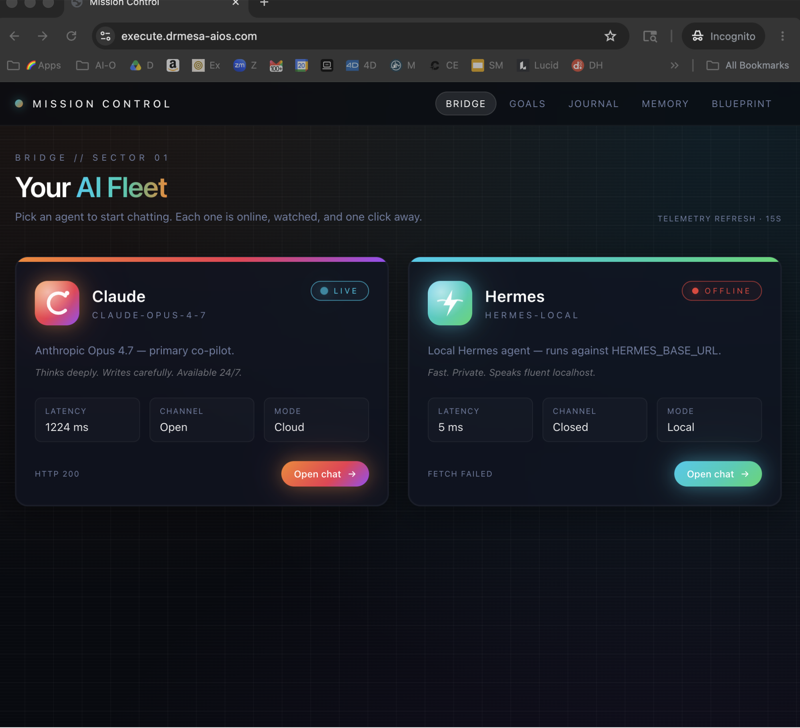
- Hermes installed as part of your Agent OS.
- Ollama, a free tool that runs open models on your own machine.
That is the whole list. No credit card, no account, and no API key to manage.
How to Install Hermes Free AI Model Locally: Step by Step
Follow these four steps in order. The whole thing usually takes under 20 minutes, and most of that is just the model downloading in the background.
Step 1: Install Ollama
Ollama is the engine that runs your free model. Go to the official Ollama website, download the version for your operating system (macOS, Windows, or Linux), and install it like any normal app. Once installed, it runs quietly in the background and exposes a local endpoint on your machine that Hermes can talk to.
Step 2: Pull a Free Model
With Ollama installed, you "pull" a model — meaning you download it once so it lives locally. Ollama offers a library of free, open models in different sizes. Smaller models download faster and run on lighter hardware; larger ones are more capable but need more memory. Pick one to start, and you can always add more later.
Step 3: Point Hermes at Your Local Model
Now connect the two. In your Agent OS settings, tell Hermes to use your local Ollama endpoint instead of a cloud provider. You point it at the local address Ollama serves and choose the exact model name you pulled in step 2. Save the config, and Hermes will route its thinking through the free local model.
Step 4: Run a Test Mission
Give Hermes a small job to confirm everything is wired up — something like summarising a short document or drafting a quick outline. If it responds using your local model, you are done. If it stalls, check that Ollama is running and that the model name in Hermes matches exactly what you pulled.
📺 Watch: Run Hermes Agent FREE With This NEW Model🤯
Which Free Models Work Well
There is no single "best" free model — it depends on your hardware and the kind of missions you run. As a rough guide:
| Model size | Good for | Rough hardware |
|---|---|---|
| Small (a few GB) | Quick drafts, simple tasks, older laptops | 8GB RAM |
| Medium | Most general agent work, balanced speed and quality | 16GB RAM |
| Large | Heavier reasoning and longer context | 32GB+ RAM |
After his own hands-on Goldie Bench testing, the free model Julian reaches for is a mid-sized general-purpose model like Llama or Mistral — enough quality for real agent work without needing a powerful machine. That is his preference from putting them through actual missions, not a universal ranking, so test a couple on your own setup and keep whichever feels best for your tasks.
📺 Watch: Run Hermes Agent FREE With This NEW Model 🤯
Local vs VPS: Where Should Hermes Live?
Running Hermes and your model locally is the most private and secure option — everything stays on hardware you own and control. That is the setup worth starting with for most people, especially if you handle client data.
The one limitation is that a local machine has to be switched on for the agent to work. If you want Hermes running around the clock — for example, to handle scheduled missions overnight — a VPS (a small always-on cloud server) is a reasonable option. You install Ollama and your model there instead. You give up a little of the "never leaves my device" privacy, but you gain an agent that is always awake. For sensitive work, keep it local; for always-on automation, a VPS is worth considering.
If you want the free Hermes + local model setup done for you, check out the AI Profit Boardroom — the complete Agent OS build with Hermes is waiting inside, alongside 75,000+ members putting it to work. → Get Hermes set up the easy way
Tips for a Smooth Setup
- Start small. Confirm the pipeline works with a lighter model, then upgrade to a bigger one once you know it connects.
- Keep Ollama updated. New versions bring better performance and access to newer models.
- Free up memory. Close heavy apps while running larger models so the machine has room to breathe.
- Match the name exactly. A mismatched model name in Hermes is the most common cause of a failed connection.
- Test before you commit. Try two or three models on real missions before settling on your default.
Frequently Asked Questions
Is it really free?
Yes. Ollama and the open models are free to download and run. Your only cost is the electricity and the hardware you already own.
Do I need to be technical?
Not really. If you can install an app and paste a model name into a settings field, you can do this. There is no coding required at any point.
Will a local model be as good as a cloud one?
For many everyday agent tasks, a good mid-sized local model is more than enough. The largest cloud models still lead on the hardest reasoning, but you may be surprised how capable free local models have become.
Can I switch back to a cloud model later?
Absolutely. Hermes lets you change which model it uses, so you can keep a free local model for private or routine work and switch to a cloud model when you want maximum power.
What if Hermes will not connect?
Check three things: Ollama is running, the model has finished downloading, and the model name in Hermes matches it exactly. That fixes the vast majority of issues.
The Bottom Line
Now you know how to install hermes free ai model locally: install Ollama, pull a free model, point Hermes at it, and run a test mission. That is the whole flow, and it gives you a private, low-cost, fully controlled AI agent that answers to you and no one else.
Keep it local for the best privacy, or move to a VPS if you need it always on. Start with a smaller model, test a couple of options on real work, and let Hermes take it from there. The people getting the most out of AI are not the ones paying the biggest bills — they are the ones who own their setup and put it to work.