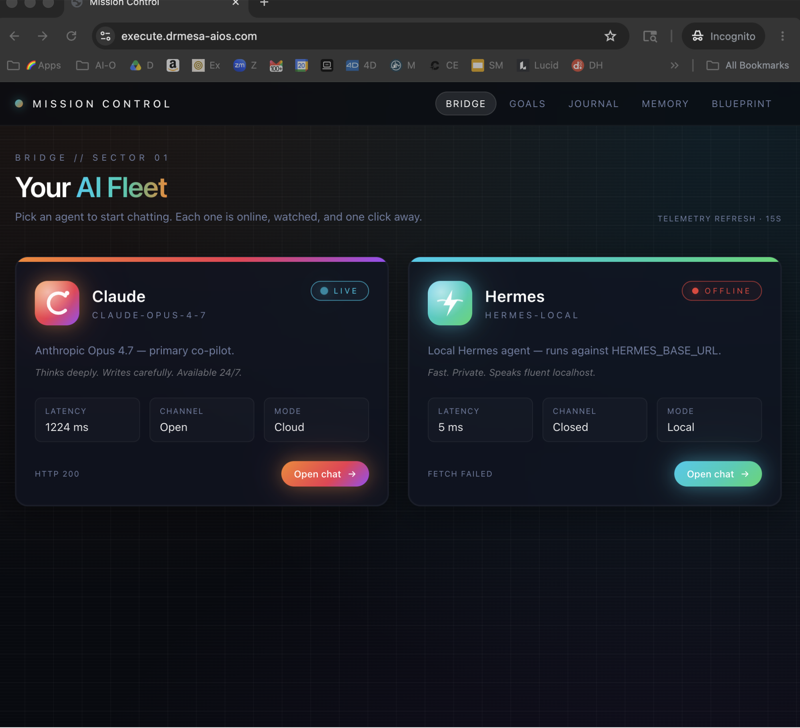
Hermes Workspace v2 is the free open-source mission control that turns Hermes from a terminal tool into a proper AI command centre. If you've been running Hermes in the terminal, this changes everything about your daily workflow.
This post covers what Hermes Workspace v2 is, the chat, terminal, memory, skills, and inspector features, how to install it (local plus Docker options), and why it beats the standard Hermes dashboard.
What Hermes Workspace Is
Imagine your Hermes AI agent. Now imagine giving it a proper home — not just a chat window, but a full command centre. That's Hermes Workspace.
It's free, open source, and provides a native gateway where you can chat with your AI, run terminal commands, browse files, manage memory, and control 2,000+ skills, all from one screen. Think ChatGPT or Claude Desktop, but way more powerful because it's running your actual Hermes agent underneath.
What V2 Adds
Hermes Workspace just got v2, with a meaningful set of new features.
You get a native gateway you can speak to your AI agents through online. Chat, terminal, memory, skills, and inspector are all integrated. The mission control style dashboard organises everything visually. Sub-agent orchestration lets you coordinate multi-agent setups. The profile system makes managing multiple agents practical.
If you used the v0.9 Hermes dashboard, v2 is a major upgrade because it adds chat-with-agent that v0.9 doesn't have at all.
Two Install Options
You can run Hermes Workspace two ways. The Docker option runs siloed in a container with cleaner separation from your machine. The local option runs directly on local host with easier integration to your existing Hermes setup. Most users go local for simplicity.
How To Install
Six steps to get Hermes Workspace running.
Step one is opening Hermes — use your existing Hermes setup, or follow How To Setup Hermes Agent if you don't have one. Step two is asking Hermes to install Workspace by typing "Can you set up Hermes Workspace?" in your Hermes chat. Hermes guides you through. Step three is picking local or Docker — choose local for the simplest setup. Step four is waiting for the install, which takes a few minutes. Sometimes it needs Claude Code to help if the terminal install fails — see Free Claude Code. Step five is opening the local URL once installed, where you'll see the Hermes Workspace UI. Step six is connecting to the Hermes gateway by configuring it to point at your Hermes setup if it doesn't auto-connect.
Local Models Support
Hermes Workspace works with cloud models (Claude, GPT, Gemini, etc), local models via Ollama, and Atomic Chat for local model running. You switch between providers seamlessly inside Workspace, which means one UI handles everything.
For local model setup, see Ollama Hermes.
🔥 Want my full Hermes Workspace setup? Inside the AI Profit Boardroom, I share my Hermes Workspace setup, configs, and 30-day road map. Plus 2-hour Hermes course and weekly live coaching where you can share your screen for help. 3,000+ members. → Get the setup
Key Features
Hermes Workspace v2 ships with seven features that combine to make it a real workspace rather than just a UI shell.
The first is chat — speak directly to your Hermes agent inside the UI, which is way nicer than terminal. The second is memory, where you can edit and manage memory, add new memories, and switch between memory profiles. The third is skills, with 2,000+ ready-to-use skills you can toggle on and off in the UI plus custom skills you can add. The fourth is a file manager for browsing, editing, and managing files. The fifth is the terminal, still available if you prefer CLI. The sixth is themes, with 8 different visual themes to pick from. The seventh is multi-device support — works on Mac, PC, iPhone, and Android as a progressive web app with the same experience everywhere.
Profile System For Multi-Agent
Hermes Workspace supports profiles, which means multiple AI agents in the same setup. For each agent you configure sessions, skills, context, and memory separately, and you can activate, switch, and delete profiles as needed.
This is way easier than managing agent profiles in the terminal where every change means editing config files.
Virtual Office View
Hermes Workspace has a "virtual office" view that lets you see your agents working together. You can switch between round table view, grid view, and office view depending on preference.
For visual people, this is fun. For practical people, it shows agent status at a glance and helps you spot stuck agents quickly.
Kanban Task Board
Workspace has a Kanban-style task board where you assign tasks to agents and track them through Backlog, To Do, In Progress, Review, and Done columns. You move tasks between columns and agents work the assigned tasks in the background.
I cover broader workflows in Hermes Agent Workspace.
Hermes Workspace v0.9 Vs v2
Quick comparison between the two versions.
v0.9 (Hermes default mission control) gives you sessions and analytics, scheduled tasks, config files, and skills setup, but no chat with agents. v2 (Hermes Workspace) gives you all of the above plus chat with agents, multi-profile management, the virtual office view, the Kanban task board, and multi-device plus phone access.
For most users, v2 is the obvious upgrade.
Common Setup Issues
Three issues that come up most often.
The first is connection error on first launch. Workspace needs the Hermes gateway running, so make sure Hermes is up before opening Workspace. The second is local URL not loading. Check the install completed and restart if needed. The third is needing help mid-install — use Claude Code or Hermes itself to debug, because both communicate well with Workspace.
What Hermes Workspace Doesn't Do
Honest about the limits.
It doesn't replace Hermes itself — it's a UI on top. Some advanced settings still need terminal or config edits. The mobile experience is good but not quite as polished as desktop.
For 95% of Hermes users, it's the better daily driver.
Daily Reality
What it looks like in daily use. Open Hermes Workspace in your browser or app, chat with your agent in the chat panel, toggle skills as needed, manage memory, track tasks on the Kanban board, and switch between agent profiles.
Used to need 5 different terminal windows. Now lives in one app.
🚀 Want my full Hermes Workspace playbook? The AI Profit Boardroom has my Workspace setup, 2-hour Hermes course, OpenClaw 6-hour course, daily training, weekly live coaching. 3,000+ members. → Join here
FAQ — Hermes Workspace
Is Hermes Workspace free?
Yes — fully free, open source.
Does it work with local models?
Yes — Ollama, Atomic Chat, others all work.
Can I run on my phone?
Yes — installs as progressive web app.
Will my existing Hermes setup work?
Yes — Workspace picks up your existing config.
What's the difference vs Hermes v0.9?
v0.9 is the default Hermes dashboard. Workspace v2 adds chat plus multi-profile plus Kanban.
Can I run multiple agents?
Yes — profile system supports many.
Is there a paid tier?
No — fully free.
Related Reading
- Hermes Agent Workspace — broader Workspace overview.
- Hermes Swarm — multi-agent inside Workspace.
- How To Setup Hermes Agent — install foundation.
📺 Video notes + links to the tools 👉
🎥 Learn how I make these videos 👉
🆓 Get a FREE AI Course + Community + 1,000 AI Agents 👉
Hermes Workspace v2 is the free mission control your Hermes setup needs — install today and run your AI agents from a real UI instead of a terminal.