The Julian Goldie avatar is one of the most-asked questions I get on YouTube, and this 2026 guide breaks down exactly what it is, how it works, and how you can build one for your own content stack. The short version is that an AI-generated version of me records most of my videos now, the workflow is fully automated, and the whole stack costs less than £50 a month to run.
This post covers what an AI avatar actually is, the exact tools in my stack, how to build your own in under 30 minutes, and how to automate the entire content pipeline so videos ship daily without you ever sitting in front of a camera.
🔥 Want the full Julian Goldie avatar process? AI Profit Boardroom has the complete HeyGen + 11Labs + n8n automation walkthrough plus weekly live coaching. → Get the full process
What The Julian Goldie Avatar Actually Is
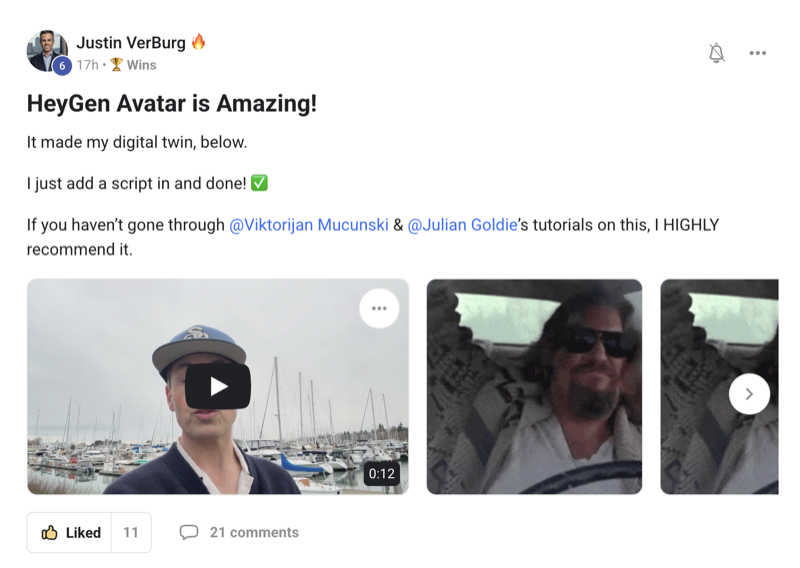
An AI avatar is a digital version of you that can speak in your cloned voice, reproduce your facial expressions, say anything you type, and record content 24/7 without you ever being on camera. The video at the top of this post is delivered by my AI avatar, which gives you a sense of how convincing the current generation has become.
Done well, an avatar is indistinguishable from a real recording for casual viewers, while giving you the ability to ship at a pace that simply isn't possible if you're recording everything yourself.
The Tools In The Julian Goldie Avatar Stack
Three core tools handle the entire pipeline.
HeyGen is the avatar engine. It trains on a 30-second video of you and outputs unlimited videos in your likeness, with surprisingly good results given how simple the training step is. 11Labs is the voice clone — a few minutes of audio gives you a scary-accurate voice replica that even people who know me well struggle to distinguish from the real thing. n8n is the automation orchestrator that glues research, script writing, avatar rendering, and distribution into one end-to-end pipeline.
Together those three tools cover everything from "I have an idea for a video" to "the video is live on YouTube" without manual intervention.
Watch The Walkthrough
Setup In Under 30 Minutes
The full setup takes three steps and well under an hour for most people.
The first step is recording the HeyGen training video, which takes 30 seconds of you looking at the camera and talking casually with decent lighting. Upload to HeyGen and roughly 10 minutes of processing later your avatar is live and ready to use. The second step is recording the 11Labs voice clone, which takes 3-5 minutes of reading the provided script. Upload it and the voice clone is ready in minutes. The third step is connecting them together — in HeyGen settings, attach your 11Labs voice ID, and now your avatar speaks in your real voice rather than the generic HeyGen default.
That's the whole setup. Anyone can do it in an afternoon.
Automating The Full Content Pipeline
The full pipeline has five layers that run end-to-end with no human touch required after the initial setup.
The first is the research agent, where n8n plus Firecrawl scrapes Reddit and Twitter for trending topics in your niche each morning. The second is the script writer agent, which takes the research output and writes a plain-text video script in your style and voice. The third is the HeyGen avatar render, where the script gets sent to HeyGen and a finished video comes back. The fourth is auto-publish, where tools like Blow Auto upload the rendered video to YouTube, TikTok, Instagram, and LinkedIn simultaneously. The fifth is engagement monitoring, where the system tracks which videos perform and feeds that data back to the script agent so future scripts get better over time.
End-to-end, this pipeline runs with zero human touch once it's set up.
Why This Matters In 2026
Three reasons this is suddenly a winning strategy rather than an experimental gimmick.
The first is that the content barrier has effectively vanished. Anyone can ship daily videos now, which means the differentiator has moved from equipment and production quality to system and speed. The second is 24/7 production — your avatar publishes while you sleep, on weekends, and during holidays without missing a beat. The third is that one person can now run a 5-channel content operation single-handedly, which used to require a full team of editors, producers, and content strategists.
What You Can Use AI Avatars For
Six common use cases I've seen work in production.
Daily YouTube uploads without showing your face every day are the obvious one and the highest-volume use case. Course and coaching content delivery at scale is another big win, especially for cohort-based programmes. Product demos for ecommerce and SaaS companies work brilliantly because the avatar can demo a product without needing to schedule someone. Testimonial content (synthetic but always disclosed) lets you prototype social proof before you have real testimonials. Multi-language content lets you take one script and ship it in five languages with the same avatar speaking each. Niche channels let you run multiple personas across different niches without spreading yourself thin.
Cost Of The Stack
The economics are part of why this works.
HeyGen starts at £19/month, 11Labs starts at £4/month, and n8n is either free if you self-host or £20/month on their cloud tier. Total stack cost lands around £25-50/month depending on your usage.
Compare that to the alternatives. A full-time video editor costs £400-2,000/month for the volume the stack handles. Hiring a content creator for the same output runs £2,000-5,000/month. The avatar stack is dramatically cheaper while shipping more content than either alternative.
Common Mistakes
Three mistakes I see people make when setting this up.
The first is using a bad training video. Garbage in, garbage out — make sure you have good lighting, a stable camera, and at least 30 seconds of natural-looking footage. The second is skipping the voice clone and using the default HeyGen voices. The defaults feel robotic and immediately tank the quality of the output, so always clone your own voice. The third is skipping disclosure. Always disclose AI avatar use in your videos — transparency builds trust, and getting caught not disclosing is a brand-killer.
Quality Control
Three rules to maintain quality once the pipeline is running.
Always preview before publishing. Watch the avatar render before it goes live, because occasionally something goes wrong and you don't want that on your channel. Tweak scripts for AI delivery, because avatars handle short, punchy sentences better than long meandering ones. Iterate weekly on what's working — track performance, adjust your style, hooks, and length based on what your audience actually engages with.
🚀 Want the full automation walkthrough? AI Profit Boardroom has the complete HeyGen + 11Labs + n8n setup video plus weekly live coaching. → Get the walkthrough
Real Time Saved
From running this stack daily, the time savings are dramatic.
Recording takes 0 minutes because the avatar handles it. Editing takes 5-10 minutes for any final polish. Distribution is fully automated. Total human time per video is 10-15 minutes.
Compare that to traditional video production where recording, editing, and posting takes 60-120 minutes per video. That's roughly a 10x productivity gain, which compounds dramatically over the course of a year.
Ethical Considerations
Three principles to follow if you want to use avatars without burning trust.
Always disclose. Add a line like "this video features my AI avatar" to your description or pin it in the comments. Don't deceive — avatars are tools for scaling production, not for impersonating you in conversations or making it seem like you said something you didn't. Stay in your lane and don't put words in your AI mouth that would harm the trust your audience has built with you.
Multi-Avatar Strategy
The advanced play is running multiple avatars across different angles.
You can run different avatars per niche, with one avatar dedicated to each channel and brand. You can run different formats from the same avatar — long-form face-to-camera content for YouTube, short TikTok-style content for vertical platforms. You can run different languages, taking the same content and shipping it in multiple markets simultaneously.
I cover the full multi-avatar strategy in the Boardroom course.
What AI Avatars Won't Do
Honest about the limits.
Avatars won't replace human creativity — you still need ideas, angles, and strategy that come from real thinking. They won't replace genuine connection through live calls, DMs, and in-person meetups, which still matter for deep audience trust. They won't replace storytelling judgement, because avatars deliver but you decide what's worth delivering.
The Compounding Effect
Daily uploads multiplied by an AI avatar produce genuinely compound growth over time.
In month one you ship 30 videos. By month six you've shipped 180. By the end of year one you've shipped 365+ videos. Without an avatar, most creators ship 30-50 videos in a year, which means the avatar approach delivers roughly 10x the output. That output gap translates into exponential audience growth because every video is a new chance to reach someone new.
My Daily Avatar Routine
Here's what a typical day looks like in my avatar pipeline.
At 7am the research agent runs and pulls trending topics. At 8am the script agent generates the day's video script. At 9am I review and tweak the script for about five minutes. At 10am HeyGen renders the video. At 11am auto-distribution publishes to all channels.
Total human time is 10-15 minutes per day, and the output is a daily video across YouTube, TikTok, Instagram, LinkedIn, and X.
When AI Avatars Fit Your Business
Avatars fit if you hate being on camera, need content at scale, want to test multiple niches without spreading thin, or can't afford a video editor on a regular salary.
Avatars are riskier if you have a strong on-camera personal brand where the audience explicitly expects the raw, unfiltered you. In that case, use avatars sparingly and always disclose clearly.
FAQ — Julian Goldie Avatar
Is the avatar really me?
It's an AI clone trained on a 30-second video of me, with the voice cloned from my real voice. So it looks and sounds like me but isn't me speaking in real time.
How long does it take to make one?
The setup is 30-60 minutes for most people, including training video and voice clone.
What does it cost?
Around £25-50/month for the full stack, depending on your volume.
Will viewers notice?
Increasingly less as the technology improves. Disclose anyway — trust matters more than the technical question of "did they notice."
Can I sell avatar setup as a service?
Yes — £500-2,000 per setup is typical pricing for this kind of done-for-you service.
Best avatar tool in 2026?
HeyGen still leads the market for quality and ease of use.
Can I run multiple avatars?
Yes — different niches, languages, and formats are all supported and a common scaling pattern.
Also On Our Network
- 🌐 Read on aiprofitboardroom.com
- 🌐 Read on juliangoldieaiautomation.com
- 🌐 Read on aisuccesslabjuliangoldie.com
- 🌐 Read on aimoneylabjuliangoldie.com
Related Reading
- Hermes Agent Goals — autonomous content creation.
- Claude Code SEO Agent — content automation.
- AI Profit Boardroom Inside — full avatar process.
📺 Video notes + links to the tools 👉
🎥 Learn how I make these videos 👉
🆓 Get a FREE AI Course + Community + 1,000 AI Agents 👉
The Julian Goldie avatar stack is the highest-leverage content tool of 2026 — set it up this week and watch your output 10x.