The Hermes AI agent framework just hit 106,000 GitHub stars in 2026, and this guide is everything I know about using it after hundreds of hours of testing across my own businesses. By the end of this post, you'll know how to install Hermes through both one-click and manual paths, how to give it personalised context (the missing piece most users skip), how to build agent teams that actually work, how to use Hermes Workspace and Mission Control, and how to scale with four advanced setups.
This is the practical playbook rather than the marketing tour, so expect specifics rather than vague promises.
🔥 Want my full Hermes framework playbook? AI Profit Boardroom has my Hermes 2-hour course + 6-hour OpenClaw course + weekly live coaching. → Get the playbook
Why The Hermes AI Agent Framework 2026 Wins
Hermes is the agent I run daily because it's free, open source, and the most reliable AI agent I've tested over the past year — noticeably less buggy than OpenClaw across the same workloads. With 106,000 GitHub stars, it has the biggest community of any open-source agent framework right now, which means the ecosystem of skills, integrations, and community fixes moves faster than anywhere else.
It works with any LLM you want to point it at, whether that's local Ollama models for privacy or cloud APIs for raw power. And it's built by News Research, one of the most respected AI labs in the space, which gives me confidence the foundation will keep being maintained rather than abandoned.
For 2026, Hermes is the foundation framework I build everything else on top of.
Watch The Full Walkthrough
Here's the full walkthrough that covers everything I'll discuss below.
That covers everything I know about Hermes for 2026 in video form, and the rest of this post is the written reference you can keep coming back to.
Step 1 — Setup
Setup has two paths depending on how technical you are.
Quick Install For Technical Users
Grab the install command from the Hermes GitHub, paste it in your terminal, hit enter, and you're done within a minute or two on most machines. If you've used a CLI tool before, this path is the fastest way in.
Non-Technical Install Through An AI
If the terminal isn't your friend, open Claude Code or Codex, paste the GitHub URL, and tell the AI "install this for me" with your operating system. The AI handles the install for you and works through any errors that come up. This trick is covered in more depth in How To Setup Hermes Agent.
Step 2 — Use Cases
Once Hermes is installed, the unlock for getting real value is asking it the right opening question.
After install, ask Hermes: "Knowing what you know about me, how can you help me?" It will return ideas based on whatever context it has, but here's the catch — out of the box it has no context yet, so the suggestions will be generic. This is exactly why the memory step that follows is the difference between a generic Hermes and a personalised one.
Step 3 — Memory (The Killer Step)
Most users skip the memory setup and then wonder why Hermes feels generic. Don't make this mistake — the memory layer is what turns Hermes from impressive to indispensable.
Use Obsidian As Your Vault
Head to obsidian.md, install the free desktop app, and create a vault for your personal context. Obsidian becomes the file-based memory layer that Hermes will read on every prompt.
Use OMI To Capture Memories Automatically
OMI captures memories automatically by listening to your screen and microphone, and it syncs cleanly to Obsidian so the memory layer fills itself over time without you having to type notes manually. I cover the full setup in Hermes Second Brain.
Point Hermes At The Vault
Once Obsidian and OMI are running, tell Hermes: "Use my Obsidian vault for memory. Path: [your-path]." Hermes now reads your context on every prompt, and the quality of the outputs jumps roughly 10x because the agent finally knows who you are and what you're working on.
Watch The Memory Setup
Here's the full second brain walkthrough showing how the memory pieces fit together.
The video walks through Obsidian, OMI, and the Hermes memory configuration end-to-end.
Step 4 — Agent Teams
Once a single Hermes agent is working well, the next leverage step is scaling to teams of agents working in parallel.
Option 1 — Hermes Workspace
Hermes Workspace is the official mission control with built-in agent team support, and it's the easiest entry point for most users. The full walkthrough is in Hermes Workspace.
Option 2 — Paperclip
Paperclip is a community-built agent team setup specifically designed for Hermes, with a tighter focus on team coordination than Workspace.
Option 3 — Multica
Multica is a multi-agent management layer that gives you finer-grained control over how agents coordinate and hand off tasks to each other.
Option 4 — Multiple Profiles
For the simplest possible teams, just run multiple Hermes profiles simultaneously with different system prompts and memory layers. This works surprisingly well for basic parallel workflows.
For most users, Hermes Workspace is the easiest entry to teams because everything is built-in.
Watch The Workspace + Teams Setup
Here's the Workspace and multi-agent walkthrough covering the team setup in detail.
This covers mission control plus the multi-agent setup end-to-end.
Step 5 — Hermes Dashboard
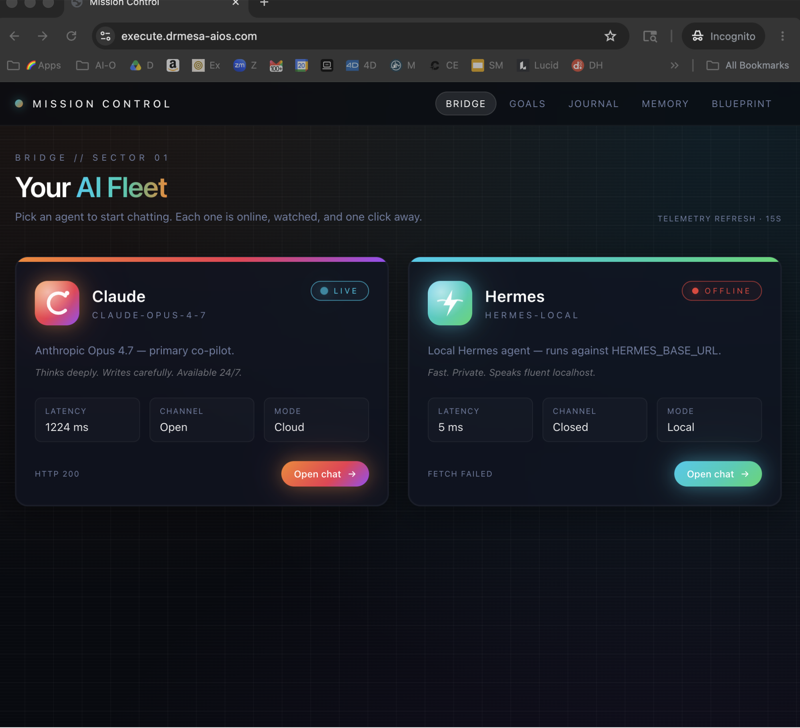
The Hermes Dashboard is the v0.9 mission control feature and gives you a single pane of glass for managing your entire Hermes setup.
Type Hermes dashboard in your terminal and a local-host UI opens with all your sessions, analytics and token usage, cron jobs for scheduled tasks, skills management, and configuration plus memory setup all in one place. For a broader OpenClaw-style mission control comparison, see OpenClaw Mission Control.
🚀 Want guided Hermes setup? AI Profit Boardroom has weekly live coaching where I'll set up the full Hermes framework with you on a screen-share. → Join here
Step 6 — Schedule Tasks
Scheduled tasks are where Hermes earns its keep because they run 24 hours a day without you having to babysit them.
A few examples of what I have running right now: "Every morning at 8am, summarise overnight news in my industry." "Every Monday, pull weekly metrics across my businesses and post them to Slack." "Hourly, check my inbox for urgent items and surface anything that needs a same-day response." These run without any manual intervention, which is the whole point.
This is where Hermes stops being a tool and starts being a team member.
Step 7 — Skills
Skills are saved automations you call by name when you need them, and they compound the longer you use Hermes.
Examples I use daily include: "Use the SEO skill to write and publish a blog post on [topic]." "Use the research skill to deep-dive [topic] and produce a briefing document." "Use the customer support skill to draft replies to my pending tickets." The more skills you build, the more leverage you stack up over time, which is why I treat skill creation as one of the highest-ROI activities inside Hermes.
Step 8 — One-Click Setups
If you're non-technical and want to skip setup pain entirely, there are two one-click options worth knowing about.
Ollama Option
Run ollama launch hermes and you have free local models running with Hermes in a single command — no terminal acrobatics required. This is the cheapest path to a working setup.
Max Hermes Option
Head to agent.mminia.io for a paid hosted option with literally zero setup — sign up, log in, and you're using Hermes in your browser. For absolute beginners who want to skip all installation, this is the easiest path of all.
What Makes Hermes 106K-Stars Worthy
There are three structural reasons Hermes has run away with the open-source agent space.
1 — Reliability
Hermes is significantly less buggy than OpenClaw and most alternatives I've tested, which matters enormously when you're relying on agents for daily production work rather than just experimentation.
2 — Flexibility
Hermes works with any LLM, whether local through Ollama or cloud through Anthropic, OpenAI, or any major provider. You're not locked into a specific model vendor.
3 — Active Community
Built by News Research and supported by an unusually active open-source community, the contribution velocity means Hermes keeps improving while many competitors stagnate. These three properties compound to make Hermes the default daily driver in 2026.
Hermes Vs Other 2026 Agents
Here's how Hermes stacks up against the alternatives I've tested.
Hermes Vs OpenClaw
Hermes is more reliable and less buggy across daily use, while OpenClaw has more channel integrations for things like Telegram, Discord, and WhatsApp. For most users, Hermes wins on reliability.
Hermes Vs Claude Code
Hermes is free and broadly agentic, while Claude Code is paid and more polished specifically for code. They serve different jobs and many operators run both.
Hermes Vs Accomplish
Hermes is more powerful and more custom-friendly for advanced workflows, while Accomplish offers faster setup and a simpler experience for basic automation. I cover Hermes vs Accomplish in Accomplish AI Vs OpenClaw from a slightly different angle.
Daily Reality With Hermes
A typical day with Hermes running in the background looks like this. At 8am, Hermes summarises everything that happened overnight via a scheduled task. At 9am, I fire a research mission and walk away to do other work. By mid-morning, Hermes Workspace shows me progress across whatever agents are running. Throughout the day, I call skills as needed for specific tasks like SEO publishing or customer support. In the evening, I review what's been built and plan the next day's queue.
Hermes does the work and I orchestrate. That's leverage.
What To Build First
If you're new to Hermes, here's the four-week ramp I'd recommend rather than trying to do everything at once.
Week 1 — Basic Install + Memory
Install Hermes, set up Obsidian and OMI, and point Hermes at the vault. By the end of week one, you have a personalised agent that knows who you are.
Week 2 — First Skill
Build one skill for a routine task you do weekly. The skill creation process is the foundation for everything else, so investing time here pays off massively later.
Week 3 — First Scheduled Task
Add one daily automation that runs without you. This is the moment Hermes starts feeling like a team member rather than a tool you have to drive manually.
Week 4 — First Multi-Agent Setup
Add a second profile or fire up Workspace for a multi-agent workflow. By the end of month one, you've covered the full framework end-to-end.
Common Hermes Mistakes
There are three mistakes I see new Hermes users make repeatedly, and avoiding them dramatically improves your experience.
1 — Skipping The Memory Setup
Generic Hermes is okay but personalised Hermes is roughly 10x better. Always set up the second brain even if it feels like extra work upfront — it pays back every single prompt thereafter.
2 — Trying Multi-Agent Too Early
Master a single agent first before adding teams to the mix. Multi-agent setups amplify both the leverage and the chaos, so you want a solid single-agent foundation first.
3 — Manual Setup When Not Needed
If you're non-technical, use the one-click Ollama or Max Hermes options rather than fighting the terminal. There's no medal for choosing the harder install path.
The Hermes AI Agent Framework 2026 Verdict
Here's a visual summary of how the layers stack together in a complete 2026 Hermes setup.
The foundation is the Hermes agent itself. The memory layer is Obsidian plus OMI feeding personalised context into every prompt. The team layer is Workspace, Paperclip, or Multica orchestrating multiple agents working in parallel. The mission control layer is the Hermes Dashboard giving you a single pane of glass over everything. And the automation layer is your scheduled tasks plus skills running 24 hours a day in the background.
Build them in that order and the framework compounds rather than overwhelms.
FAQ — Hermes AI Agent Framework 2026
Is Hermes Really Free?
Yes — Hermes is open source and free forever. You only pay for cloud LLM API costs if you choose to use cloud models, or you can run entirely free with local Ollama.
Is It More Reliable Than OpenClaw?
In my testing, yes — significantly so across the same workloads. Hermes simply breaks less often.
How Long To Set Up The Full Framework?
Basic Hermes takes around 5 minutes to install. The full framework with memory, teams, dashboard, and automation takes 1 to 2 days of incremental setup spread across the first month.
Will It Work For Non-Technical Users?
Yes — the one-click Ollama and Max Hermes options exist specifically for non-technical users who want to skip the terminal entirely.
Can I Run Hermes With Cloud Models?
Yes — Hermes works with Anthropic, OpenAI, and all major LLM providers via standard API keys.
How Much Memory Can Hermes Handle?
The active context is limited by your model's context window, but the Obsidian vault stores unlimited notes that Hermes pulls from on demand. In practice, this means memory is effectively unlimited.
Should I Use Hermes Or OpenClaw?
For 2026, use Hermes for reliability and OpenClaw for specific advanced features like deep channel integrations. Most operators end up running both.
Related Reading
- How To Setup Hermes Agent — install detail.
- Hermes Second Brain — memory setup.
- Hermes Workspace — mission control.
- Hermes Agent Swarm — multi-agent.
Latest Updates
- Hermes Agent Goals (NEW Persistent Update FREE) — major new feature.
- Atomic Chat Vs Ollama (Free OpenClaw Setup 2026) — free setup guide.
- 🌐 Read on aiprofitboardroom.com — sister-site take.
Further Reading On Agent OS Guide
For deeper walkthroughs on the topics in this article, the Agent OS Guide library has these worth bookmarking.
- Agent OS Guide — the full library covering every layer of the Hermes-powered stack in one place.
- Hermes Agent OS Q&A — top Hermes Agent OS questions answered if you want the operator FAQ next to this framework guide.
- Hermes SEO Agent OS — Hermes-driven SEO with the OS layer so you can deploy the framework for traffic.
- NotebookLM Agent OS — wiring NotebookLM into the memory layer so Hermes has long-term context.
📺 Video notes + links to the tools 👉
🎥 Learn how I make these videos 👉
🆓 Get a FREE AI Course + Community + 1,000 AI Agents 👉
The Hermes AI agent framework 2026 is the most reliable AI agent stack I run across all my businesses — 106,000 GitHub stars don't lie, and this guide gives you everything you need to build with it from day one.