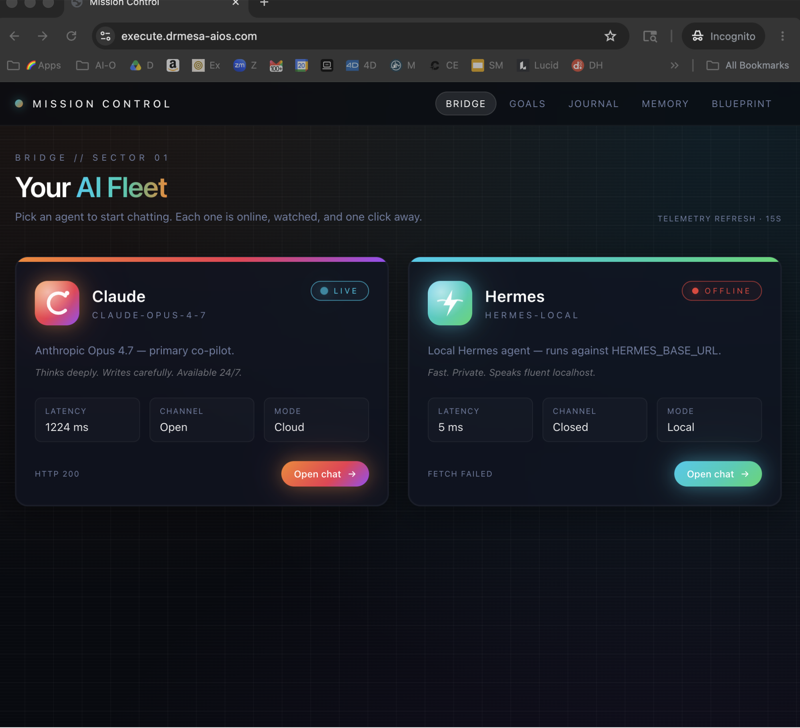
The hermes bot vs grok bot question got answered the day Hermes Bot Mode launched, and the answer is not what most people expected.
Grok Bot showed everyone what an AI agent team is supposed to look like.
Hermes Bot Mode just made that same thing free, open source, and yours to run on your own machine.
Teknium, the co-founder and lead engineer at Hermes Agent and Nous Research, shipped it as a one-day public beta plugin.
The community sends feedback, and then it ships inside the main Hermes desktop app for everyone.
When someone pointed out that it looks a lot like Grok Bot, he answered with three words: "That's the point."
In this post I'll show you exactly what Bot Mode does, how it stacks up against Grok Bot feature by feature, and the setting buried in the advanced menu that almost nobody notices.
That setting is the one that lets every single bot run a completely different AI brain.
That is the piece that actually decides this comparison.
🔥 Want the full Hermes Bot Mode setup walked through step by step? Inside the AI Profit Boardroom we've got the complete Hermes Agent masterclass plus the Agent Operating System, so you can copy my bot roster instead of building it from scratch. → Get access here
Hermes bot vs Grok bot: the head-to-head table
Here's the short version before I break each row down.
| Feature | Hermes Bot Mode | Grok Bot |
|---|---|---|
| Cost | Free | Paid, inside xAI's platform |
| Licence | Open source, MIT | Closed, xAI owned |
| Where it runs | Your own computer | xAI's cloud |
| Model choice | Any model, different one per bot | xAI's models only |
| Local models | Yes, fully offline models supported | No |
| Memory | Separate memory per bot, on your disk | Held on their infrastructure |
| Bot-to-bot messaging | Yes, via the Agent Inbox | Yes |
| Scheduled routines | Yes, on Hermes cron jobs | Yes |
| Maturity | One-day public beta | Shipped product |
Grok Bot wins on polish, and I'll be straight with you about that.
Hermes Bot Mode wins on control, cost, and model freedom.
What Bot Mode actually is
Up until launch day, Hermes Agent worked in sessions.
You open a chat, you give the agent a task, and it does the work.
When you want a different kind of task done, you open another session.
It works, but it gets messy fast.
Your inbox summary lives in one session, your content research lives in another, and your competitor tracking lives in a third.
They all look the same, which is a long list of chats with no faces, no names, and no jobs.
Bot Mode flips that completely.
Instead of a pile of sessions, you get a roster.
It's a panel on the left side of your screen with named bots in it.
Each bot has its own avatar, its own personality, its own chat, its own memory, and its own schedule.
You click a bot and you land in a chat like you're messaging a person on your team.
Creating a new bot takes seconds, because you just give it a name, a title, and a description of its job.
That bot now exists.
If you already have agent profiles set up in Hermes, they automatically show up as bots the moment you install the plugin.
You don't rebuild anything, which is the part I appreciated most.
The advanced setting that decides hermes bot vs grok bot
When you create or edit a bot, there's an advanced section inside it.
You can pin a specific model to that bot.
Your research bot can run one model.
Your writing bot can run another.
Your inbox bot can run a small fast local model that lives on your own machine and never touches the internet.
Every bot on your roster can think with a different brain, and you pick each one.
That is the piece Grok Bot does not give you.
Grok Bot runs on xAI's models inside xAI's cloud, which means it's their agents, their infrastructure, and their rules.
Hermes Bot Mode is open source under an MIT licence, it's free, and it runs on your own computer.
You can point a bot at a big frontier model, a free model, or a local model, and the choice is per bot.
If you want a deeper dive on which model to pin where, I broke that down in the best Ollama model for Hermes Agent and best Hermes Agent models.
Every bot keeps its own memory
Each bot keeps a completely separate memory.
Your research bot remembers what it researched.
Your content bot remembers your style.
They don't blur together into one confused history, which is exactly what happens when you run everything through one session.
Each bot builds up its own history over time, like a team member who's been in the role for months.
That's also why cloning matters so much, and I'll come back to that in a minute.
Bot-to-bot messaging and mentions
The biggest feature in this release is bot-to-bot messaging.
Every bot has a persistent inbox called the Agent Inbox.
Your bots can send messages to each other, and when a message arrives it shows up with attribution.
The receiving bot knows exactly which agent sent it.
Each bot's personality file teaches it the protocol, including how to reply.
Then there are mentions.
You type an @ sign and a bot's name in any chat, something like "@researcher have a look at this".
The bot you're talking to hands the message off to the researcher bot, waits for the answer, and reports back to you in the same conversation.
In plain terms, you're chatting with your main bot about a blog post.
You type "@researcher pull the latest facts on this topic" and your main bot passes it over.
The researcher does the digging with its own memory and its own model, then sends the answer back.
Your main bot folds that answer into the draft.
You watched one conversation, but two agents did the work.
Someone in the community even took their existing Grok Bot setup, the coordinator bot and all the worker bots underneath it, and had Hermes clone the whole structure into Bot Mode.
Same team layout, rebuilt on free open source software they fully control.
🔥 Want my exact bot roster instead of guessing? Inside the AI Profit Boardroom I'm sharing which bots to create first for a business like yours, how to write the job descriptions, and which model to pin to each one. Plus four coaching calls a week and 3,700+ members. → Get access here
Routines are where the money is
Every bot gets its own routines panel.
A routine is a recurring task on a schedule.
You can tell a bot to summarise your inbox every morning.
You can tell another one to check your niche for new developments every day at noon.
You can tell a third to pull fresh content ideas every Monday.
You attach the routine to the bot whose job it is, and the results land in that bot's chat history.
So when you wake up and click your inbox bot, the morning summary is already sitting there waiting for you.
Under the hood these run on Hermes cron jobs, which is the built-in scheduler Hermes already had.
Nothing new was bolted on, and that's actually the smartest design decision in the whole release.
I go deeper on scheduling patterns in Hermes Agent goals if you want to build these out properly.
Under the hood, a bot is just a Hermes profile
This is the part that tells you whether Bot Mode will still work in six months.
A bot in Bot Mode is just a Hermes profile.
Profiles already existed long before this launch.
Each profile is its own isolated setup with its own config, its own memory, its own skills, its own credentials, and its own chat history, all stored in its own folder on your machine.
Bot Mode is a new interface layered on top of that.
There are no core patches, no background daemons running on your computer, and no extra storage system.
Teknium confirmed it himself when someone asked how this differs from profiles, saying it's just a new simplified experience for profiles.
Why should you care about that?
Because plugins that try to hack around the system always break on the next update.
This one can't break that way, because it only uses the standard surface Hermes already exposes.
It's the difference between a house built on a proper foundation and a treehouse nailed to a branch.
The soul file and cloning
Every bot has a SOUL.md file, which is its personality file.
It defines how the bot talks, what it cares about, and how it behaves.
You can write a custom one for each bot.
Cloning copies everything, including the config, the skills, the personality file, and even the memory.
If you've spent months training up a research bot that knows your business inside out, you can duplicate it and point the copy at a different project.
The new one starts with everything the original learned.
That's a serious unlock for anyone running more than one business or more than one client.
The avatars are silly and useful at the same time
Each bot gets a little geometric face built from seven shapes and ten colours.
The eyes blink and scan back and forth while the bot is working.
You can upload your own image, generate an AI portrait, or give a bot a pixel pet that bounces next to its avatar while it's busy.
It sounds like fluff until you've got six bots and three of them are mid task.
Then you can see at a glance who's working, because the moving eyes mean work is happening.
It's a status light with personality.
I'll admit Grok Bot's interface still looks slicker, and one commenter on my video said exactly that: "UI is a bit ugly in comparison."
Fair point, and it's a one-day beta.
How I'm actually using this
Inside my Agentic Operating System I already run named agents.
Oracle watches my competitors.
Astros pulls keyword and content ideas from our search data.
Apollo handles voice.
Before Bot Mode, those lived as separate profiles that I'd hop between manually.
Now each of them has a face, a chat, and a schedule sitting side by side in one panel.
Oracle can message Astros directly when it spots a competitor moving on a keyword.
That handoff used to be me copying and pasting between windows like an idiot.
If you want to see how the wider system fits together, start with the Hermes Agent OS and Hermes Agent swarms.
The honest limitations
This is a beta and it is not perfectly smooth, so let me be straight with you.
It's a desktop plugin, so it has to be installed on the machine running the Hermes desktop app rather than on your server.
A bunch of early testers installed it on their home server, saw nothing, and got confused.
It belongs on the laptop where the app actually runs.
If your Hermes gateway lives on a VPS somewhere, that's fine, because the desktop app connects to it remotely and Teknium confirmed remote gateways work.
You can't put multiple bots into one group chat yet, and when someone asked, the answer was "not yet".
Right now it's one bot per chat, plus messaging and mentions between them.
Bot-to-bot delivery isn't an instant interruption either.
When one bot messages another, the receiving bot sees it in its inbox the next time it runs, so it won't drop what it's doing mid task.
Deleting a bot isn't in the interface on purpose, and you do it from the command line instead.
That's a safety choice so you can't wipe a bot's memory with a misclick.
None of these are dealbreakers, and they're the rough edges of software that went from idea to public beta at Nous Research speed.
Who this is actually for
Some people will look at agent teams and assume this is a developer thing.
The routines tell you otherwise.
"Summarise my inbox every morning" is not a developer task.
"Watch my market for new ideas" is not a developer task.
"Draft my weekly newsletter from these notes" is not a developer task either.
These are business owner tasks, and that's who this is aimed at.
Creating a bot is three clicks, a name, a title, and a description.
The install is copying one folder onto the machine where you run the desktop app.
After this beta, you won't even have to do that, because it ships built into the app.
The people struggling with Hermes a year ago were writing config files by hand.
The people using it today are clicking a button that says new agent.
That gap keeps shrinking every month, and it shrinks in your favour.
Frequently asked questions about hermes bot vs grok bot
Is Hermes Bot Mode really free?
Yes, it's open source under an MIT licence and it runs on your own computer.
You pay for whatever model you point each bot at, and if you pin a local model, that part costs you nothing at all.
Can Hermes Bot Mode replace Grok Bot completely?
For most workflows, yes, and someone already cloned an entire Grok Bot team structure into Bot Mode.
Grok Bot still has the smoother interface, so if polish is your priority, that gap is real today.
Do I need to be technical to set up Hermes bots?
No, because creating a bot is a name, a title, and a description in three clicks.
The only slightly technical step is copying one folder to install the beta plugin, and that disappears once it ships inside the app.
Can each Hermes bot use a different AI model?
Yes, and this is the single biggest advantage in the hermes bot vs grok bot comparison.
In the advanced section of each bot you pin the model, so a frontier model, a free model, and a local model can all sit on the same roster.
Do the bots keep working when I'm not there?
They run their scheduled routines on Hermes cron jobs, so morning summaries and daily checks happen without you.
They won't invent work forever on their own, so give each bot clear routines instead of expecting it to stay busy in an empty room.
Where does Bot Mode store my data?
Everything sits in each profile's own folder on your machine, including config, memory, skills, credentials, and chat history.
That's the practical difference between running your own agents and renting somebody else's.
About Julian
I'm Julian Goldie, an AI entrepreneur, SEO expert, and founder of the AI Profit Boardroom with 3,700+ members inside.
I help business owners scale with AI agents, automation, and SEO.
I've got 417K+ YouTube subscribers, a 7-figure AI agency, daily training inside the Boardroom, and multiple AI automation playbooks to my name.
→ Get my best AI training inside the AI Profit Boardroom
Also On Our Network
🌐 Read on aiprofitboardroom.com
🌐 Read on juliangoldieaiautomation.com
🌐 Read on aisuccesslabjuliangoldie.com
🌐 Read on aimoneylabjuliangoldie.com
Related reading
- Hermes Agent OS shows you the wider system these bots plug into.
- Hermes Agent swarms covers multiple agents working on one job together.
- Hermes vs OpenClaw is the other comparison people ask me about most.
The verdict
Grok Bot showed the world what an AI agent team looks like.
Hermes Bot Mode made that same pattern free, open source, and yours.
You get per-bot models, per-bot memory, and bot-to-bot messaging on software you fully control.
The specific tool matters less than the pattern, and the pattern is now everywhere.
Named agents with jobs, memory, schedules, and the ability to talk to each other.
Learn to run a bot roster once and that skill transfers to every version of this that ships from here on.
The people who set up their roster now, while it's fresh, will have bots with months of built-up memory by the time everyone else installs it.
That's the real answer to hermes bot vs grok bot.
📺 Video notes + links to the tools 👉 AI Profit Boardroom
🎥 Learn how I make these videos 👉 aiprofitboardroom.com
🆓 Get a FREE AI Course + Community + 1,000 AI Agents 👉 Free AI Money Lab