Hermes Computer Use is the most useful free AI feature I've installed all year, and after running it on my Mac for a few days I'm convinced this is the model for how solo operators and small teams will actually use AI in 2026. The agent operates your computer in the background — clicking, typing, scrolling, dragging — while you carry on with your own work on the same machine.
This article is the full setup walkthrough plus the live tests I ran on day one. I'll show you the install command, the permission flow, the prompting framework I use, and the four real tests that exposed both the strengths and the limits of this thing.
🔥 Want my full Hermes Computer Use guide + 100 prompts? AI Profit Boardroom has the 100-prompt guide, 30-day roadmap, step-by-step SOPs, daily custom-video Q&A, and 4 weekly coaching calls with 2,900+ entrepreneurs. → Get inside
What Hermes Computer Use Actually Is
Hermes Computer Use is a brand new free update to the Hermes Agent framework from Nous Research. It lets the agent operate your Mac desktop the same way you would. The agent reads the screen, identifies every button on it, picks the right one, clicks it, types into the right field, and moves on to the next step.
The headline behaviour is that all of this happens in the background. Your cursor doesn't jump. Your keyboard focus doesn't change. The agent doesn't yank you off your current space. You and the agent share the same Mac as a two-person team would share an office.
Underneath the surface, Hermes Computer Use is powered by an MCP server. It's currently Mac-only. It's free and open source. It works with any AI model you want to plug in — Claude, ChatGPT, Gemini, OpenRouter, or a free local model running through LM Studio or Ollama.
Why This Is Different From Copy-Paste AI Workflows
Most people still use AI the slow way. They open ChatGPT in a browser tab. They copy the prompt. They paste the answer back into their app. They tweak it. They repeat the loop fifty times a day. That's the workflow that's getting replaced.
Hermes Computer Use collapses that loop into one prompt. You describe the outcome you want and the agent reads the screen, identifies the buttons, clicks them, types the content, and saves the result while you do something completely different on the same machine. The friction goes from "fifty context switches a day" to "one sentence in the morning."
That difference compounds. If you save five minutes per task and you do twenty tasks a day, you've bought yourself an extra hour and a half every single day for the cost of zero pounds.
Installation Walkthrough
The install is genuinely one command. You open your terminal and you type hermes computer-use install. If you're inside Hermes already, you can paste the install instructions into the agent and it'll run the setup itself, which is the meta moment a lot of new users enjoy.
Once the install finishes, you have to grant Accessibility permissions in System Settings. Go to Privacy and Security, find Accessibility, and allow Terminal (or whichever shell you launched Hermes from). This is the bit most people skip on their first attempt and then wonder why nothing works.
After the permission grant, restart Hermes once. The toolset shows up inside the agent ready to use. You can verify it with a basic prompt like "open Notes" — if it pops Notes open in the background, you're live.
The Goal-Oversee-Stack-Transform Prompting Framework
You can't prompt Hermes Computer Use the same way you prompt ChatGPT. I've boiled the right approach down to four moves that work consistently.
Goal. Give the agent a full real-world outcome, not a micro-task. Bad prompt: "write me an email." Good prompt: "open Apple Mail, read the last ten unread emails, draft replies to the three that need responses, and leave them in my Drafts folder."
Oversee, don't operate. Once you've handed the goal off, your job is to be the CEO not the operator. You watch the screen, you sanity-check the work, and you intervene only when something looks off. You don't backseat-drive every click.
Stack any model. Hermes is model-agnostic. Use Claude for reasoning-heavy tasks. Use GPT for general work. Use a free OpenRouter model when you want to save tokens. Use a local model when privacy matters.
Transform the output. The agent's work should always land somewhere useful — a content piece, a client deliverable, a research note, a productivity system. Don't run agents for fun. Run them because they're producing artefacts you actually use.
Live Test 1 — Open Notes App
The first test I ran was the simplest. One prompt: "open Notes." Hermes opened the Notes app in the background while I carried on typing in my terminal. My cursor didn't move. My focus didn't change. The app just appeared, ready to use, in seconds.
This is the basic-but-revealing test. If a computer-use agent can't do this cleanly without hijacking your machine, the rest of the workflow falls apart. Hermes passed it without a wobble.
Live Test 2 — Create A Personalised Journal Note
The second test was a step up. The prompt was: "Open up Notes app and create a new note journaling about the best ways you could help me save time day-to-day."
The agent stacked two skills together — Apple Notes plus Mac OS Computer Use — and produced a complete personalised note in seconds. It had ten ideas in it. Inbox triage. Content research. AI SEO context capture. Personal knowledge capture. Second brain surfacing. The list went on. Each idea was tied to my actual workflow, not a generic AI-assistant response.
This is the test that convinced me the feature has commercial weight. It's not just opening apps. It's reading what kind of operator I am from previous context and writing content that's actually relevant to me.
Live Test 3 — Reorganise My Obsidian Vault
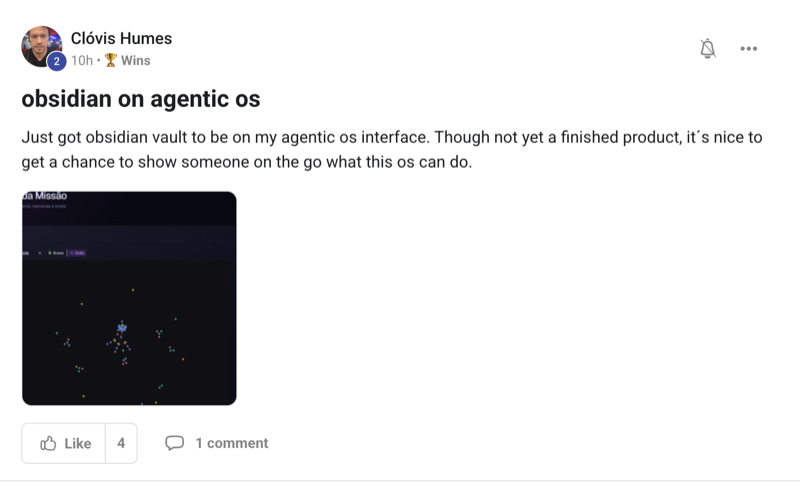
The third test was the bigger ask. I prompted: "Go into my Obsidian app, organise my knowledge base, add details and context, make it a more organised useful second brain, add emojis and titles and headlines, organise the folders, and improve the knowledge graph."
The first good sign was that Hermes asked for permission before any destructive action. The guardrails worked. It didn't just start moving files around.
The honest result is that it started the work but moved slower than I expected on a task with this many steps. I stopped it after a few minutes because the loop wasn't tight enough yet for a big multi-step reorg. This is a known limitation of computer-use agents in 2026 — they're brilliant at three-to-five step workflows and shaky on twenty-to-fifty step workflows.
I'll come back to it once the model behind it improves. For now, the lesson is: scope the task to something Hermes can finish in under five minutes and you'll get clean output.
Live Test 4 — Hermes Talks To Hermes
The fourth test was the meta one. Codex had hit a token limit so I switched to Kimi K2.6 as the backing model. I prompted Hermes to open a new Terminal window, start another Hermes instance inside it, and say hello.
It opened the new terminal. It started Hermes inside it. It typed "hello." The second Hermes responded back: "Hey Julian, what are we working on today?"
That's two AI agents talking to each other on my own Mac, in the background, while I watched. The autonomous-loop implications are obvious. You can chain agents into pipelines that hand off work to each other while you're doing something else entirely.
Watch The Q&A
The Q&A above covers the questions I get asked most about Hermes Agent — model choice, safety, scaling, and how it fits into a broader operator stack. Watch it before you start your own setup.
Best Models For Hermes Computer Use
The agent works with any vision-capable model. Text-only models won't work because the system needs to see screenshots to identify buttons.
Anthropic Claude is my default for reasoning-heavy tasks. It handles nuance well. OpenRouter is the smart middle ground because you get 200+ models behind a single API key. OpenAI GPT-5.4 and Codex are solid for general work, with the caveat that Codex burns tokens fast on computer-use sessions. Local models via Ollama or LM Studio — Gemma 4 is the one I rotate to most — are perfect for privacy-sensitive workflows.
The one I'd skip on day one is any text-only model. No vision, no computer use. Simple as that.
Token Efficiency And Free APIs
Computer-use workflows are token-heavy because every step takes a screenshot and feeds it to the model. Codex actually hit its token limit during my testing.
The fix is to route high-volume work through free APIs. Step 3.5 Flash on Nous Portal is currently free and fast enough for most computer-use tasks. Various OpenRouter free models work too. Save your premium tokens for the reasoning-heavy moves and run the everyday clicks through the free tier.
This is the lever most new users miss. The tool is free. The model behind it is the cost. Choose your model strategically and your monthly bill stays close to zero.
Comparison — Hermes Computer Use Vs The Alternatives
| Tool | Background mode | Free | Mac native | Permission guardrails | Best for |
|---|---|---|---|---|---|
| Hermes Computer Use | Yes | Yes | Yes | Yes | Background operator workflows |
| OpenClaw | Partial | Yes | Yes | Weaker | Browser-heavy automation |
| Manus | No | Paid | Web only | Yes | Cloud agent work |
| Native Claude Desktop | No | Paid | Yes | No | Single-task agentic chat |
| Operator (OpenAI) | No | Paid | Web only | Yes | Web tasks in cloud |
For day-to-day Mac operator work, Hermes is the only option in that table that does all four things — runs in the background, costs nothing, ships permission guardrails, and is genuinely native on macOS.
🚀 Free SEO Strategy Session — Goldie Agency Want to pair Hermes Computer Use with real link building? Book a free strategy session with my 7-figure SEO agency (50-person team). → Book free session
Safety And Permissions
Hermes Computer Use ships with multi-layer guardrails. Anything destructive — deleting files, sending an email, moving documents — requires explicit permission from you before the agent acts. That's the design choice that separates this from the early-days computer-use tools that went off the rails inside ten minutes.
The agent is still experimental. Treat it like a junior employee on day one — capable, eager, and worth supervising for the first week. Don't point it at your production database. Don't give it your billing dashboard. Build trust on low-stakes tasks first and graduate it to bigger jobs once you've seen how it behaves.
Honest Limitations
Three things are worth being honest about. The first is that complex multi-step tasks are slower than expected right now. The Obsidian reorg I tried in test three is at the edge of what's reliable. The second is the token weight — screenshots aren't cheap, and high-volume usage on premium models will rack up costs unless you use the free APIs trick. The third is the Mac-only restriction. Windows and Linux support will come, but it's not here today.
None of these are deal-breakers. They're scope notes. Use Hermes for what it's currently good at — notes, journaling, file organisation, opening apps, basic cross-app workflows — and you'll be delighted.
The Belief Shifts That Matter
There are four lies I see new operators tell themselves about computer-use agents. I want to call each one out.
"AI can't do real computer tasks." False. I just showed you four tests where it did real computer tasks. The lie is two years out of date.
"You need to be a tech expert." False. If you can type a sentence in plain English, you can run Hermes. The install is one command and the prompting is conversational.
"It will take over my computer." False. The permission guardrails ask before anything destructive. You're always in the loop on the moves that matter.
"I'm too late, everyone's ahead." Completely wrong. The feature dropped this week. Almost nobody has it installed yet. This is the rare moment where early adopters genuinely win.
Daily Routine I Run With Hermes Computer Use
The routine I've settled on after a few days of testing is straightforward. In the morning I send Hermes one prompt to capture journal notes about the day ahead and stack them into my second brain. Mid-morning I let it triage emails into draft replies. After lunch I batch any file-organisation work that's piled up. End of day I run a recap prompt that summarises what I shipped and queues tomorrow's priorities.
Total active operator time is maybe ten minutes across the whole day. The agent does the rest in the background while I'm on calls, writing content, or coaching members.
FAQ — Hermes Computer Use Setup And Tests
Is Hermes Computer Use actually free?
Yes. The tool itself is free and open source. You only pay for the model API calls if you use a paid model, and even those can be routed through free options like Step 3.5 Flash on Nous Portal.
Does it work on Windows or Linux?
Not yet. Currently Mac-only. Cross-platform support is on the roadmap but no firm date.
How do I install it?
One command in your terminal: hermes computer-use install. Then grant Accessibility permissions in System Settings. Done.
What if I haven't installed Hermes Agent yet?
Start with my Hermes Agent Installation Guide first, then come back to this article.
Will it move my cursor while I'm working?
No. The whole point of the feature is that it operates in the background. Your cursor stays where it is and your focus doesn't change.
Which model should I use first?
Start with a free OpenRouter model or Step 3.5 Flash. Once you've validated the workflow, switch to Claude or GPT for the moves that need stronger reasoning.
Can Hermes delete my files?
Only with your explicit permission for that action. The permission guardrails are layered specifically to prevent the runaway-agent risk.
Is this better than OpenClaw?
For background Mac operator work, yes — Hermes wins on guardrails and on running quietly without hijacking your machine. See my OpenClaw Computer Use comparison for the side-by-side.
Latest Updates
- Hermes Agent Goals (Persistent Autonomous Loops) — the autonomous loop layer that pairs with Computer Use.
- Hermes MCP Server — the protocol layer under the hood.
- Hermes Agent HUD UI — the visual control panel for monitoring runs.
Also On Our Network
- 🌐 Read on aiprofitboardroom.com
- 🌐 Read on juliangoldieaiautomation.com
- 🌐 Read on aisuccesslabjuliangoldie.com
- 🌐 Read on aimoneylabjuliangoldie.com
Related Reading
- Hermes AI Agent Framework 2026 — the full agent framework Computer Use plugs into.
- Hermes Agent Installation Guide 2026 — start-to-finish install steps.
- Claude Hermes Agent — pairing Claude as the brain behind Hermes.
- Atomic Chat Vs Ollama — picking the right local model backend.
📺 Video notes + links to the tools 👉
🎥 Learn how I make these videos 👉
🆓 Get a FREE AI Course + Community + 1,000 AI Agents 👉
For solo operators and small teams, Hermes Computer Use is the highest-leverage free install of 2026 — set it up today, run your first background task this afternoon, and you'll wonder how you ever ran your Mac without it.