The Claude Hermes Agent setup is the single biggest delegation unlock I've added to my stack in 2026, and it took me 15 minutes flat to install end-to-end. Claude is the brain, Hermes is the hands, and the MCP bridge in the middle is what 99% of AI users are still missing.
This post is the no-fluff walkthrough of how to wire Claude to Hermes Agent using MCP, why the workaround matters now that Claude has restricted OAuth login, and the exact prompts I used to test it end-to-end on day one.
🔥 Want the full Claude+Hermes setup + 100 prompts? AI Profit Boardroom has the 30-day roadmap, full setup SOPs, custom-video daily Q&A, plus 4 weekly coaching calls with 2,900+ entrepreneurs. → Get inside
What The Claude Hermes Agent Setup Actually Is
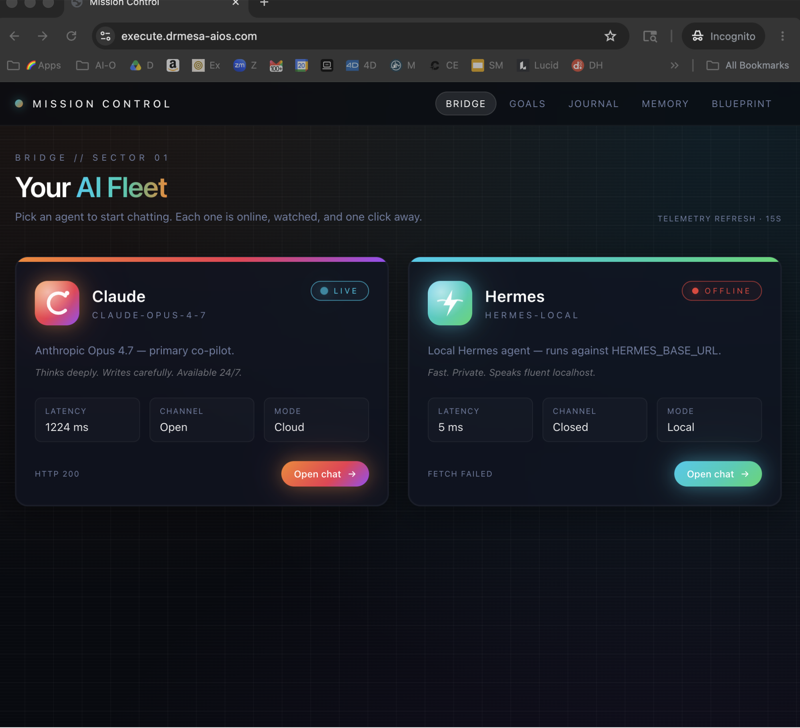
The Claude Hermes Agent setup is a bridge between Claude Desktop or Claude Mobile and the Hermes Agent runtime.
Claude on its own can think, write, and reason but it can't really act outside the chat window.
Hermes Agent on its own can act — browse the web, send emails, schedule tasks, remember things long-term — but most people drive it manually.
The Hermes MCP connector links the two so you can tell Claude what you want and Hermes does it.
The whole thing is free, runs on your existing Claude subscription, and installs in roughly 15 minutes.
The Goldie Delegation Loop — Brain, Bridge, Hands
I call this stack the Goldie Delegation Loop because it maps cleanly onto how I delegate to a human team.
Layer one is the Brain.
Claude is the CEO of this setup — it thinks, it plans, it decides what to do next.
Layer two is the Bridge.
Hermes MCP is the connector that 99% of AI users don't have installed — it carries instructions from Claude over to Hermes Agent in real time.
Layer three is the Hands.
Hermes Agent is what physically does the work — it opens browsers, sends emails, creates documents, schedules cron jobs, messages people, and remembers everything long-term.
The flow is simple.
You speak to Claude.
Claude listens and thinks.
Hermes acts on the plan.
Results come back to you.
You delegate again.
That's the loop, and once you've run it once you'll never want to use a standalone chatbot again.
The 15-Minute Setup Walkthrough
The setup is friendlier than most MCP bridges I've installed.
You grab the Hermes MCP GitHub link from the Hermes repo.
You paste it directly into Claude Desktop and ask Claude to install the MCP server for you.
Claude reads the repo, adds the entry to your MCP config, and restarts itself.
Once Claude reopens, Hermes MCP shows up in the connectors panel on the right-hand side.
You'll see the list of Hermes skills exposed as MCP tools — schedule tasks, send messages, run web research, store memories, all of it.
Total elapsed time on my install was 15 minutes including a Hermes Gateway restart.
If you want the longer screen-recorded version, my Hermes agent installation guide 2026 has the full walkthrough with screenshots.
Permissions And Safety — Set This Before You Run Anything
The most important step most people skip is setting MCP permissions correctly.
Claude's MCP connectors panel has three permission levels.
"Always allow" runs the tool with no prompt.
"Needs approval" pops up a confirmation before every tool call.
"Block" disables the tool entirely.
I strongly recommend setting Hermes MCP to "needs approval" for the first week.
The reason is that if anything ever gets prompt-injected into your chat — a web page Claude reads, a document it processes, anything — you don't want it silently triggering Hermes to delete files or send emails.
Approval prompts add roughly 2 seconds per action.
That's a fair trade for not waking up to a Hermes that sent 400 outreach emails to the wrong list.
After two weeks of clean use you can switch the safe tools to "always allow" and keep the destructive ones on approval.
Why Claude Hermes Agent Bypasses The OAuth Restriction
This is the part most people miss and it matters a lot in 2026.
Claude has stopped letting you connect Hermes Agent — and tools like OpenClaw — through plain OAuth login.
Their official position is that if you want Hermes to use Claude's brain, you should pay for Claude API access directly.
API access is excellent but expensive at any real volume.
The Hermes MCP bridge sidesteps that entirely.
Instead of Hermes calling out to Claude API and burning tokens at API pricing, Claude Desktop calls out to Hermes through MCP.
Hermes runs the work, sends results back to Claude, and Claude responds inside your normal subscription chat.
The brain is Claude — the best LLM in the world right now — but you pay subscription pricing, not API pricing.
That single change saves serious agencies four figures a month, and for solo founders it makes the difference between running this stack daily and not running it at all.
My Real Test — The 8AM Cron Job
The first thing I did once Hermes MCP was wired was test it with something verifiable.
I typed into Claude: "Use Hermes to schedule a cron job that says hello at 8am every day."
Claude thought for a second, called the Hermes scheduling tool, and came back with a structured response.
It returned a job ID, a job name, a scheduled task ID, the next run time in UTC, and a sample output line.
The next morning at 8am sharp, the job fired and Hermes logged "hello" exactly as scheduled.
That's a tiny test but it proves the entire chain works — Claude understood the intent, MCP carried the instruction, Hermes scheduled the task, the scheduler fired on time, and the result was visible back inside Claude.
If that works, everything else works too.
Tasks Worth Automating With Claude+Hermes
Once I knew the bridge was solid I started moving real workflows onto it.
Email automation went first.
I set Hermes to compile a daily inbox summary at 8am — top 5 messages, action items, who's waiting on me — and drop it into a doc I read with coffee.
Auto-replies for low-priority threads went on next.
Scheduling came second.
Recurring weekly reports, monthly client emails, social media reminders, and morning briefs all moved off my calendar and onto Hermes cron jobs.
Web research came third.
Competitor page monitoring, automated briefing docs on industry news, and trend detection on specific search terms all run on schedule now.
The throughline is simple.
Anything Hermes Agent can do, you can now control from Claude with a clean conversational UI.
You stop manually clicking around Hermes dashboards and start delegating in plain English.
Marketing Agency Use Cases I Run At Goldie Agency
We run a 50-person SEO agency and the Claude+Hermes stack has replaced a meaningful chunk of repetitive operator work.
Competitor monitoring runs nightly with a content gap analysis dropped into Slack each morning.
Outreach automation is wired into our prospect tracker — Hermes auto-cues a follow-up if a prospect hasn't replied in five days.
Content production briefs come from Claude, save into the writers folder, and ping the team in Slack.
Publish-ready research packs assemble trending angles, competitor articles, stats, and Reddit questions into one document.
Client monthly reports get pulled by Hermes, formatted by Claude, and emailed on the first of the month.
The Friday 5pm performance digest goes out to each account team automatically.
Ad copy generation produces 10 variations per adset, saved by campaign in the right folder.
Competitor ad tracking checks the Facebook Ads Library on schedule and logs new ads to a swipe file.
Social scheduling briefs are produced weekly based on trending topics in our space.
None of this was possible to run cleanly until we put Claude in front of Hermes.
What Is MCP In Plain English
MCP stands for Model Context Protocol.
It's a language that lets different AI tools talk to each other in real time.
Before MCP, Claude and Hermes could both run on the same machine but couldn't communicate with each other.
After MCP, there's a phone line between them.
Claude asks Hermes to do something, Hermes does it, Hermes reports back, Claude responds to you.
You don't need to understand the wire format.
You just need to know that the bridge exists and that you can install it in 15 minutes.
Persistent Memory And Skills
The hidden superpower of Hermes Agent is its persistent memory.
Hermes remembers context across conversations.
It builds reusable skills the more you use it — write-style preferences, tone, the way you format emails, the structure of your weekly digest, all of it.
Your personal knowledge base grows automatically over time.
When you talk to Claude with the Hermes MCP active, Claude can reference everything Hermes has stored.
That means your conversations get sharper as the months go on instead of starting from scratch every chat.
I pair this with the OMI Obsidian second-brain setup so the memory loops are fed from real meetings, screen recordings, and notes instead of just chat history.
That stack is what makes the delegation actually feel like a chief of staff and not a chatbot.
Common Objections I Hear
There are three objections I hear every week from founders about this stack.
The first is "I'm not technical enough."
If you can type a sentence into Claude, you can run this.
You don't need to know what OAuth means, what an MCP wire format is, or how cron jobs work.
You paste a GitHub link, you confirm permissions, you're done.
The second is "this'll take months to set up properly."
Not true.
The MCP install is 15 minutes.
Your first automated task takes another 30 minutes.
Total time from zero to running a real automation is under an hour.
The third is "AI tools keep changing — why bother learning this?"
The tools change.
The skill of AI delegation does not.
Whatever bridge replaces MCP in three years will follow the same three-layer pattern — brain, bridge, hands.
Learn the loop once, the implementations are commodities after that.
Claude Alone Vs Claude+Hermes Vs Claude API Direct
| Setup | Cost | Can Take Actions | Memory | Best For |
|---|---|---|---|---|
| Claude alone | Subscription | No — chat only | Within chat only | Reasoning, writing |
| Claude + Hermes MCP | Subscription only | Yes — full Hermes stack | Persistent across sessions | Full delegation loop |
| Claude API direct | Per-token (expensive at scale) | Yes via custom integration | Only what you build | Production apps, devs |
For 99% of founders and operators the middle row is the obvious answer.
You get API-level capability on subscription pricing, and you don't have to build any integration code yourself.
Pair Claude+Hermes With A Local Model For Privacy
If you have client work that can't leave your infrastructure, run a local model as the brain instead of Claude.
Gemma 4 paired with Hermes is the non-technical-friendly option.
Less powerful than Claude.
Runs locally.
Offline.
Free.
Pair it with LM Studio or Ollama and you've got a fully private agent stack for sensitive work.
For everything else, Claude is the default brain because it's currently the best reasoning model in the world.
🚀 Are you a marketing agency? Want SEO + AI combined? Book a free strategy session with my 7-figure SEO agency Goldie Agency (50-person team). → Book free session
FAQ — Claude Hermes Agent
Is the Claude Hermes Agent bridge really free?
Yes — the Hermes MCP connector is a free extension and runs on your existing Claude subscription.
Will this work on Claude Mobile?
Yes — the same MCP setup connects Claude Mobile to your Hermes Gateway once your gateway is reachable.
Do I need API access?
No — that's the whole point of this setup. You stay on the standard Claude subscription.
How long does setup actually take?
Roughly 15 minutes for the MCP bridge, another 30 minutes for your first real automation.
Is it safe to give Hermes full permissions?
Start with "needs approval" on every tool for the first week. Move safe tools to "always allow" once you trust the loop.
Can I run this with a local model instead of Claude?
Yes — Gemma 4 with Hermes works for fully local, offline, free setups. Less powerful than Claude but private.
What if Anthropic closes the MCP loophole?
The MCP protocol is now the industry standard — there's no loophole to close. This is the recommended way to connect external tools to Claude.
Latest Updates
- Hermes Agent Goals (NEW Persistent Update FREE) — the autonomous goal loops that pair perfectly with Claude as the brain.
- Sonnet 4.8 Review — the model I default to as the brain in this stack.
- Hermes Agent HUD UI — the visual layer that makes the Claude+Hermes loop legible at a glance.
Also On Our Network
- 🌐 Read on bestaiagentcommunity.com
- 🌐 Read on juliangoldieaiautomation.com
- 🌐 Read on aisuccesslabjuliangoldie.com
- 🌐 Read on aimoneylabjuliangoldie.com
Related Reading
- Hermes AI Agent Framework 2026 — the framework powering the hands layer.
- Hermes Agent Installation Guide 2026 — the deep-dive install walkthrough.
- Claude Code SEO Agent — Claude Code paired with SEO automation.
- OMI Obsidian — the second-brain layer that feeds context into this stack.
📺 Video notes + links to the tools 👉
🎥 Learn how I make these videos 👉
🆓 Get a FREE AI Course + Community + 1,000 AI Agents 👉
If you want the cleanest delegation upgrade of 2026, the Claude Hermes Agent setup is the one — install the MCP bridge today, run your first cron job tonight, and you'll wonder how you ever ran an agent stack without it.