The Hermes MCP server is the single missing bridge that turns Codex from a coding agent into a full autonomous machine, and after running it daily for the last few weeks I can honestly say this is the most powerful free AI agent stack available right now. It exposes Hermes Agent as an MCP server so Codex, Claude, and any other compatible client can call Hermes's full toolset directly.
This post is the full setup walkthrough for the Hermes MCP server. I'll show you both the simple path (Hermes inside the Codex terminal) and the powerful path (Hermes registered as a global MCP server in Codex), the four-layer power stack that explains why this works so well, and the token-economy hack I use to run unlimited Hermes tasks for free while Codex burns premium tokens on the hard stuff.
🔥 Want my full Hermes MCP server + Codex setup guide? AI Profit Boardroom has the 30-day roadmap, 100 prompts, full setup SOPs, plus guides on Hermes + Claude MCP, Paperclip + Hermes, and more. Daily Q&A + 4 weekly coaching calls. → Get inside
What The Hermes MCP Server Actually Is
The Hermes MCP server is Hermes Agent wrapped in the Model Context Protocol so other AI tools can call it as a tool. That is the whole concept in one sentence. Instead of Hermes being a standalone agent you log into separately, it becomes a service that Codex (or Claude, or anything MCP-compatible) can talk to programmatically.
The Model Context Protocol is the open standard that lets AI models call external tools in a consistent way. Without MCP, every integration is a custom build and most agents end up siloed. With MCP, Codex can list Hermes's tools, call them, read their results, and chain them into its own workflows without me writing a single line of glue code.
The Hermes MCP server is free and open source. That part matters because it means you can wire this into your stack today without paying anyone, without waiting for a roadmap, and without depending on a vendor's approval queue.
Why The Codex + Hermes MCP Stack Wins
The reason Codex + Hermes MCP is the strongest stack in 2026 is that it gives you two genuine agents in parallel on the same project, each doing different jobs simultaneously. This is not one agent. This is not two agents taking turns. This is two agents running in parallel and that distinction is everything.
Codex is the builder. It reads code, writes code, fixes code, and ships features. That is what OpenAI built it for and that is what it is best at. Hermes is the brain. It runs tasks, reads files, sends messages, makes deployments, schedules work, and basically does anything that is not raw code authoring. Together they cover the entire surface of what a small dev or marketing team would do.
I used to lose hours every week to context-switching between the agent that built the thing and the human who had to ship the thing. With Hermes MCP wired into Codex, that gap is closed. Codex builds, Hermes ships, and I just review the output.
The Simple Setup — Run Hermes Inside The Codex Terminal
The simple path takes about ninety seconds and you do not need to touch any config files. It is the path I recommend for anyone trying this for the first time because it gets you to a working state immediately and lets you see the value before you invest more time.
You install Hermes Agent with one command from the project README. You open Codex. You click the terminal toggle to bring up the Codex integrated terminal. You type hermes in that terminal. You now have Hermes Agent running inside Codex with full access to the Codex project directory. That is the whole thing.
Once Hermes is running inside the Codex terminal it can see every file in the project. Codex writes the code on one side. Hermes handles deployment, content publishing, scheduled tasks, or anything else you would normally do outside the IDE on the other. They share the same workspace and the same files which means handoffs are basically free.
The classic flow I run on the simple setup is build-then-ship. Codex builds the site or the feature. I then ask Hermes to deploy it to Netlify using the built-in Netlify skill. Hermes handles the deploy, the DNS check, and the live verification while Codex queues up the next feature.
The Powerful Hermes MCP Server Setup — Registered In Codex
The powerful path is what you graduate to once you want Hermes available system-wide in every Codex project without typing the start command each time. It takes longer to set up — maybe ten to fifteen minutes — but the payoff is that Hermes becomes a first-class citizen in Codex with proper tool discovery, persistent state, and conversation history that Codex can query directly.
The setup is mostly copy-paste. You open a new Codex chat. You add a new project folder called something like "Hermes-Codex-MCP". You paste the Hermes MCP server documentation into that folder. You paste the main Hermes GitHub readme into the same folder. You tell Codex: "Set up Hermes MCP with Codex." That is the whole instruction.
Codex then writes the config file, registers Hermes as a global MCP server in your Codex settings, and verifies the connection works before handing back. After you restart Codex once, you can run something like "do a test run" and Codex will initialise the Hermes MCP, list the available MCP tools, call the conversations list, and return everything Hermes has done previously. The real test from the original walkthrough returned exactly that result on the first try.
The reason the powerful path is worth doing eventually is persistence. Once Hermes is registered globally, every Codex project you open already knows about Hermes and can call its tools without setup. You stop thinking about it as a separate agent and start treating it as another set of capabilities Codex can reach for.
The Four-Layer Power Stack
The mental model that finally made this click for me is the four-layer power stack. Once you see it this way you stop thinking about Hermes and Codex as two separate tools and start seeing them as one machine.
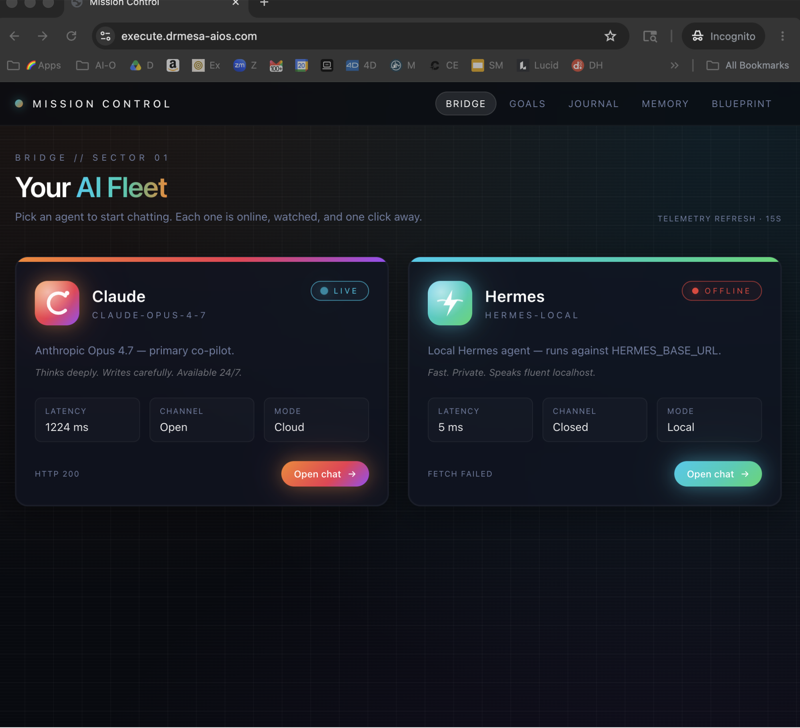
The Brain is Hermes Agent. It is the smart middle frame that talks to other tools, reads files, writes code, sends messages, and takes actions. Hiring Hermes is like hiring a smart employee who never sleeps and never asks for a salary increase.
The Hands are MCP. The Model Context Protocol is the bridge between the brain and the real world. Without MCP, AI can think but cannot actually do that much by itself. With MCP, the brain can reach out and touch any system that exposes itself as a tool — your file system, your Netlify account, your WordPress site, your email, anything.
The Builder is Codex. OpenAI's coding agent reads, writes, and fixes code automatically. When you connect Codex to Hermes via MCP, Codex gets superpowers. It can now do everything Hermes does on top of everything it already did. It is the same Codex you already use but with hands attached.
The Output is the automated work. When all three layers run together you get automated SEO, content research, outreach, code, deployments, and a full machine that genuinely runs itself. That last layer is what most founders never reach because they stop at "I have an agent." Having an agent is not the win. Wiring four layers together so the agent actually produces real-world output is the win.
Claude + Hermes MCP As The Alternative
Codex is not the only way to drive Hermes through MCP. Claude works just as well as the brain, and for some people the nicer UI is worth the trade-off. The concept is identical — Hermes runs as an MCP server, Claude calls Hermes's tools, and you command the whole stack from Claude's interface instead of from a terminal.
I have walked through this in Claude + Hermes Agent in full detail, but the short version is that the setup takes around fifteen minutes and you do not have to live in a terminal to use it. If you prefer Claude's chat UI to Codex's IDE-style workflow, this is the path I would point you at first.
The deeper reason to know about both is that some weeks you will want one and some weeks you will want the other. Codex is unbeatable when the work is mostly code. Claude is nicer when the work is mostly content, research, or planning with occasional code on the side. Run both, switch as needed, and Hermes serves either one through the same MCP layer.
Why Parallel Beats Serial
The single biggest reason this stack beats every other AI workflow I have tried is the parallel nature of the two agents. Codex has to be open on your machine to run. It is an IDE-style agent so the moment you close the laptop, the work stops. Hermes does not have that constraint at all. Hermes runs 24/7 in the background on a serverless platform or a VPS and keeps working with the lid closed.
That means you can stack agents on top of each other in time. While you are awake and at the laptop, Codex is building features and Hermes is shipping them. While you are asleep, Codex is off and Hermes is monitoring competitors, publishing scheduled content, or running SEO audits. The agents do not have to wait for each other and they do not have to wait for you.
The compounding effect is silly. A typical week I am at the keyboard maybe twenty hours actively driving Codex. Hermes is up the other one hundred and forty-eight hours doing work I queued up. Output per founder hour is not the right metric anymore. Output per founder week is what you should measure once you stack agents this way.
Watch The Claude-Side Walkthrough
The Claude Code walkthrough is worth watching even if you plan to drive Hermes from Codex, because it shows the MCP server doing the same job through a different brain. Seeing both clients call the same Hermes tools is the moment the MCP concept clicks for most people.
The Token Economy Hack
The trick that nobody talks about but everyone running this stack at scale uses is splitting the token economy between premium and free models. Codex is your premium-brain agent. You pay for it via your Codex subscription and you let it use the strongest reasoning model available because that is where intelligence per dollar matters most. Hermes is your unlimited-grunt-work agent. You pair it with a free API like Step 3.5 Flash on Nous Portal so it can run as many tasks as you can throw at it without metering.
The result is that you pay once for the brain that designs and reviews the work, and the hands that execute the work are essentially free. Hermes can churn through hundreds of small SEO checks, content rewrites, deployment verifications, or competitor monitors per day at zero marginal cost. Codex stays focused on the high-leverage code and architecture decisions where the better model actually matters.
If you have ever hit a Codex token limit mid-build you already know how painful the rate ceiling is. The neat workaround that came out of the original walkthrough is to just open Hermes in the same Codex terminal and let Hermes finish the work using its own model and its own tokens. You keep moving instead of stopping for an hour. This single tip has saved me more sessions than any other workflow tweak this year.
Comparison Table — Simple Vs Powerful Setup
| Factor | Simple Setup | Powerful Setup |
|---|---|---|
| Time to set up | ~2 minutes | ~10-15 minutes |
| Persistence | Per-project, manual start | Global, auto-loaded everywhere |
| Tool discovery | Manual | Automatic via MCP |
| Skill level needed | Copy one command | Copy-paste documentation |
| Best for | First-time users | Daily power users |
| Codex restart needed | No | Yes, once after setup |
| Conversation history visible to Codex | No | Yes |
The honest take is that everyone should start on the simple setup, run it for a week, and move to the powerful setup once they hit a moment of friction. There is no point doing the registered MCP server work until you know you actually want this in every project.
Real Use Cases I Run Every Week
The use case I run most often is build-and-ship. Codex builds a feature, a blog post, or a landing page. Hermes deploys it to Netlify on a subdomain, verifies the URL is live, and confirms the DNS resolved. That single flow has eliminated about ninety per cent of the back-and-forth I used to do between writing code and shipping it.
The next most-used flow is content publishing. Codex writes a blog post in markdown. Hermes pushes it into WordPress on schedule with the right tags, categories, and featured image. I never touch the WordPress admin. The drafts land themselves.
The third flow is SEO automation. Hermes runs 24/7 on a VPS, monitoring competitor sites for new content, identifying ranking gaps, and feeding those gaps back into Codex as build tickets. When I open Codex in the morning there are already topics queued and Codex starts writing immediately. This compounds in a way that completely changes what one person can produce in a month — see Hermes SEO for the full SEO-automation breakdown.
The fourth flow is test-and-deploy. Codex generates code. Hermes runs tests and deploys to staging. If tests pass, Hermes promotes the build. If tests fail, Hermes sends me a Slack with the error and the failing test. I do not babysit any of this.
Common Objections Handled
The most common objection I hear is "I'm not a coder, this is too technical for me." If you can copy text and paste it, you can do this. The powerful setup is literally pasting two documents into Codex and saying "set this up." Codex writes the config. You are not writing the config. That is the whole point of agents.
The second objection is "I'll set this up later." AI moves fast and six months in AI is equivalent to about five years in any other space. Early adopters of agent stacks are already miles ahead of late adopters. The cost of waiting is not zero. The cost of waiting is the gap between you and the people who started today widening every week.
The third objection is "what's the difference between Hermes and ChatGPT?" ChatGPT answers questions. Hermes takes actions. Hermes sends messages, reads files, writes code, deploys websites, monitors competitors, and runs on a schedule whether you are awake or not. They are not the same category of tool. ChatGPT is a chat interface. Hermes is a worker.
Free Models That Pair Well With Hermes
If you are running the token-economy hack, the free model options that work well as a Hermes brain are worth knowing. Step 3.5 Flash on Nous Portal is currently my default — it is free, has no rate limit that I have ever hit, and is fast enough for the kind of agentic loops Hermes runs. Our Alpha (Qwen 3) on Nous Portal or OpenRouter is the backup when I want a second model in rotation. For privacy-sensitive client work I run local models via LM Studio or Ollama.
The point is not which specific model. The point is that the brain side of Hermes does not have to be premium. The execution does not require frontier reasoning. The decisions do, and that is what your Codex subscription is for.
What Setup To Pick Based On Where You Are
If you have never run an AI agent before, start with the simple setup. Install Hermes, open Codex, type hermes in the terminal, and watch what happens. Once you have shipped one thing through that flow, you will know whether this stack is for you.
If you already use Codex daily, jump straight to the powerful setup. Spend the fifteen minutes pasting docs and letting Codex register the MCP server. You will get the benefit in every project from that day forward.
If you prefer Claude to Codex, do the Claude + Hermes MCP setup instead. Same concept, same outcome, nicer UI for some workflows.
🚀 Are you a marketing agency? Want SEO + AI combined? Book a free strategy session with my 7-figure SEO agency Goldie Agency (50-person team). → Book free session
FAQ — Hermes MCP Server
What is the Hermes MCP server in one sentence?
The Hermes MCP server is Hermes Agent exposed through the Model Context Protocol so external clients like Codex and Claude can call Hermes's tools directly as part of their own workflows.
Is the Hermes MCP server actually free?
Yes. It is free and open source. The only thing you pay for is whatever model you point Hermes at, and even that can be free if you use Step 3.5 Flash on Nous Portal.
Do I need to know how to code to set this up?
No. The simple path is one install command and one hermes command in the Codex terminal. The powerful path is pasting two documents into Codex and asking it to set up the MCP. If you can copy and paste, you can run this.
Does Hermes work with Claude as well as Codex?
Yes. Hermes works with any MCP-compatible client. Claude works particularly well as the brain if you prefer a chat UI to a terminal — see Claude + Hermes Agent.
Can I run Hermes when my laptop is closed?
Yes. Hermes can run on a serverless host or a VPS and operate twenty-four hours a day in the background. That is the main reason this stack beats single-agent setups — Codex needs to be open, Hermes does not.
What if I hit the Codex token limit?
Open Hermes in the same Codex terminal and keep working. Hermes uses its own model and tokens, so you do not have to wait for the Codex quota to reset.
Should I pick the simple or powerful setup?
Start simple. Move to powerful once you find yourself running the simple setup daily and want it available in every project without typing the start command.
Should I upgrade to AI Profit Boardroom for help?
If you want the full Hermes MCP playbook, the 30-day roadmap, the 100 prompt library, and weekly live coaching where I demo this stack on screen-share, yes — the AI Profit Boardroom is the home for all of this.
Latest Updates
- Hermes AI Agent Framework 2026 — the full framework Hermes is built on, useful context for the MCP server.
- Hermes Agent Installation Guide 2026 — step-by-step Hermes install if you have not done it yet.
- Sonnet 4.8 Review — the model I run as the Codex/Claude brain when reasoning matters most.
Also On Our Network
- 🌐 Read on aiprofitboardroom.com
- 🌐 Read on juliangoldieaiautomation.com
- 🌐 Read on aisuccesslabjuliangoldie.com
- 🌐 Read on aimoneylabjuliangoldie.com
Related Reading
- Hermes Agent Goals — the autonomous goal-loop layer that pairs with the MCP server.
- Hermes Agent HUD UI — the visual control surface for Hermes when you are not driving it via MCP.
- Hermes Computer Use — extending Hermes with desktop control alongside MCP.
- Claude + Hermes Agent — the Claude-side version of the MCP setup.
- OpenClaw SEO Agent — alternative SEO agent that pairs with the Hermes stack.
📺 Video notes + links to the tools 👉
🎥 Learn how I make these videos 👉
🆓 Get a FREE AI Course + Community + 1,000 AI Agents 👉
For anyone building a serious AI agent stack in 2026, the Hermes MCP server is the bridge you cannot afford to leave out — install it today, ship your first Codex-plus-Hermes flow this week, and you will wonder how you ever ran agents without an MCP server.