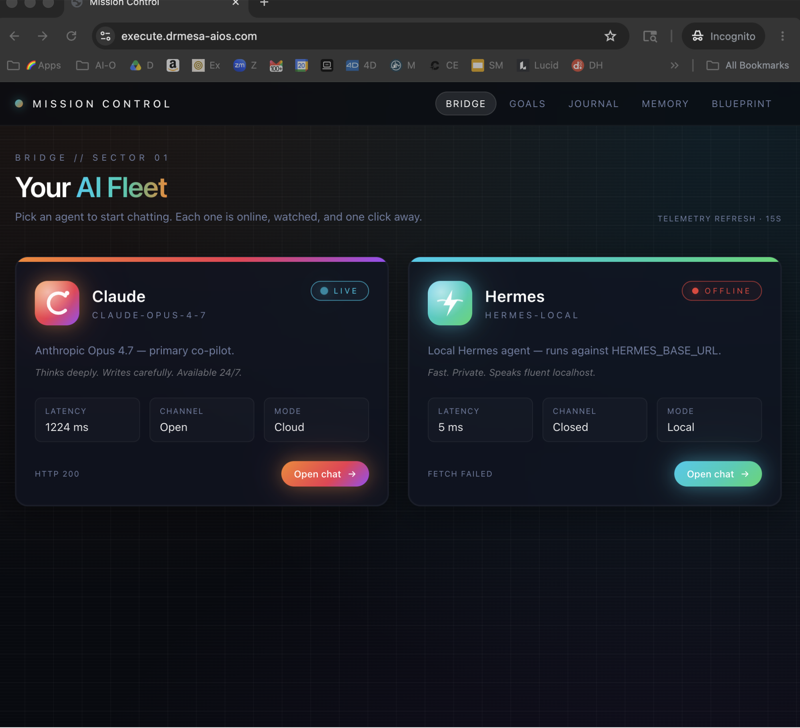
Run hermes gateway setup, pick A2A, then enable the toolset with hermes tools enable a2a --platform cli — and your Hermes agent can discover, message and delegate work to any other agent that speaks the open Agent2Agent protocol. The hermes a2a plugin is the bridge that turns a solo agent into a member of a team: outbound, it gives your agent five tools for calling A2A-compatible peers; inbound, it publishes your agent as a service other agents can send tasks to over HTTP. Everything below comes from the official Hermes Agent A2A documentation by Nous Research, current as of September 2026.
📺 Watch: Hermes Just Turned One AI Agent Into a Team
🔥 Get the Agent OS as a free bonus: AI Profit Boardroom members get the full Agent OS zip, prompt libraries, daily tutorials and weekly live coaching calls. → Get inside · Want AI SEO help 1-on-1? Book a free SEO strategy session →
What The A2A Protocol Actually Is
A2A is the open Agent2Agent protocol — version 1.0, stewarded by the Linux Foundation — for communication between independent AI agents. The point of a shared protocol is that the agents on each end do not need to be the same product: per the official docs, the Hermes implementation interoperates with any A2A-compliant peer, whether that is another Hermes install, a LangChain or CrewAI agent, something built with Google's ADK, or anything using the official a2a-sdk. Nous Research states interoperability was verified against the Python a2a-sdk directly.
That neutrality is why this matters for anyone building multi-agent systems. Instead of gluing agents together with brittle custom webhooks, you get one standard handshake: every agent advertises an Agent Card describing its name, skills and auth requirements, and every agent accepts tasks through the same JSON-RPC methods.
The Five Outbound Tools You Get
Once the toolset is enabled, the docs list five tools your agent can use in conversation, the same way it uses any other tool:
| Tool | What it does (per the official docs) |
|---|---|
| a2a_discover | Fetches and summarises a peer's Agent Card so your agent knows what the other agent can do. |
| a2a_call | Sends a task to a peer and gets the reply, with multi-turn conversations supported via a context id. |
| a2a_list | Shows configured peers, saved conversations and metrics. |
| a2a_history | Recalls a persisted A2A conversation by its context id. |
| a2a_orchestrate | Fans a task out to every peer advertising a given capability — the one-to-many delegation tool. |
The orchestrate tool is the sleeper here. If three of your peers advertise a research capability, one instruction fans the job out to all three — which is the pattern behind agent societies like the ones in the Agent OS: specialised agents, each doing one job well, coordinated rather than merged.
If you want a team of agents running your business instead of one overworked chatbot — with done-for-you workflows, the full Agent OS zip and weekly live coaching — check out the AI Profit Boardroom → get inside and grab the stack. Rather scope your build 1-on-1 first? Book a free SEO strategy session and map it with Julian.
How To Enable The Hermes A2A Plugin
Setup is a two-step job per the documentation. First, hermes gateway setup lets you pick A2A as a platform; in the config file this lives under the gateway platforms section, where the a2a entry is switched to enabled with a port — the docs use 9900 in their example. Second, hermes tools enable a2a --platform cli turns on the outbound toolset, which the docs note is off by default.
Peers are then configured under an a2a_agents section in the config: each named peer gets a URL, optional auth such as a bearer token, and a list of capabilities it advertises. Those capability labels are what a2a_orchestrate matches against when it fans work out. It is worth being deliberate here — a peer registry is like a team roster, and the discipline you apply to it determines whether orchestration feels like management or chaos. If you are still deciding which agents deserve a slot on that roster, the Hermes bot vs Grok bot comparison is a useful starting point, and the best Hermes agent plugins round-up covers what else pairs well with a networked setup.
Inbound: Your Agent Becomes A Service
The plugin works in both directions, and the inbound side is what makes your Hermes a first-class citizen of someone else's system. Per the docs, your agent serves its Agent Card at the standard well-known path — /.well-known/agent-card.json, the canonical v1.0 location, with a legacy agent.json alias — advertising its name, skills and auth requirements to anyone who fetches it.
Tasks arrive as JSON-RPC 2.0 calls with the canonical v1.0 method set: SendMessage, SendStreamingMessage with server-sent-events streaming, plus GetTask, ListTasks, CancelTask and SubscribeToTask, alongside pre-1.0 path-style aliases for older peers. For long-running work, the docs describe push notifications signed with HMAC-SHA256, so a peer can hand your agent a slow job and get a verified callback instead of polling. Combined with the session persistence covered in the Hermes memory system guide, that means multi-turn agent-to-agent conversations survive restarts rather than evaporating.
Security Controls Worth Knowing
Opening an agent to inbound traffic is exactly the kind of thing that should make you pause, and the documentation is unusually thorough here. The defaults are conservative: the A2A host binds to 127.0.0.1 and, per the docs, only widens when a token is set. Access control runs through environment variables — per-peer credentials via A2A_PEER_TOKENS, which the docs mark as the preferred route, or a shared A2A_BEARER_TOKEN. Rate limiting defaults to 60 requests per minute per identity, and an anti-loop cap limits ping-pong exchanges to 5 turns per context by default, with 20 as the documented maximum — so two chatty agents cannot burn your token budget in an infinite conversation.
Three further protections stand out in the official feature list: inbound text is filtered and framed as untrusted peer input to blunt prompt-injection attempts; credential-shaped strings are scrubbed from outbound replies; and every exchange appends to an audit log at ~/.hermes/a2a_audit.jsonl, so there is always a record of what your agent said to whom. None of this makes an exposed agent risk-free, but it is a materially more serious security posture than most DIY agent-to-agent wiring.
Where It Fits In A Multi-Agent Stack
The practical question is when to reach for A2A instead of Hermes's own built-in multi-agent features. The internal route — subagents and bot groups inside one install, managed from views like the Hermes dashboard command — is simpler when every agent is yours and lives on one machine. The A2A route earns its complexity when the agents are genuinely independent: different machines, different owners, or different frameworks entirely. A research agent on your home server, a client's CrewAI pipeline, and your main Hermes in your Hermes workspace can all cooperate without sharing a codebase, because the protocol is the contract.
It also changes what "agent community" means in a literal way. Tools like OpenClaw are moving the same direction with governed self-improvement — see the OpenClaw skill learning update — and a shared protocol is what lets those ecosystems talk to each other rather than compete for your whole stack. Which model you run behind each agent still matters, of course; the Goldie Bench write-up covers how the current model brains compare in hands-on tests, and the answer differs by role — a cheap fast model for fan-out workers, a heavyweight for the orchestrator.
A concrete example makes the shape of this clear. Picture a content operation: your main Hermes agent takes the brief, uses a2a_discover to confirm what each peer on the roster can do, then a2a_orchestrate fans research out to every peer advertising that capability. The replies come back into one conversation, the orchestrator drafts from them, and a2a_history lets you audit exactly which peer contributed what. Every step in that flow uses a documented tool rather than custom glue code, which means the whole thing keeps working when you swap one peer's framework for another — that is the practical payoff of building on a protocol instead of a product.
Is The Hermes A2A Plugin Worth Enabling?
If you run one agent on one machine and nothing else talks to it, you can skip it — the toolset is off by default for a reason, and enabling surface area you do not use is poor hygiene. The moment a second independent agent enters your world, it becomes one of the highest-leverage switches in the config: five tools, one standard, verified interop with the major frameworks, and security defaults that assume the internet is hostile. For a feature that takes two commands to enable, that is a strong deal.
If you want the full playbook for agent teams that actually earn — workflows, prompt libraries, daily tutorials and five live coaching calls a week — check out the AI Profit Boardroom → join 3,000+ operators inside. Prefer a personal plan first? Book a free SEO strategy session and get your roadmap 1-on-1.