Agentic AI OS is the term I now use for the personal operating system I run on my own machine that thinks, acts, remembers and creates across text, image, video and voice in one place. It is not a chatbot. It is a coordinated stack of agents that share memory and run together, and once I plugged Grok into Hermes inside my Agent OS this week, the whole thing stopped feeling like software and started feeling like a team.
In this post I am going to walk you through the full Agentic AI OS I run as a solo founder in 2026. I will cover the stack, the three commands that wire Grok into Hermes, the Studio section that handles all my media work, and the four-layer Goldie Mission Stack that holds the whole thing together.
🔥 Get the full Agentic AI OS as an AIPB bonus AI Profit Boardroom members get the Agent OS zip file, 100 prompts, 30-day roadmap, plus Hermes Agent + Claude OS launch kit. → Get inside
What An Agentic AI OS Actually Is
An Agentic AI OS is a local operating system for your AI agents. It is not a single tool and it is not a SaaS dashboard you log in to. It runs on your own machine and gives every agent on your stack a shared dashboard, a shared memory and a shared mission.
The reason the term matters is that 2025 was the year of disconnected tools. You had ChatGPT in one tab, Claude in another, Midjourney somewhere else, and a notes app trying to glue it all together. None of those tools talked to each other and none of them remembered what you were doing yesterday.
An Agentic AI OS fixes that. Every agent runs inside one shell. Every output gets saved to one memory. Every workflow can hand off to the next agent without you copying anything between tabs. That is the difference between a hammer and a construction company.
Why It Matters In 2026
The shift in 2026 is from AI assistants to AI operators. An assistant waits for your next prompt. An operator runs in the background, watches signals, executes tasks and only pings you when it needs a decision.
You cannot build an operator on top of disconnected tools. You need a layer underneath all of them that handles memory, coordination, scheduling and context. That layer is what an Agentic AI OS provides.
The other thing 2026 changed is multi-modality. A real AI workflow now spans text, image, video and voice in a single run. If your stack can only do one of those, you are leaving the other three on the table. My Agentic AI OS does all four in parallel.
The Hermes + Grok Stack
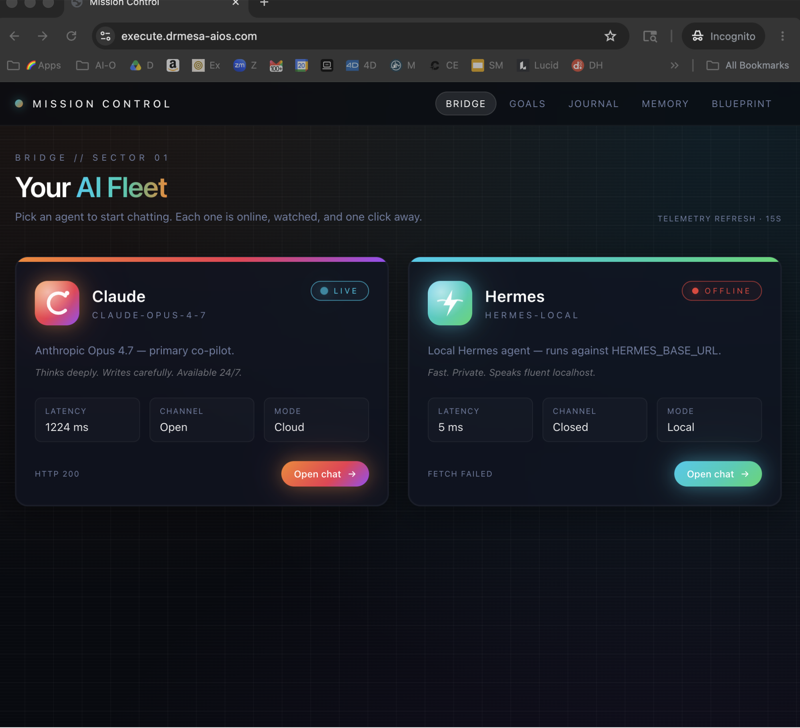
Hermes is the agent framework I use as the backbone of my Agentic AI OS. It is the layer that hosts every other agent, holds the memory, and provides the dashboard I look at every morning.
For most of 2025 Hermes had no native Twitter search, no native image generation and no native video generation. You could plug in your own tools but it was not seamless. The new Grok integration changes that completely.
Plugging Grok into Hermes gives the OS four new modalities at once. X search becomes the eyes that watch the live feed of the internet. Voice in becomes the ears that take dictation. Text to speech becomes the voice that talks back. Image and video generation become the hands that ship creative work.
That is what people mean when they say Hermes finally got eyes, ears and a voice. The OS went from being smart to being aware.
The Three-Command Setup
Wiring Grok into Hermes takes three commands in the terminal and roughly two minutes. There is no SaaS signup and no extra fee if you already have an X subscription.
The first command is hermes update. That pulls the latest Hermes build with the Grok auth flow baked in. If you skip this step the model picker will not show Grok as an option, so do not skip it.
The second command is hermes model. That opens the model picker, you scroll to XAI Grok Auth, and it launches a browser window where you log in with your X account. Once that handshake completes, Hermes has a live token for Grok and the whole platform is unlocked.
The third command is hermes tools. That opens the tools picker where you enable X search, image generation, video generation and text to speech. Tick all four. Each one is its own module inside the OS and you can toggle them on or off later if you want a leaner agent.
That is the entire setup. Three commands, one browser login, four new modalities live inside your Agent OS.
What Each Modality Actually Unlocks
X search is the one I use most. Hermes pulls real-time Twitter content into whatever workflow you are running, which means your agents can react to live signals instead of stale training data. Competitor monitoring, trend spotting and audience listening all become background tasks.
Image generation runs through Grok Imagine. I set the quality option to best, accept the slightly slower render, and let it produce thumbnails, hero shots and social posts on demand. The cost is your existing X subscription, which is a fraction of what dedicated image tools charge.
Video generation is the one that genuinely surprised me. I asked for a dragon flying through cyberpunk Tokyo at night and got a usable 25-second clip back. Not perfect, but absolutely usable for hooks, B-roll and YouTube intros.
Text to speech gives every agent in your OS a voice. I use it for voice memos, video narration and quick draft podcasts. The Grok voice is closer to a real human than most TTS engines I have tested this year.
The Goldie Mission Stack — Four Layers
My Agentic AI OS is structured around four layers I call the Goldie Mission Stack. Each layer has one job and one set of tools, and they hand off to each other automatically.
The first layer is Intelligence. That is Claude and Claude Code. This is the brain that does reasoning, planning, and most of the writing. Everything that needs judgement starts here.
The second layer is Execution. That is OpenClaw. This is the layer that actually clicks buttons, fills forms and runs jobs on my computer. It is what turns a Claude plan into an action.
The third layer is Research. That is Hermes plus Grok. This is the layer that gathers fresh information from the live web, from X and from any tool I have plugged in. It feeds the other layers with current context.
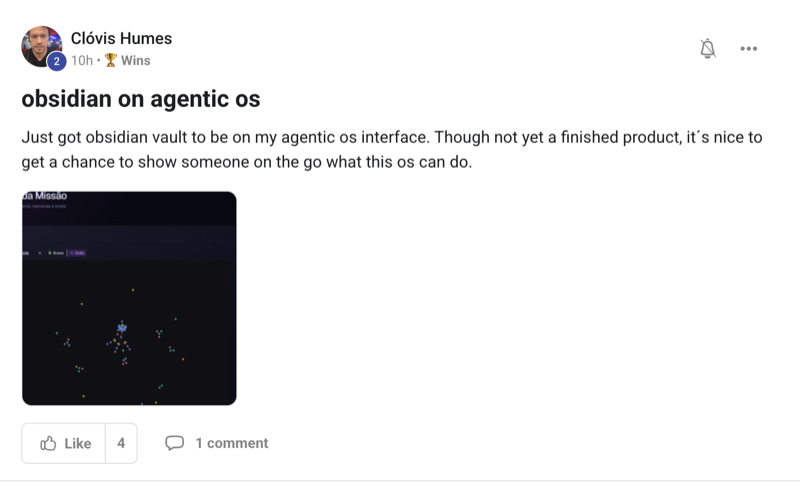
The fourth layer is Self. That is Obsidian plus OMI. This is where my personal memory, my notes and my voice transcripts live. It is what turns generic AI into AI that knows me.
The Self Layer — Obsidian Plus OMI
The Self layer is the one that most people skip and the one that makes the biggest difference. Without it, your Agentic AI OS is intelligent but anonymous. With it, every agent in your stack starts giving advice that fits your business, your tone and your goals.
Obsidian is where I keep every note, every standard operating procedure, every offer description and every transcript of every call I take. It is a local vault of markdown files that any agent in my OS can read.
OMI is the wearable that captures voice notes throughout the day and pipes them into Obsidian automatically. I do not have to remember to type ideas down. The device does it for me, the OS indexes it, and the agents read it.
When I ask Hermes "knowing what you know about me in my Obsidian vault, what are the best ways I could build automations with X search?", I get answers shaped around Goldie Agency, the AIPB community and my Hermes work. Generic AI cannot do that. An Agentic AI OS can.
The Studio Section Inside Agent OS
The newest piece I built into the OS this week is a Studio section. It is the place where the visual and audio modalities live, and it was a single prompt to Claude Desktop to scaffold the whole thing.
Studio lets me run image, video and speech generation in parallel. I can have one tab spinning up a video while another tab handles voice and a third generates a static image. The history is saved to the OS so I can grab any output later without re-running it.
The point of Studio is parallelism. Single-tab AI tools force you to wait. A real Agent OS lets you fan out work across modalities at the same time, which collapses the production time on content from hours to minutes.
Watch The Build Walkthrough
For the deeper Hermes context I recommend pairing that with my Hermes Agent OS breakdown so you can see how the dashboard hangs together end to end.
Why Local-First Beats Cloud
A real Agentic AI OS runs locally on your machine. That is a deliberate choice and it matters for three reasons.
The first is privacy. Your Obsidian vault, your voice notes and your business context never leave your computer. Cloud platforms turn that into training data. Local does not.
The second is speed. A local agent does not round-trip to a server for every read or write. Memory lookups, planning and execution all happen on your hardware, which feels instant compared to cloud agents that pause every few seconds.
The third is control. If a SaaS vendor changes pricing, shuts a model down or rate-limits your account, your workflows break. With a local Agent OS, the only thing that can shut you down is your laptop.
Comparison Table — Tabs Vs Agentic OS
| Capability | Disconnected Tabs | Agentic AI OS |
|---|---|---|
| Memory across sessions | None | Shared Obsidian vault |
| Multi-modal output | One tool per modality | Text, image, video, voice in one shell |
| Real-time web context | Manual copy-paste | Live X search via Grok |
| Personalisation | Generic answers | Trained on your vault |
| Parallel execution | Sequential | Multi-agent fan-out |
| Cost | Multiple SaaS subscriptions | One stack, mostly local |
| Privacy | Vendor-controlled | Local-first |
| Improvement over time | Static | Self-improving via memory |
The gap is not subtle. Once you run an Agentic AI OS for a week, going back to tabs feels like going back to dial-up.
🚀 Need an AI agent stack for your agency? Book a free SEO + AI Strategy Session with Goldie Agency. → Book free session
Real Workflows I Run Every Day
The first daily workflow is the morning intel sweep. Hermes uses Grok X search to pull trending content in my niche, summarises it through Claude, drops the digest into my Obsidian inbox and pings me with the top five signals.
The second is content production. I voice a hook into OMI, the OS transcribes it, Claude turns it into a script, Studio generates a hero image, Grok video generates the B-roll and TTS produces the voice-over. One prompt, four outputs, zero tabs.
The third is competitor monitoring. Hermes watches a fixed list of X accounts every hour, pulls anything that mentions my keywords, and decides whether it is worth surfacing or ignoring. I only see what matters.
The fourth is overnight automation. Before bed I queue tasks for OpenClaw to execute while I sleep. Mornings now arrive with finished work waiting in my inbox.
FAQs
Do I need to be technical to run an Agentic AI OS?
You need to be comfortable in a terminal for the three Hermes commands, but no coding is required. Most of my members at AIPB get the stack running in an afternoon with the launch kit.
Is Grok inside Hermes free if I already pay for X?
Yes. The X subscription you already pay for covers Grok access, including image and video generation. No extra fee.
Can I run this without an Obsidian vault?
You can, but you will lose the personalisation. The Self layer is what turns this from a generic AI stack into your AI stack.
What hardware do I need?
A modern Mac or PC with 16GB of RAM minimum is fine. You do not need a GPU because heavy lifting still happens through model APIs.
How is this different from just using Grok in a browser?
Browser Grok is a tab. Grok inside Hermes inside an Agent OS is a coordinated agent with memory, automation and other tools alongside it. Same subscription, different power level.
When An Agentic AI OS Is Overkill
If you only use AI for one-off tasks a few times a week, this is too much infrastructure. A standard chat interface is fine for occasional questions.
If you never need real-time information, you can skip the Grok layer and keep things simpler. Static knowledge tasks do not need a live feed.
If you do not care about personalisation, you can also skip the Self layer. Most people regret that within a month, but the option is there.
When An Agentic AI OS Is Non-Negotiable
If you ship content daily, an Agent OS pays for itself in the first week through saved production time.
If you run an agency or community, the parallel multi-agent setup is how you serve more clients without hiring.
If you sell anything online, the real-time signals from X search and the personalised outputs from the Self layer compound into compounding distribution.
If you want AI that gets smarter every week instead of resetting at every prompt, this is the only structure I have found that actually does that.
FAQ — Agentic AI OS
How long does the full setup take?
Roughly two hours end to end if you follow the launch kit. The three Hermes commands take two minutes. Wiring up Obsidian and OMI takes longer.
Will this replace my current AI tools?
It absorbs them. ChatGPT, Claude, Midjourney and Grok all become modules inside one OS instead of separate tabs.
Does it work offline?
The local memory and the Obsidian vault work offline. Model calls and X search need a connection.
Is it production-ready for client work?
Yes, with the usual caveat that you review outputs before they go live. I run client deliverables through this stack every week.
Should I join AIPB to get the launch kit?
If you want the Agent OS zip file, the 100 prompts and the 30-day roadmap pre-built for you, yes. The weekly live coaching is where most members say the real ROI sits.
Latest Updates
- Hermes Agent OS — the full Agent OS breakdown that this post builds on.
- Hermes AI Agent Framework 2026 — the framework powering the Research layer.
- OMI Obsidian — the wearable plus vault combo that powers the Self layer.
Further Reading On Agent OS Guide
For deeper walkthroughs on the topics in this article, the Agent OS Guide library has these worth bookmarking.
- Agent OS Guide — the full library covering every layer of the agentic AI OS stack in one place.
- Hermes Agent OS Q&A — top Hermes Agent OS questions answered for the research seat in your stack.
- NotebookLM Agent OS — wiring NotebookLM into the memory layer so the Self layer has long-term context.
- Agent OS Member Testimonials — real wins from operators running this agentic AI OS day-to-day.
Also On Our Network
- 🌐 Read on juliangoldieaiautomation.com
- 🌐 Read on aisuccesslabjuliangoldie.com
- 🌐 Read on aimoneylabjuliangoldie.com
- 🌐 Read on bestaiagentcommunity.com
Related Reading
- Hermes Agent Installation Guide 2026 — the install path I recommend for new members.
- Hermes MCP Server — how to expose Hermes capabilities to other agents in your OS.
- Hermes Computer Use — the Execution layer that handles real clicks and keystrokes.
- Claude Hermes Agent — the Claude plus Hermes pairing at the heart of the Intelligence layer.
- Hermes Agent HUD UI — the dashboard that ties every layer together.
📺 Video notes + links to the tools 👉
🎥 Learn how I make these videos 👉
🆓 Get a FREE AI Course + Community + 1,000 AI Agents 👉
Agentic AI OS is the upgrade path from disconnected tools to a coordinated multi-modal team — wire Grok into Hermes today, plug in your Obsidian vault, and you will never want to go back to tabs.