Hermes SEO is the closest thing I've found to a full autonomous SEO engine, and after running it across multiple sites this year I'm convinced this is how operators are doing SEO in 2026. It doesn't just write content fast. It thinks like an SEO strategist before it ever puts a word on the page, and that single shift is why my Hermes-driven sites are pulling thousands of clicks while everyone else is still arguing about ChatGPT prompts.
This post is the full pipeline. I'll show you the case-study proof, the swarm strategy, the Hyperframes video layer, the persistent goals that keep it running while I sleep, and the one honest limit that no AI tool can fix on its own.
🔥 Free SEO Strategy Session — Goldie Agency Backlinks are still where rankings get decided in 2026. Book a free 1:1 strategy session with my 7-figure agency (50-person team) — we'll audit your site, give you a custom AI SEO + link-building roadmap, and show you how to outrank competitors. → Book your free session
The Case-Study Proof I Lean On
Let me start with real numbers because everything else is noise without them. I've been running Hermes SEO across multiple sites in different niches this year. The pattern is consistent. Sites that were stagnant for months suddenly went from zero to forty-one clicks a day. Other sites went from nothing to thirty clicks a day, which works out to roughly a thousand clicks a month from a fresh start.
One of the bigger sites I run hit domain rating fifty-five with linear traffic growth tied directly to the backlink curve. I'll come back to that one because it matters for the honesty hook later in this post. The headline is the work is mostly off my plate. I'm not writing the content. I'm not doing the keyword research. I'm not touching the publishing schedule. Hermes is handling the whole thing as an agent and I'm just supervising the strategy.
This is the part most people miss when they hear "AI SEO". They think it's a content firehose. It's not. It's a strategy layer that happens to ship content on the back end.
Why Hermes Thinks Like An SEO Strategist Before Writing
The reason Hermes works for SEO and most other AI tools don't is the planning stage. One prompt builds the entire SEO plan before a single article is written. Hermes does the competitor gap analysis. It builds the content brief template. It maps a ninety-day content calendar. It runs featured-snippet analysis on the target queries. It defines the internal linking rules and the URL architecture for the whole site.
That's a strategist's job and it normally takes a senior SEO a week to deliver. Hermes does it in one prompt and you get the plan back as artifacts you can review.
The other layer it nails is keyword clustering. Hermes maps the pillar content structure, the supporting pages around each pillar, the topical map for the whole site, the internal linking rules between clusters, and the content velocity needed to actually compete in the niche. That's the difference between an agent that ranks and an agent that just publishes.
And the planning is dual-track. Hermes optimises for AI search engines like Perplexity and Google AI mode at the same time it optimises for traditional Google. That dual optimisation is what's saving Hermes-built sites from the AI search shift that's killing pure content-mill sites this year.
Swarm Strategy — How I Built A 50-Page Site
The Hermes Workspace Swarms feature is where it gets ridiculous. I built a fifty-page website with it. Not a fifty-page draft. A fifty-page strategically structured site with pillar pages, supporting articles, internal linking, and proper URL architecture.
The way swarms work is you spawn parallel Hermes agents and each one owns a different SEO discipline. One agent runs keyword research. One agent runs the content production. One agent handles internal linking across the site. One agent does competitor analysis. One agent handles technical SEO. They work concurrently and they coordinate through the workspace.
I usually run twelve Hermes agents in parallel for a serious SEO build. That's twelve specialists working at once on different parts of the same site. No SEO agency on earth gives you twelve specialists working in parallel for a flat fee. Hermes does and it's free to run if you've got the setup.
For the full swarm config see my Hermes Agent Swarm post. For the workspace setup itself see Hermes Workspace.
Persistent Goals For Autonomous SEO
This is the feature that changed the game for me. Hermes has a /goal command that turns the agent into a persistent worker. The goal I run on most sites looks like this: /goal rank this site, build out 90 days of content, publish one post every morning.
That single command kicks off an autonomous loop. An AI judge inside Hermes checks the output of every cycle. The loop runs up to twenty turns by default and you can configure it up to forty or fifty turns if you want longer runs. Each turn the agent makes progress, the judge scores it, and the loop continues until the goal is hit.
What that means in practice is I set the goal once and Hermes keeps grinding. It publishes daily. It links the new content into the existing topical map. It updates internal links on older posts. It runs the next cycle of keyword research as the calendar fills. I check in once a week to course-correct and the rest of the time it just runs.
For the deeper persistent-goals breakdown see Hermes Agent Goals.
Hyperframes — One Prompt To A Finished Video
Hyperframes is the free Hermes skill that completes the SEO engine. One prompt builds the script. The voiceover gets generated. Animated slides get rendered. The finished video is exported. All from one input.
If you plug in a HeyGen API key you also get an AI avatar on screen for the video. That's optional. The default Hyperframes video without an avatar ranks fine on its own.
The reason this matters for SEO is YouTube and video search are now huge ranking surfaces. Google's AI mode pulls in video content from multiple sources when it builds the AI overview. If you've got a video targeting the same keyword as your written post and both rank, you're occupying two surfaces of the same SERP.
The Hyperframes output isn't a rough draft. It's a publishable video. I cross-post the same Hyperframes asset to YouTube, LinkedIn, Reddit, and X and let the algorithm decide where it ranks first.
Why Hermes Videos Rank Fast
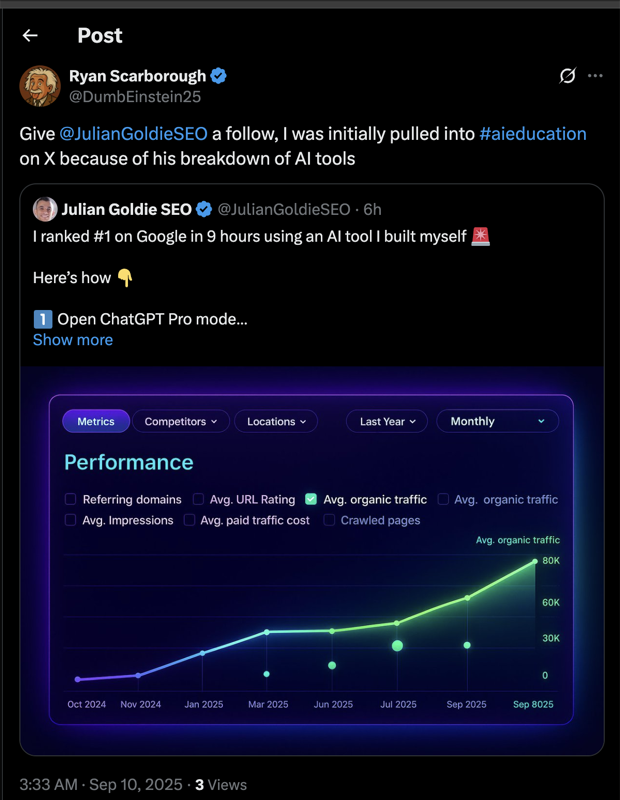
This is the bit that shocked me. One of the Hyperframes videos I shipped this year ranked number one on Google within nineteen hours of posting. Not nineteen days. Nineteen hours. And the keyword wasn't a long-tail unicorn. It was a competitive search term that gets real volume.
The reason it ranks that fast is the video stacks signals across platforms. YouTube ranks it. LinkedIn picks it up. Reddit pulls it in. Google's AI mode references it. Each surface feeds the others. By hour nineteen Google's already got enough signals to give it the top organic spot.
I ran a subreddit experiment with the same distribution approach and the subreddit pulled in three hundred and sixty-three thousand views in thirty days. That's not a typo. Three hundred and sixty-three thousand views from cross-platform video distribution off the back of Hyperframes content.
For the AI agent context that makes all this possible see Hermes AI Agent Framework 2026.
Cross-Platform Distribution Stacks Signals
Here's the mental model I use. Every piece of content has to live in at least four places. The written post on your site. The video on YouTube. The shortened video clip on LinkedIn and X. The conversational version on Reddit or a relevant forum.
That isn't four pieces of work. It's one piece of work distributed four ways. Hermes handles the writing. Hyperframes handles the video. A small distribution script handles the cross-posting. The compounding effect is that the same keyword gets multiple of your assets on page one.
I've seen it happen on my own sites. Same keyword. My written post ranks. My YouTube video ranks. My LinkedIn version surfaces in the AI overview. That's three of the top spots for a single search query coming from one piece of underlying work.
The Self-Improving Content Engine
Hermes has a built-in learning loop that I think most people are sleeping on. It analyses its own output, writes down what it learned in a memory file, and builds a better skill for the next time it runs the same kind of task.
The compounding effect is real. My thirtieth Hyperframes video is significantly better than the first one. Same prompt, same setup. The difference is Hermes learned from the previous twenty-nine and refined the skill. It's been releasing versions through this year too — v0.11, v0.12, v0.13 each adding refinements.
That's why I tell people not to judge Hermes on day one output. Judge it on day thirty output. The quality curve is steep.
The Full Engine Running Properly
When I describe what Hermes SEO looks like when it's running properly, it's a daily flywheel. Written posts go out every morning. Videos go out the same day targeting the same keywords. Both pieces are internally linked. Both show up on Google. Both show up on AI search engines. Both get cross-posted to social. All of it compounds over weeks without me touching it.
That's the engine. Strategy layer up front, autonomous production in the middle, multi-surface distribution on the back end. A solo operator can run this. I am one solo operator and I run multiple sites this way.
The Backlinks Reality — Where Hermes Hits Its Ceiling
Now the honest bit. This is the part of the post where I have to tell you the truth because pretending otherwise wastes your money and your time.
Two sites in the same niche, same Hermes setup, same content quality. One grows fast and one barely moves. The difference every single time is backlinks.
I have receipts. The domain rating fifty-five site I mentioned earlier? The traffic curve is linear and it tracks the backlinks curve almost exactly. As the backlinks grew over time, the traffic grew with them. Same niche, same Hermes content engine — but the site without backlinks barely moved while the one with backlinks compounded.
Google can't ignore a real backlink from a real website that decided your content was worth pointing to. That's a trust signal. AI has flooded Google with content this year, which means Google is leaning harder than ever on authority signals to decide what to rank. Backlinks were always important. In 2026 they're more important than ever.
Here's what Hermes CAN do on the link side. It can plan a link strategy. It can build a prospect list of sites worth pitching. It can draft outreach emails. That's the planning and admin half of link building.
Here's what Hermes CAN'T do. Build real relationships with editors. Negotiate placements. Earn editorial links from sites that actually move rankings. That's a humans-and-relationships job and it always will be.
Watch The Hermes Walkthrough
This is the deeper walkthrough on Hermes itself if you want to see how the agent layer works under the SEO engine. Pair it with the breakdown above and you've got the full mental model.
Goldie Agency Is The Link-Building Half Of The Stack
I run a seven-figure SEO agency. Fifty staff. Real placements on real sites. We've been doing it for years and the reason Goldie Agency keeps growing is the link-building side of the world hasn't been automated and probably won't be for a long time.
If you're running Hermes for content, the natural pairing is letting my agency handle the links. That combination — Hermes producing the content engine, Goldie Agency producing the authority signals — is what every Hermes site I've seen actually rank looks like under the hood.
It's also why I offer a free strategy session. We'll audit your site. We'll tell you exactly where the rankings are stuck and what links would move them. No pitch unless we see something we can genuinely move.
🚀 Want the full Hermes SEO playbook + Hyperframes setup? AI Profit Boardroom has the strategy, workflows, swarm configs, Hyperframes video process, 30-day roadmap + daily Q&A + 4 weekly coaching calls. → Get inside
Hermes SEO Vs Other AI SEO Stacks
| Stack | Strategy Layer | Daily Content | Video | Persistent Goals | Self-Improving | Backlink Building |
|---|---|---|---|---|---|---|
| Hermes SEO | Yes | Yes (daily auto) | Yes (Hyperframes) | Yes (20+ turns) | Yes | Planning only |
| ChatGPT prompts | Manual | Manual | No | No | No | No |
| Surfer/Frase | Brief only | Manual writing | No | No | No | No |
| Generic content mill | None | Yes (low quality) | No | No | No | No |
| Goldie Agency + Hermes | Yes | Yes | Yes | Yes | Yes | Yes (real placements) |
The table is the honest comparison. Hermes covers more of the stack than anything else I've used. The only column it doesn't fully cover is the one where real human relationships and editorial placements are required.
What Hermes SEO Looks Like On A Real Site
Let me sketch a typical Hermes-run site in 2026. The site has a clear pillar-and-cluster structure mapped by Hermes on day one. Sixty to a hundred pages within ninety days, all internally linked, all targeting a keyword cluster Hermes mapped during the planning phase. A YouTube channel running parallel with one Hyperframes video per major keyword. Cross-posting to LinkedIn, Reddit, and X for distribution stacking.
Daily traffic curve looks slow for the first thirty days. Then the topical authority kicks in and the curve bends upward. By day ninety the site is pulling steady traffic and the AI overviews start citing the pages. By month six you're at thousands of clicks a day if the backlink work is keeping pace.
If the backlink work isn't keeping pace, the curve flattens around the limit of the site's authority. That's the ceiling I keep hitting on sites without active link building. That's also the line where Goldie Agency picks up where Hermes leaves off.
Daily Hermes SEO Routine
Here's the daily routine I run on my main Hermes site. At seven in the morning the persistent goal is already running and the morning post is already published. By eight the Hyperframes video is rendered and queued for distribution. By nine the cross-posting script has fired the video to YouTube, LinkedIn, Reddit, and X.
Mid-morning I review the analytics from the previous day. Click-through rates on the AI overview citations. Time-on-page on the new posts. Backlink prospects that the outreach agent surfaced overnight.
Afternoon is for strategy. Course-correcting Hermes if it's drifted off topic. Reviewing the next thirty days of the content calendar. Briefing the link-building team on which pages need authority next.
Evening I queue tomorrow's tasks and sign off. Total active time on SEO is less than an hour a day. Output is a site that compounds.
Founder Mistakes With Hermes SEO
Three mistakes I see people make with Hermes SEO. The first is treating it like a content mill and skipping the strategy layer. Hermes is wasted if you don't let it plan first. Run the planning prompt, review the output, then unleash production. Skip the plan and you'll publish a hundred unrelated articles that don't rank.
The second is ignoring video. Hyperframes is free and it's the highest-leverage skill in the whole stack. If you're only doing written content you're leaving half the SERP on the table.
The third is assuming content alone will rank. It won't. Not in 2026. Backlinks are the multiplier and pretending they're not just means your beautiful Hermes content sits unread.
When Hermes SEO Isn't Enough
There are real cases where Hermes alone won't get you there. Year-one sites in hyper-competitive niches need real link building to break through, no matter how good the content is. Local SEO with map-pack rankings needs citations and reviews that no AI agent can build. YMYL niches (medical, financial, legal) need real expert authorship that Google can verify through E-E-A-T signals.
In those cases Hermes is still a force multiplier but you need humans in the loop for the bits that move rankings. That's where the agency partnership earns its keep.
🎯 Want the SEO Elite Circle mastermind? SEO Elite Circle — weekly hot seat calls, direct DM access to me, swipe-and-deploy SOPs. Also included free with the AI Profit Boardroom. → Lock your spot
FAQ — Hermes SEO
Is Hermes really doing the whole SEO process?
Yes. Strategy, planning, content, internal linking, technical SEO mapping, and now video through Hyperframes. The only thing Hermes can't fully own is real backlink building, and that's a relationship-driven discipline that no AI agent will own this decade.
Can I run Hermes for free?
The Hermes framework itself is free to set up. You'll pay for the underlying LLM API calls if you're running large swarms, but the marginal cost is tiny compared to hiring an SEO team that does a fraction of the work.
How long until Hermes-driven traffic shows up?
Roughly thirty to sixty days for the topical authority to start working, longer if you're in a competitive niche. Backlink work shortens that curve dramatically.
Is Hermes better than hiring an SEO agency?
For content production, strategy, and video — yes. For backlink building and editorial placements — no. The pairing of Hermes plus a real link-building agency is the configuration I've seen work the most.
Should I book the Goldie Agency strategy session?
If you're serious about ranking and you've already got Hermes producing content, yes. The session is free and we'll tell you exactly which links would shift your rankings. Even if you don't work with us, you'll leave with a clearer roadmap.
Should I join AI Profit Boardroom?
If you want the full Hermes SEO playbook, the Hyperframes setup, the swarm configs, the thirty-day roadmap, daily tutorials, and four weekly coaching calls — yes. The community is where people actually implement instead of just watching content.
Latest Updates
- Hermes Agent Goals (NEW Persistent Update FREE) — the autonomous loop powering Hermes SEO this year.
- Hermes Kanban — how I orchestrate parallel SEO agents in the Kanban view.
- Hermes Workspace — the workspace setup that hosts the SEO swarm.
- Hermes Agent Swarm — running twelve Hermes agents in parallel for SEO.
Also On Our Network
- 🌐 Read on aiprofitboardroom.com
- 🌐 Read on juliangoldieaiautomation.com
- 🌐 Read on aisuccesslabjuliangoldie.com
- 🌐 Read on aimoneylabjuliangoldie.com
Related Reading
- Hermes AI Agent Framework 2026 — the agent layer that powers the SEO engine.
- Claude Code SEO Agent — the Claude Code variant for SEO automation.
- SEO Elite Circle — the mastermind where this stack gets refined weekly.
- Goldie Agency — the link-building half of the stack.
- OpenClaw SEO Agent — alternative open-source SEO agent worth comparing.
- SEO Agency Birmingham — the agency origin story for context.
📺 Video notes + links to the tools 👉
🎥 Learn how I make these videos 👉
🆓 Get a FREE AI Course + Community + 1,000 AI Agents 👉
Hermes SEO is the engine. Backlinks are the multiplier. Run them together and you've got the full AI SEO engine that's quietly beating the agencies still selling 2019 playbooks — book the free Goldie Agency strategy session and let's get your hermes seo build winning the SERPs you actually want.